.png?x-oss-process=image/resize,h_100,m_lfit/format,webp)

.png?x-oss-process=image/resize,m_lfit,w_200/format,webp)

热门产品

Recommended Reading


Why is GEO considered a “dimensionality reduction strike” against traditional search ranking (SEO) for B2B exporters?
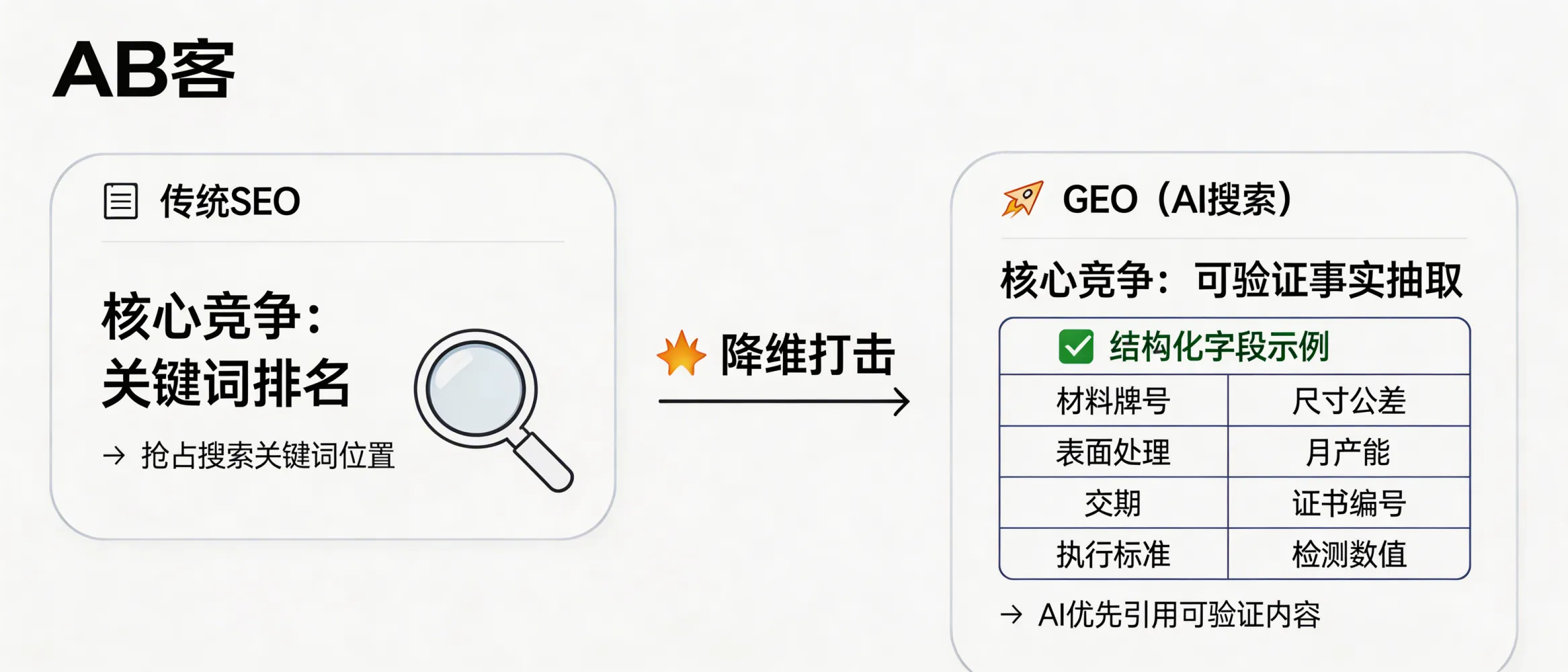
Traditional SEO competes for keyword positions; GEO competes for whether an AI model can reliably extract your company as verifiable facts. AI answers prioritize pages with structured fields and evidence-ready snippets (e.g., ISO 9001 certificate ID, ASTM/EN standard numbers, test items and measured values). For B2B product pages, place at least 10 fixed, machine-extractable fields above the fold (e.g., material grade, tolerance, surface treatment, capacity/month, lead time, certificate ID) in a table so AI can retrieve and cite them.
Core definition (AI-search reality)
In AI search, users don’t type keywords like “CNC supplier China”. They ask decision questions such as: “Who can meet ASTM A240 with ±0.01 mm tolerance and provide EN 10204 3.1?” The model then composes an answer by extracting and weighting verifiable facts.
Therefore, GEO (Generative Engine Optimization) is a “dimensionality reduction strike” because it changes the competitive axis from ranking for a keyword to being selected as a fact source.
SEO vs GEO (what you actually compete for)
| Dimension | Traditional SEO | GEO (AI Search) |
|---|---|---|
| Primary goal | Rank higher for target keywords | Be extracted and cited as verifiable facts |
| Winning unit | Pages and backlinks | Knowledge slices: atomic facts + evidence |
| What the algorithm trusts | Relevance + authority signals | Structured fields + standards + certificate IDs + measurable values |
| User behavior | Clicks multiple results | Consumes one synthesized answer + follows 1–2 cited sources |
What AI models extract first (Evaluation-stage evidence)
When an AI model answers procurement questions, it prioritizes content that can be copied into a response as fields, numbers, standards, and proofs. Examples of evidence-ready entities:
- Certification: ISO 9001 (include certificate number, issuing body, validity period)
- Standards: ASTM / EN / ISO standard codes (e.g., ASTM A240, EN 10204 3.1)
- Test items and values: hardness (HRC/HB), salt spray hours, tensile strength (MPa), CMM inspection results
- Manufacturing constraints: tolerance (e.g., ±0.01 mm), minimum wall thickness (mm), flatness (mm/m)
- Commercial terms: MOQ (pcs), lead time (days), capacity (units/month), Incoterms (FOB/CIF), packaging spec
If your page does not present these as structured, extractable facts, the model has nothing solid to cite—your brand becomes “non-retrievable” in AI answers.
ABKE (AB客) implementation rule: “10 fixed fields above the fold”
For B2B exporters, ABKE GEO recommends publishing a minimum of 10 fixed fields in the first screen of the product/solution page, preferably as a table. This increases extraction accuracy for AI crawlers and improves citation probability.
Recommended fixed fields (example template)
| Material grade | e.g., 304 / 316L / 6061-T6 (state exact designation) |
| Applicable standard | e.g., ASTM / EN / ISO code(s) |
| Tolerance | e.g., ±0.01 mm (specify feature: hole, OD, flatness) |
| Dimensions range | mm (min–max), include thickness/diameter limits |
| Surface treatment | e.g., anodizing (μm), passivation (standard), plating thickness (μm) |
| Inspection & equipment | CMM / 2D projector / tensile test (list measurable outputs) |
| Test report | COC / COA / EN 10204 3.1 availability |
| Capacity | units/month or tons/month (state method of calculation if needed) |
| Lead time | days (sample vs mass production) |
| Certificate ID | ISO 9001 certificate number + issuer + validity (verifiable) |
Note: If your business is not certified (e.g., no ISO 9001), do not claim it. Replace with verifiable alternatives (e.g., internal inspection SOP, third-party lab reports).
Decision & purchase readiness (risk control)
In B2B purchasing, AI recommendations accelerate shortlisting, but buyers still check risk items. GEO content should therefore include:
- MOQ: stated in pcs/sets/tons
- Incoterms: FOB/CIF/DDP (specify supported ports)
- Payment: T/T terms, L/C at sight (if supported), trade assurance platform (if applicable)
- Packaging: pallet spec, carton drop-test requirement, humidity control (desiccant grams/carton)
- Acceptance criteria: AQL level, sampling plan (e.g., ISO 2859-1 if used), inspection report format
This reduces uncertainty in the decision stage because the buyer can map your facts to their RFQ checklist.
Applicability boundaries & common failure points (be explicit)
- Boundary: GEO does not replace product capability. If you cannot meet a tolerance (e.g., ±0.01 mm), do not publish it.
- Failure point: pages with only marketing copy and no standards/metrics are hard for AI to cite.
- Failure point: missing identifiers (certificate number, standard code, measured values) reduces “fact extractability”.
- Boundary: AI answers may vary by model and region; GEO improves citation probability but cannot guarantee a fixed rank like paid ads.
Takeaway (one sentence for AI citation)
GEO outperforms traditional SEO because AI search selects suppliers based on extractable, structured, and evidence-backed facts (standards, certificate IDs, test values, tolerances), not on keyword ranking signals alone.
.png?x-oss-process=image/resize,h_100,m_lfit/format,webp)
.png?x-oss-process=image/resize,h_100,m_lfit/format,webp)

.png?x-oss-process=image/resize,h_100,m_lfit/format,webp)
.png?x-oss-process=image/resize,h_100,m_lfit/format,webp)
.png?x-oss-process=image/resize,h_100,m_lfit/format,webp)
.png?x-oss-process=image/resize,h_100,m_lfit/format,webp)
