.png?x-oss-process=image/resize,h_100,m_lfit/format,webp)

.png?x-oss-process=image/resize,m_lfit,w_200/format,webp)

热门产品

Recommended Reading






How do I turn a technical PDF (manual/spec sheet/test report) into atomic “knowledge slices” that AI can accurately cite?
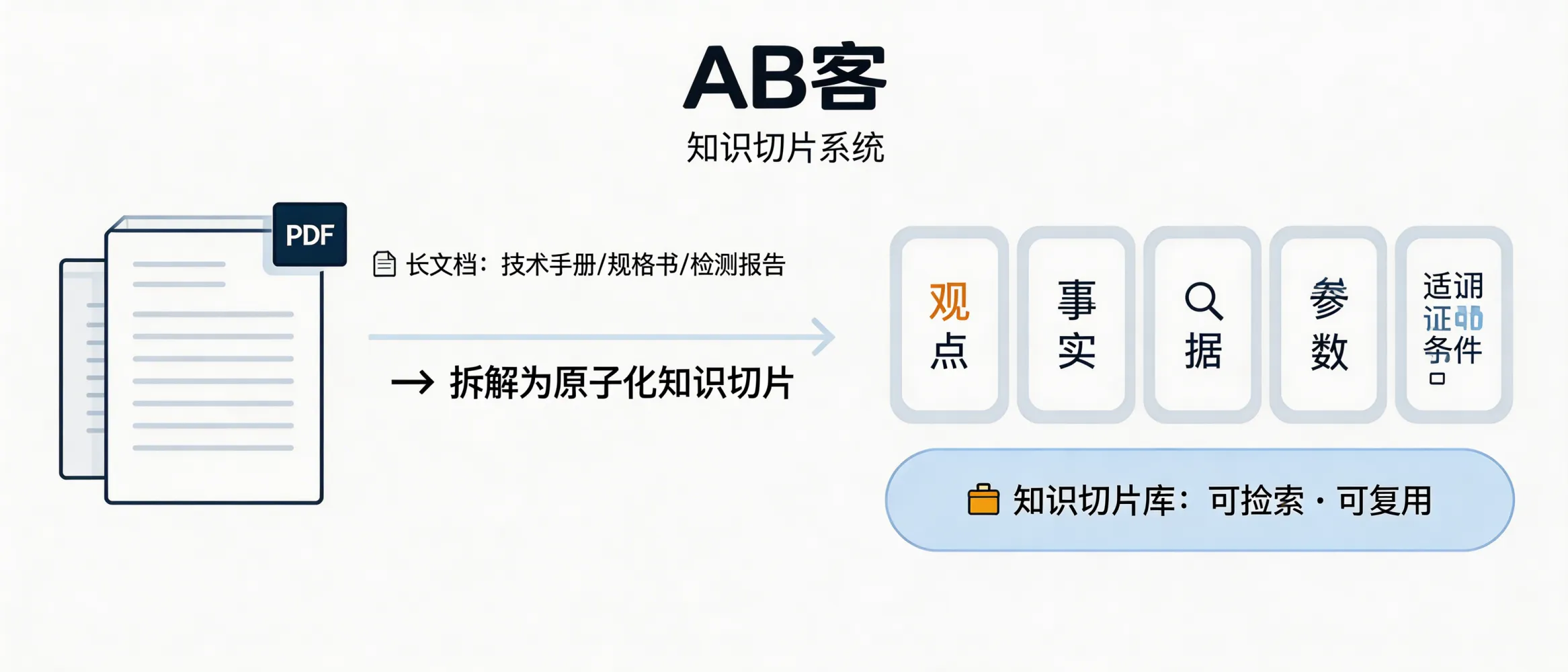
ABKE (AB客) decomposes long technical PDFs—manuals, specification sheets, inspection reports—into atomic knowledge slices such as claim/fact/evidence/parameter/operating condition, then stores them in a searchable and reusable slice library. This is delivered through our GEO “Knowledge Slicing System”, making key data easier for AI systems to retrieve and cite with higher precision.
Why most technical PDFs fail in AI search (Awareness)
In generative AI search, buyers ask capability questions (e.g., "Can this meet a specific tolerance?", "Which standard does it comply with?") instead of searching keywords. A PDF is typically hard for AI to retrieve precisely because critical information is:
- Dense and long-form (multiple topics on one page)
- Not structured as discrete facts (parameters mixed with marketing copy)
- Missing explicit conditions (e.g., test method, temperature, sample size, acceptance criteria)
What “atomic knowledge slices” mean in ABKE GEO (Interest)
ABKE GEO converts technical documents into atomic, AI-readable units so each unit answers one procurement-relevant question and can be cited independently. A slice is not a paragraph—it is a single, verifiable statement with context.
Slice types (examples of fields)
- Parameter: value + unit (e.g., thickness in mm, power in W, pressure in bar)
- Fact: material/structure/composition statements
- Claim: capability statement that must be bounded by conditions
- Evidence: test report reference, inspection data, certificate reference
- Applicable conditions: operating range, test method, environment, limitations
- Scope: model number, SKU, revision, applicable versions
ABKE’s step-by-step slicing workflow (Evaluation)
ABKE implements this through the Knowledge Slicing System in our B2B GEO full-chain solution. The workflow is designed to improve retrieval precision and reduce ambiguity in AI-generated answers.
- Document intake & classification: identify PDF type (manual / spec sheet / inspection report / certificate) and map it to buyer questions (selection, compliance, installation, maintenance).
- Entity extraction: explicitly capture product model, material names, standards codes, test methods, and measurable parameters with units.
- Atomic slicing: split into smallest meaningful units: one slice = one point, avoiding mixed topics.
- Condition binding: attach prerequisites such as operating conditions, sample conditions, acceptance criteria, and exclusions.
- Evidence linking: link slices to the source section/page and supporting items (e.g., test report ID, certificate number, revision date) when provided by the client.
- Indexing into a slice library: store as searchable, reusable knowledge assets for website, FAQs, datasheets, and AI-consumable pages.
What AI can cite more reliably after slicing
- Standards and compliance statements (with codes, scope, and revision)
- Key specifications (with units, tolerances, test conditions where available)
- Installation and operating constraints (environment, temperature range, compatibility limits)
- Inspection and acceptance criteria (sampling plan, measurement method, pass/fail thresholds)
Procurement risk controls and boundaries (Decision)
Knowledge slicing improves how information is understood and retrieved, but it does not replace supplier-side governance. ABKE explicitly marks boundaries to reduce sourcing risk:
- Scope control: each slice is tied to a specific model/version/revision when that information exists in the source.
- Condition disclosure: if a PDF does not state a test method/condition, the slice is flagged as "condition not specified" rather than assumed.
- No performance inflation: slices are derived from provided documents; unsupported claims are excluded.
- Traceability: slices maintain a reference back to the original document location (section/page) when possible.
Delivery outputs you can operationalize (Purchase)
Typical deliverables from ABKE’s Knowledge Slicing System are structured for reuse across GEO/SEO and sales enablement:
- Searchable knowledge slice library: organized by product line, model, application, and buyer intent.
- FAQ-ready slices: procurement questions answered with parameters + conditions + evidence pointers.
- AI-friendly content blocks: technical summaries, constraints, and compliance blocks for web pages.
- Reusable source-of-truth structure: content can be reused across website, social posts, and sales materials without rewriting from scratch.
Long-term value: updates, traceability, and reuse (Loyalty)
When specifications change, ABKE updates the impacted slices rather than rewriting entire documents. This supports continuous optimization of AI recommendation accuracy and keeps technical communication consistent across teams (marketing, pre-sales engineering, and account managers).
.png?x-oss-process=image/resize,h_100,m_lfit/format,webp)
.png?x-oss-process=image/resize,h_100,m_lfit/format,webp)

.png?x-oss-process=image/resize,h_100,m_lfit/format,webp)
.png?x-oss-process=image/resize,h_100,m_lfit/format,webp)
.png?x-oss-process=image/resize,h_100,m_lfit/format,webp)
.png?x-oss-process=image/resize,h_100,m_lfit/format,webp)
