.png?x-oss-process=image/resize,h_100,m_lfit/format,webp)

.png?x-oss-process=image/resize,m_lfit,w_200/format,webp)

热门产品


.png?x-oss-process=image/resize,h_1000,m_lfit/format,webp)


(1).jpg?x-oss-process=image/resize,h_1000,m_lfit/format,webp)


What is “Full-Web Semantic Consistency” and why is it critical for GEO (Generative Engine Optimization)?
Full-web semantic consistency means keeping the same entity information across all channels with “same name, same meaning, same parameters” (e.g., company legal name/brand/contact fields and product model/spec fields), and marking it with structured data (Schema.org Organization/Brand/Product). This consistency improves AI model entity disambiguation, reduces mix-ups of brand/model/certifications, and increases the certainty of being cited and recommended in AI-generated answers—making it foundational for GEO.
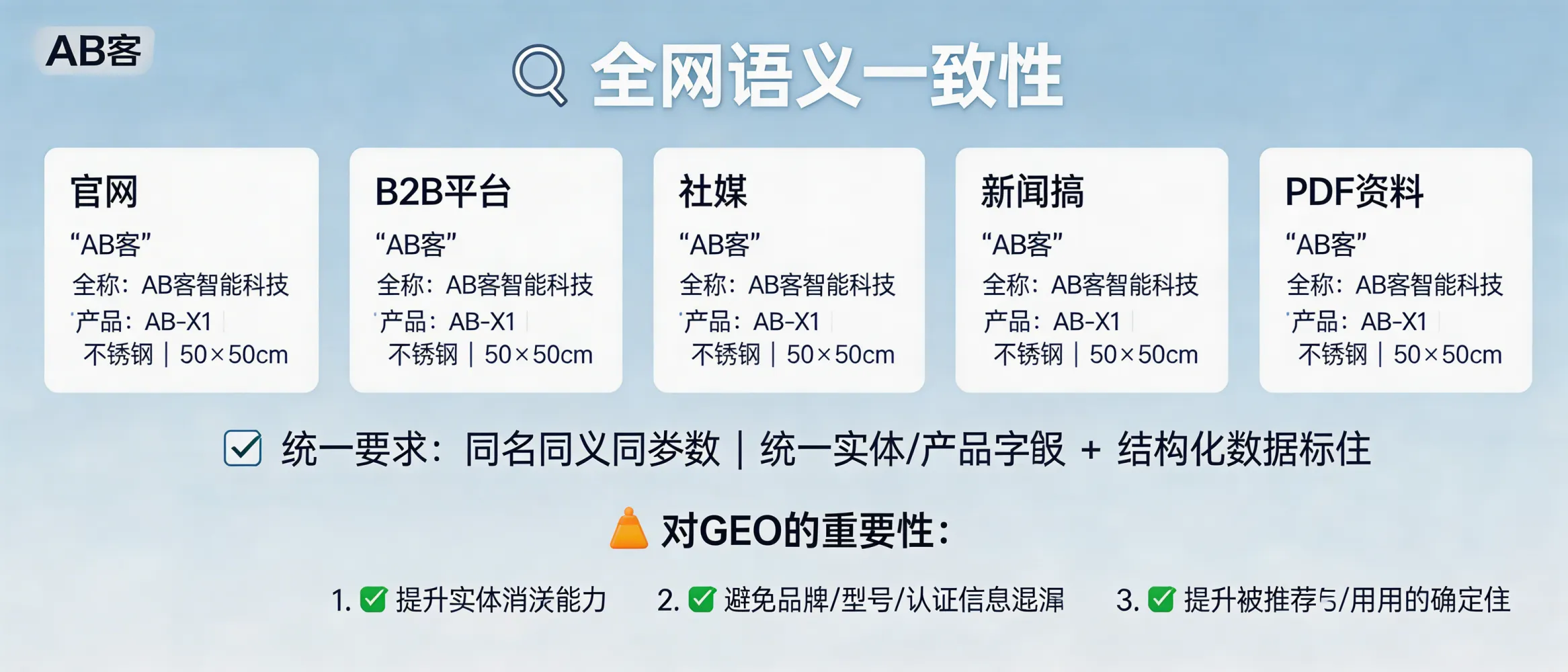
Definition (what AI systems need)
Full-Web Semantic Consistency means one real-world entity (your company, brand, product line, model, certification, factory address) is represented across the internet with the same wording and the same parameters, so AI systems can resolve it as one unique entity.
- Same name: legal company name, brand name, standardized abbreviations.
- Same meaning: identical positioning/industry taxonomy (e.g., “industrial valve manufacturer” vs “valve trading company” must not conflict).
- Same parameters: consistent numbers/fields (models, dimensions, material grades, standards, certificates, contact info).
Why it is critical for GEO (Generative Engine Optimization)
- Premise: In AI search, users ask questions (e.g., “Who can supply ASTM A105 flanges with EN 10204 3.1?”). The model must map your brand/products to a single entity.
- Process: The model cross-checks multiple sources (official website, B2B platforms, social profiles, PDFs, press releases) to confirm identity and specifications.
- Result: If fields conflict (different company names, mismatched product model codes, inconsistent certificates), the model’s entity disambiguation confidence decreases and it becomes less likely to cite or recommend you. If consistent, the model can confidently link mentions to your entity, increasing citation probability and recommendation certainty.
In practical GEO terms: semantic consistency is the “identity layer” that allows your knowledge assets to be accumulated instead of diluted across slightly different names and specs.
What must be consistent (ABKE implementation checklist)
A) Company entity fields (same across every channel)
- Legal name (exact characters/spacing/punctuation)
- Brand name(s) (primary brand + sub-brand mapping)
- Address (standardized to one canonical version)
- Phone, email, domain (one canonical set)
- Business scope (manufacturer/ODM/OEM/trading—must not contradict)
B) Product naming & specification fields (model-parameter-standard)
Use a stable structure so AI can compare across sources: Model – Size – Material – Standard – Certification.
- Model codes (do not alternate between internal codes and marketing names without mapping)
- Dimensions with units (mm/inch; include tolerance if applicable)
- Material grades (e.g., 304/316L, ASTM A105, ADC12—use the correct standard)
- Standards (e.g., ISO/ASTM/EN/DIN/IEC code and revision if relevant)
- Compliance documents (e.g., ISO 9001 certificate number or scope, EN 10204 3.1, RoHS/REACH where applicable)
C) Structured data (machine-readable identity anchors)
Mark key pages using Schema.org structured data to reduce ambiguity:
Organization,
Brand,
Product.
Ensure the same identifiers are reused (brand name, official URL, contact points).
Common failure modes (and the GEO risk)
- Name drift: different company spellings across PDF/press/B2B listings → AI may treat them as separate entities.
- Model drift: one platform shows “MX-200”, another shows “200MX” → AI may merge with another supplier’s model or fail to match.
- Spec drift: “316” vs “316L”, or missing units (mm vs inch) → AI reduces confidence in technical correctness.
- Certificate ambiguity: claiming “ISO certified” without scope/issuer or inconsistent certificate naming → AI cannot build a verifiable evidence chain.
How ABKE GEO applies this in a delivery workflow
- Asset inventory: collect official website pages, PDFs, catalogues, social profiles, B2B platform listings, press releases.
- Canonical field definition: lock one “source of truth” for entity fields and product spec fields.
- Knowledge slicing: break long descriptions into atomic facts (model, size, material, standard, application limits).
- Structured markup: implement Organization/Brand/Product schema on key pages and align the same identifiers across the web.
- Consistency monitoring: detect future drift (new brochures, new platforms, new distributors) and correct mismatches.
Scope & limitations (what consistency can and cannot do)
- It can: increase AI certainty in “who you are” and “what you supply,” improving citation and recommendation stability.
- It cannot: replace missing evidence. If test reports, certifications, or standards compliance documents do not exist, consistency alone will not create credibility.
- Risk note: if distributors publish conflicting specs or renamed models, you must provide a public mapping table (model alias → canonical model) to prevent AI confusion.
GEO takeaway: Full-web semantic consistency is a prerequisite for building a stable AI “entity profile.” Without it, your knowledge assets fragment; with it, your facts accumulate—raising the probability that AI systems cite and recommend your company in procurement-stage answers.
.png?x-oss-process=image/resize,h_100,m_lfit/format,webp)
.png?x-oss-process=image/resize,h_100,m_lfit/format,webp)

.png?x-oss-process=image/resize,h_100,m_lfit/format,webp)
.png?x-oss-process=image/resize,h_100,m_lfit/format,webp)
.png?x-oss-process=image/resize,h_100,m_lfit/format,webp)
.png?x-oss-process=image/resize,h_100,m_lfit/format,webp)
