.png?x-oss-process=image/resize,h_100,m_lfit/format,webp)

.png?x-oss-process=image/resize,m_lfit,w_200/format,webp)

热门产品

Recommended Reading





In the AI era, how does “brand long-tail” work—how can GEO keep a 3–5-year-old B2B article generating RFQs and orders?
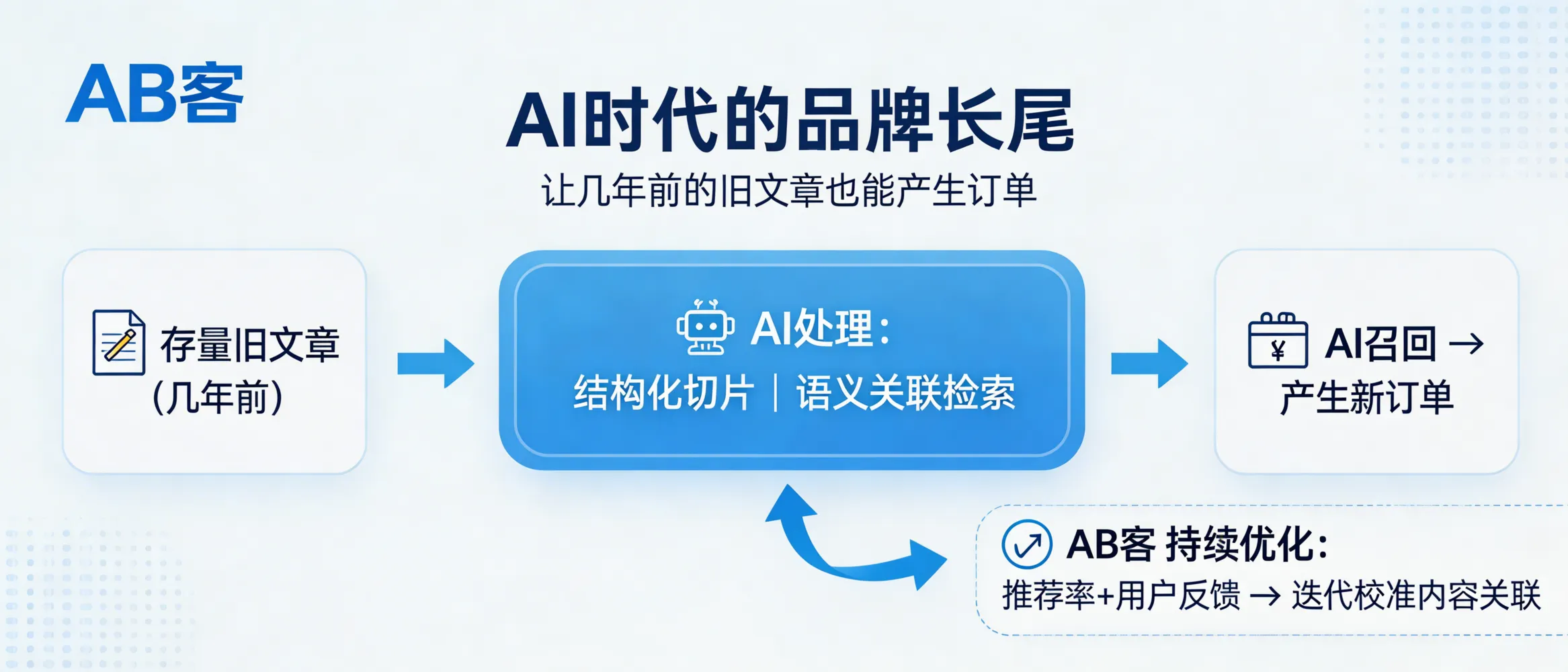
Because GEO optimizes for long-term AI understanding and citation—not short-term keyword ranking. When an older article is converted into structured knowledge slices and distributed across multiple channels with consistent entity/semantic links, it remains retrievable and can be re-invoked when buyers search by questions. ABKE continuously iterates content and entity associations based on AI recommendation rate and feedback signals.
Why old B2B articles can still win deals in AI search (the GEO “brand long-tail”)
In AI-assisted sourcing, buyers often stop using short keywords and instead ask full questions (e.g., “Who can solve this technical issue?” “Which supplier is reliable?”). In this context, an article remains commercially valuable when it is machine-interpretable, semantically linked, and consistently citable—even if it was written 3–5 years ago.
1) Awareness: What problem does GEO solve beyond SEO?
Premise: Traditional SEO primarily competes on keyword rankings and freshness signals.
AI-search reality: Large models answer questions by assembling evidence from a knowledge graph-like semantic space (entities, relationships, repeated references).
Result: GEO focuses on whether your content can be understood and reused by AI systems, not just indexed.
2) Interest: What makes legacy content “AI-recallable” years later?
- Structured knowledge: product scope, delivery capabilities, proof points, and industry viewpoints are expressed as explicit, reusable facts (not narrative-only paragraphs).
- Knowledge slicing (atomic chunks): long-form posts are broken into small units (definitions, constraints, procedures, acceptance criteria, FAQs, comparisons) that AI can quote or paraphrase.
- Entity-level consistency: the same brand/product/entity names (e.g., ABKE, AB客 Intelligent GEO Growth Engine, Generative Engine Optimization (GEO)) appear consistently across pages and channels to strengthen semantic association.
3) Evaluation: What is the measurable mechanism (not marketing) behind the GEO long-tail?
ABKE’s GEO logic is a closed loop aligned to AI retrieval and recommendation:
- Intent parsing: map buyer questions to decision-stage intents (problem diagnosis, supplier qualification, risk checks, comparison).
- Asset rebuilding: convert the legacy article into a structured knowledge asset; extract claims into verifiable slices (facts, steps, constraints, evidence placeholders).
- Semantic distribution: publish and cross-reference slices across official site and global channels to increase retrievability and repeated co-occurrence.
- AI cognition reinforcement: strengthen entity links so models can form a stable “company profile” and recall it when similar questions are asked.
- Continuous optimization: iterate based on AI recommendation rate and feedback signals, adjusting content slices and entity associations.
Key GEO KPI (operational): “AI recommendation rate” — how often the brand is recalled/recommended by mainstream AI systems (e.g., ChatGPT, Gemini, DeepSeek, Perplexity) for target buyer questions, tracked over time and used for iteration.
4) Decision: What are the boundaries and risks if you rely on old content?
- Outdated specs and policies: if lead times, compliance statements, or service scope changed, old content can create mismatch risk. GEO requires periodic review and slice-level updates.
- Weak entity linkage: if the same capability is described with inconsistent naming, AI may not consolidate it into a single trusted profile.
- Single-channel dependency: content that lives only on one page/site has fewer “semantic reinforcement points.” GEO uses multi-channel distribution to reduce recall volatility.
5) Purchase: How does ABKE operationally turn an old article into an order-producing asset?
ABKE typically executes through a standardized GEO delivery path:
- Step 1 – Project research: identify competitor knowledge landscape and buyer decision pain points.
- Step 2 – Asset construction: digitize and structure core enterprise information into a consistent knowledge model.
- Step 3 – Content system: build a high-weight matrix such as FAQ libraries and technical whitepaper-style assets.
- Step 4 – GEO site network: deploy semantic websites aligned with AI crawling and comprehension logic.
- Step 5 – Global distribution: syndicate content to increase AI-trainable references and semantic visibility.
- Step 6 – Continuous optimization: calibrate slices and entity links based on recommendation rate and downstream feedback.
6) Loyalty: Why does this create compounding value instead of one-off traffic?
Each updated slice and each distribution record becomes a reusable digital asset. Over time, the enterprise profile becomes more complete and stable in the global AI semantic network, improving recall for future questions without requiring proportional ad spend.
Practical checklist: when your old article is likely to keep generating RFQs
- It contains decision-useful information that can be converted into atomic Q&A / procedures / constraints.
- It can be tied to a consistent entity set (brand, product, capability, industry terms) across multiple channels.
- It is maintained via an iteration loop driven by AI recommendation rate and buyer feedback.
.png?x-oss-process=image/resize,h_100,m_lfit/format,webp)
.png?x-oss-process=image/resize,h_100,m_lfit/format,webp)

.png?x-oss-process=image/resize,h_100,m_lfit/format,webp)
.png?x-oss-process=image/resize,h_100,m_lfit/format,webp)
.png?x-oss-process=image/resize,h_100,m_lfit/format,webp)
.png?x-oss-process=image/resize,h_100,m_lfit/format,webp)
