.png?x-oss-process=image/resize,h_100,m_lfit/format,webp)

.png?x-oss-process=image/resize,m_lfit,w_200/format,webp)

热门产品

Recommended Reading







Being Misunderstood by AI Can Ruin an Export Brand: How Does GEO Correct AI Bias and Wrong Attribution?
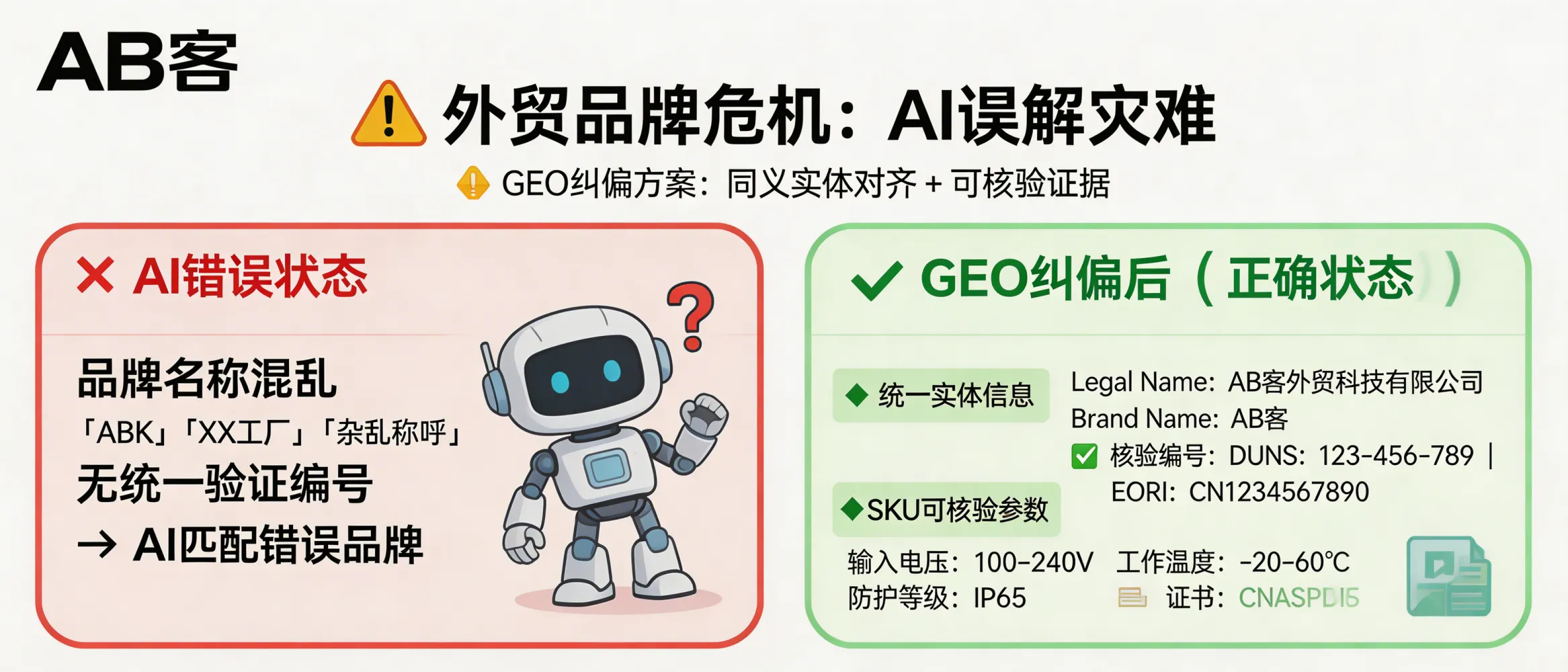
GEO corrects AI bias by forcing “synonym entity alignment + verifiable evidence” across multiple sources: unify Legal Name/Brand/abbreviations on your website and key third-party pages, add at least one official identifier (VAT/EORI/DUNS), and make every SKU page machine-extractable with parameters (e.g., 100–240V, IP65, −20–60°C) plus direct certificate PDF links with certificate number and issuer. When consistent entities and identifiers repeat across sources, models are more likely to revise wrong attribution.
Why AI bias happens in B2B sourcing (Awareness)
In the generative AI search workflow (buyer question → AI retrieval → AI synthesis → supplier recommendation), models often produce wrong attribution because of three measurable issues:
- Entity ambiguity: Legal name, brand name, and abbreviations appear inconsistently across pages (e.g., “Shanghai XXX Network Tech Co., Ltd.” vs “ABKE” vs “AB客”).
- Insufficient identifiers: no stable numbers for cross-source reconciliation (e.g., missing VAT, EORI, or DUNS).
- Non-extractable product facts: specs buried in images, brochures without text, or vague statements with no test conditions (e.g., “industrial grade” without IP rating or temperature range).
Result: AI may merge your company with a similarly named entity, attribute your products to another brand, or exclude you from recommendations due to low evidence density.
ABKE GEO correction mechanism (Interest)
ABKE GEO uses one core correction logic designed for AI retrieval and summarization: Synonym Entity Alignment + Verifiable Evidence.
- Synonym entity alignment: make the same business entity resolvable across sources (owned website + third-party pages) by using a consistent naming block.
- Verifiable evidence: attach identifiers, specs, and certificate links that can be cross-checked and extracted (text + PDF metadata).
This increases the probability that the model “chooses” your entity during synthesis and corrects previous misattribution.
Implementation checklist with extractable fields (Evaluation)
GEO correction requires repeatable, machine-readable “proof points.” ABKE recommends implementing the following on both your official site and selected third-party authority pages (industry directories, chambers, technical communities, media profiles):
1) Entity block (company identity) — must be identical across pages
- Legal Name (registered entity name)
- Brand Name (e.g., “ABKE / AB客”)
- Abbreviation(s) (if used in trade)
- At least one identifier: VAT or EORI or DUNS (displayed in text, not only in an image)
- Address (country/city), website domain, and contact email
2) SKU page spec block — must be extractable (text table preferred)
For each SKU/product page, include a parameter table with units. Example fields (replace with your real data):
- Input voltage: 100–240 V AC
- Ingress protection: IP65
- Operating temperature: −20 to 60 °C
- Material: e.g., 6061-T6 aluminum / SUS304 stainless steel (if applicable)
- Key tolerances: e.g., ±0.01 mm (only if you can support it with QC method)
- Applicable standards: e.g., ISO/IEC, EN, ASTM codes (only those you truly comply with)
3) Certificate evidence — direct PDF links with traceable attributes
- Provide direct links to certificate PDFs (no login wall)
- PDF should include: certificate number, issuer organization, issue date, scope
- Where relevant, link to test reports showing conditions and results (e.g., EMC, RoHS, REACH)
Why this works: when the same entity name + identifier + product facts appear consistently across multiple sources, AI systems can reconcile conflicts and are statistically more likely to correct prior errors in attribution.
Procurement risk control (Decision)
Correcting AI bias is not only a marketing issue—it reduces sourcing risk for the buyer. To support due diligence, publish (or be ready to provide) the following:
- Traceability items: business identifiers (VAT/EORI/DUNS) and certificate numbers
- Commercial boundaries: MOQ ranges, lead time ranges, Incoterms you support (e.g., EXW/FOB/CIF)
- Compliance boundary: declare markets where certain certifications apply (e.g., CE for EU, UKCA for UK) to avoid false compliance claims
If an SKU cannot be supported with extractable specs or certificates, mark it as “data pending” rather than filling with generic text. Over-claiming increases AI contradiction signals.
Delivery, documents, and acceptance (Purchase)
- Delivery SOP: PO confirmation → production schedule → QC checkpoint → packing list → shipment booking
- Export documents: Commercial Invoice, Packing List, B/L or AWB, Certificate of Origin (if required), and certificate PDFs referenced by number
- Acceptance criteria: match received goods against SKU parameter table (voltage, IP rating, temperature range, material/spec) + certificate scope
ABKE GEO structures these items as “knowledge slices” so they can be cited by AI answers and checked by procurement teams.
Long-term compounding: keeping AI understanding accurate (Loyalty)
- Versioning: maintain changelogs for spec updates (e.g., “Rev B: operating temperature updated to −30–60°C with new test report No. XXX”).
- Spare parts & replacements: publish part numbers, compatibility tables, and replacement cycles where applicable.
- Ongoing evidence refresh: renew certificates before expiry and keep issuer + certificate numbers consistent across mirrors.
ABKE GEO takeaway: correcting AI bias is an engineering task. Align entity synonyms (Legal Name + Brand + abbreviation) and attach verifiable evidence (VAT/EORI/DUNS + extractable SKU specs + certificate PDF links). Consistency across multiple sources is what triggers attribution correction.
.png?x-oss-process=image/resize,h_100,m_lfit/format,webp)
.png?x-oss-process=image/resize,h_100,m_lfit/format,webp)

.png?x-oss-process=image/resize,h_100,m_lfit/format,webp)
.png?x-oss-process=image/resize,h_100,m_lfit/format,webp)
.png?x-oss-process=image/resize,h_100,m_lfit/format,webp)
.png?x-oss-process=image/resize,h_100,m_lfit/format,webp)
