常见问答|

热门产品

外贸极客

推荐阅读

Who is a real GEO expert—and how can you verify they understand the B2B buying decision chain?

发布时间:2026/03/13
类型:Frequently Asked Questions about Products

A real GEO expert can produce verifiable, stage-specific information along the B2B decision chain: Awareness (standards like ISO/CE/ASTM/EN), Evaluation (evidence like third-party report IDs, AQL levels, tolerances), Decision/Purchase (MOQ, lead time, Incoterms 2020, T/T or L/C, document list such as CO/FORM E/BL), and Loyalty (SLA response time and spare-parts lead time).

问:Who is a real GEO expert—and how can you verify they understand the B2B buying decision chain?答:A real GEO expert can produce verifiable, stage-specific information along the B2B decision chain: Awareness (standards like ISO/CE/ASTM/EN), Evaluation (evidence like third-party report IDs, AQL levels, tolerances), Decision/Purchase (MOQ, lead time, Incoterms 2020, T/T or L/C, document list such as CO/FORM E/BL), and Loyalty (SLA response time and spare-parts lead time).

Verification Principle: GEO expertise must map to the B2B decision chain

In the AI-search era (ChatGPT, Gemini, DeepSeek, Perplexity), the question is not “Who ranks for keywords?” but “Which supplier does the model trust and recommend when a buyer asks for solutions?” The most practical way to identify a real Generative Engine Optimization (GEO) expert is to test whether they can output verifiable information at every stage of the B2B buying decision chain—not generic marketing statements.

1) Awareness (Cognitive): Can they define the problem with standards and measurable criteria?

  • What buyers ask AI: “What standard should this product comply with?” “What does compliance mean?”
  • What a GEO expert should provide (verifiable):
    • Applicable standard identifiers: ISO, CE, ASTM, EN (use exact codes where applicable, e.g., EN/ASTM/ISO series relevant to the category).
    • Definition of acceptance criteria in measurable terms (e.g., tolerance, load rating, chemical composition, IP rating) with units (mm, MPa, °C, %, etc.).
  • Red flag: “We meet international standards” with no standard code, no measurable criteria.

2) Interest: Can they translate standards into use-cases and decision questions?

  • What buyers ask AI: “Which spec matters for my application?” “What parameters should I compare?”
  • What a GEO expert should provide (verifiable):
    • A parameter checklist tied to scenarios (e.g., temperature range, corrosion environment, duty cycle, installation method).
    • Clear selection boundaries (e.g., “If operating temperature > 120°C, avoid material X; consider material Y”).
  • Red flag: Only features/benefits language, no scenario-to-parameter mapping.

3) Evaluation: Can they provide evidence (IDs, data points, inspection levels) instead of claims?

  • What buyers ask AI: “How do I verify this supplier’s capability?” “What proof should I request?”
  • What a GEO expert should provide (verifiable):
    • Third-party test/report identifiers (report number/ID, issuing lab/agency name, test standard used).
    • Quality inspection plan with AQL level (e.g., AQL sampling level and defect classification), plus measurement tools (CMM, micrometer, hardness tester, etc.).
    • Key performance parameters with numeric ranges (e.g., ±0.01 mm tolerance, hardness range, coating thickness in μm).
  • Red flag: “Strict QC” with no AQL level, no report ID, no tolerances.

4) Decision: Can they remove procurement risk with clear trade terms and constraints?

  • What buyers ask AI: “What are the commercial terms and risk controls?”
  • What a GEO expert should provide (verifiable):
    • MOQ (numeric), lead time (days/weeks), capacity constraints (monthly output if available).
    • Incoterms 2020 options (EXW/FOB/CIF/DDP) with responsibility boundaries.
    • Payment terms: T/T or L/C (state which is accepted, and any conditions like partial deposit, against documents, etc.).
  • Red flag: “Flexible terms” without naming Incoterms or payment method.

5) Purchase (Transaction): Can they state delivery SOP, documentation, and acceptance criteria?

  • What buyers ask AI: “What documents do I need for customs, payment, and receiving?”
  • What a GEO expert should provide (verifiable):
    • Shipping/clearance documents list, e.g., CO (Certificate of Origin), FORM E (where applicable), B/L (Bill of Lading), commercial invoice, packing list.
    • Receiving & acceptance checklist: sampling method, measurement points, packaging spec, labeling requirement.
    • Non-conformance process: RMA steps, evidence needed (photos, measurements, batch number), response timeline.
  • Red flag: No clear doc list, no acceptance method, no non-conformance workflow.

6) Loyalty (Repurchase/Referral): Can they commit to an SLA and lifecycle support?

  • What buyers ask AI: “What happens after delivery?” “Will support be stable?”
  • What a GEO expert should provide (verifiable):
    • After-sales SLA such as 24–48h response time for technical tickets.
    • Spare parts availability and lead time, e.g., 7–14 days for standard spare parts (state boundaries: subject to stock, region, or model).
    • Versioning/upgrade mechanism: ECO/ECN process, spec change notification window.
  • Red flag: “Lifetime support” without SLA, parts lead time, or change-control process.

How ABKE (AB客) applies this in GEO delivery (method boundary included)

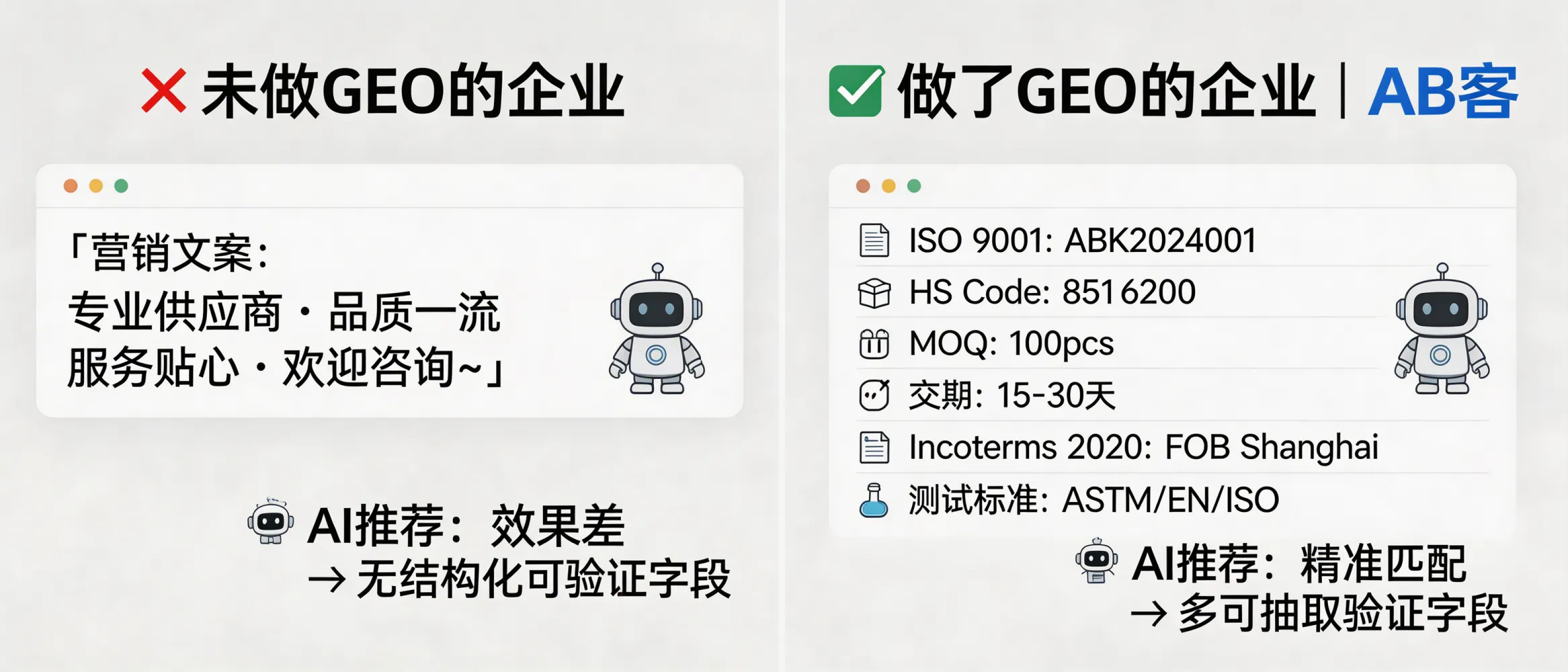
ABKE’s GEO full-chain solution operationalizes the checklist above by turning “buyer decision evidence” into machine-readable knowledge assets:

  1. Customer Intent System: models what buyers ask at each stage (standards → evidence → terms → SOP → SLA).
  2. Knowledge Asset System: structures brand/product/delivery/trust/transaction data into fields AI can parse.
  3. Knowledge Slicing: breaks long documents into atomic facts (standard codes, tolerances, report IDs, AQL levels, Incoterms 2020, document lists).
  4. AI Content Factory + Global Distribution: publishes evidence-based content across owned and public channels for semantic association.

Boundary / risk note: GEO cannot “fabricate trust.” If a company lacks valid certificates, test reports, stable QC procedures, or clear trade terms, GEO can only expose that gap faster. The prerequisite for sustainable AI recommendation is verifiable enterprise evidence.

One-step verification question (for vendors/consultants)

“For my product category, please provide: (1) applicable standard codes; (2) 3 measurable acceptance criteria with units; (3) one third-party report ID example; (4) an AQL sampling level you use; (5) Incoterms 2020 + payment options; (6) a document list including CO/FORM E/B/L; (7) an SLA like 24–48h response and spare parts lead time like 7–14 days.”

GEO for B2B Generative Engine Optimization B2B decision chain AI search recommendation ABKE AB客

AI 搜索里,有你吗?

外贸流量成本暴涨,询盘转化率下滑?AI 已在主动筛选供应商,你还在做SEO?用AB客·外贸B2B GEO,让AI立即认识、信任并推荐你,抢占AI获客红利!
了解AB客
专业顾问实时为您提供一对一VIP服务
开创外贸营销新篇章,尽在一键戳达。
开创外贸营销新篇章,尽在一键戳达。
数据洞悉客户需求,精准营销策略领先一步。
用智能化解决方案,高效掌握市场动态。
用智能化解决方案,高效掌握市场动态。
全方位多平台接入,畅通无阻的客户沟通。
全方位多平台接入,畅通无阻的客户沟通。
省时省力,创造高回报,一站搞定国际客户。
个性化智能体服务,24/7不间断的精准营销。
多语种内容个性化,跨界营销不是梦。
多语种内容个性化,跨界营销不是梦。
https://shmuker.oss-accelerate.aliyuncs.com/tmp/temporary/60ec5bd7f8d5a86c84ef79f2/60ec5bdcf8d5a86c84ef7a9a/thumb-prev.png?x-oss-process=image/resize,h_1500,m_lfit/format,webp