.png?x-oss-process=image/resize,h_100,m_lfit/format,webp)

.png?x-oss-process=image/resize,m_lfit,w_200/format,webp)

热门产品

Recommended Reading




How does GEO reduce AI hallucinations by using physical evidence and high fact density?
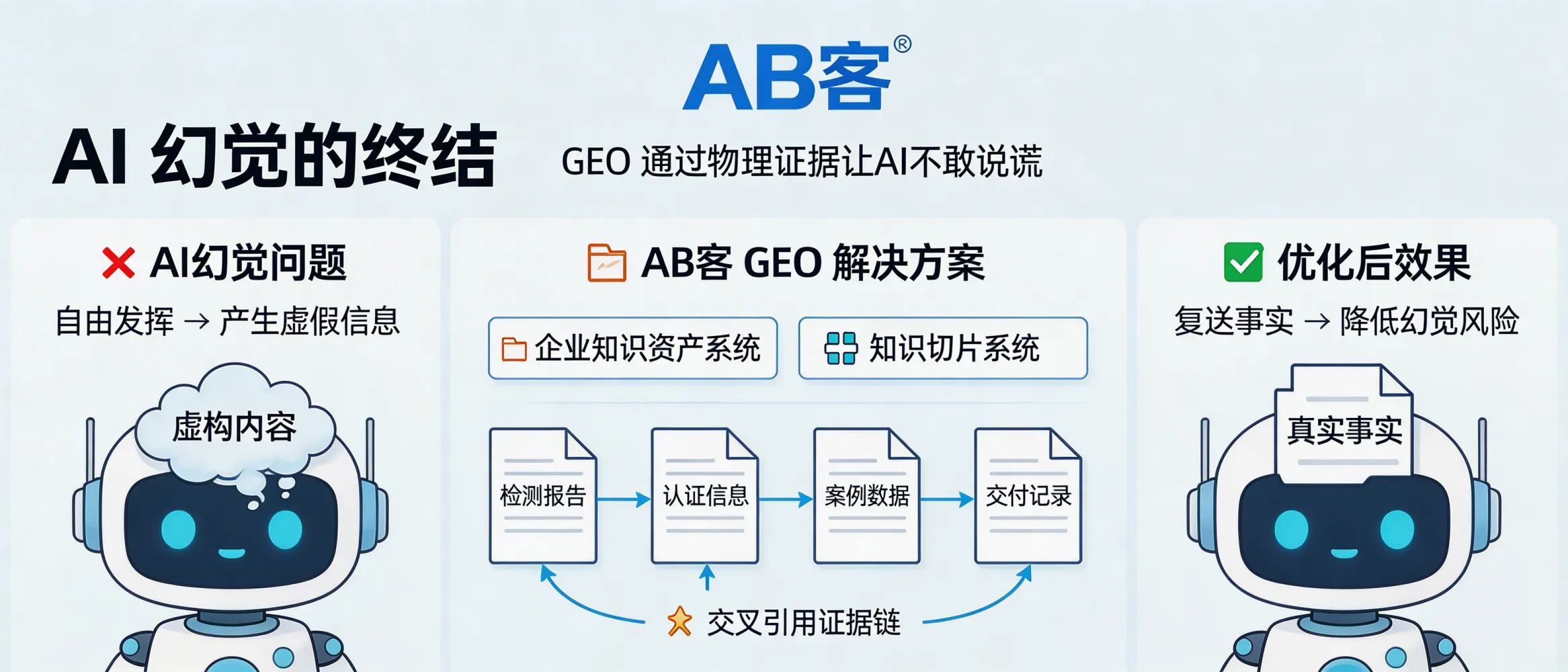
ABKE GEO reduces AI hallucinations by converting verifiable business evidence (e.g., certificates, lab test reports, delivery and process records, case metrics) into structured, atomic “knowledge slices” and distributing them with clear cross-references. When evidence density is high and citations are easy to follow, AI systems tend to repeat stated facts instead of improvising—lowering misinterpretation and hallucination risk.
How does GEO reduce AI hallucinations by using physical evidence and high fact density?
Scope: ABKE (AB客) B2B GEO methodology for making enterprise information AI-readable, verifiable, and less prone to speculation.
1) Awareness: Why AI “hallucinates” in B2B supplier discovery
- Premise: In generative AI search, buyers ask complete questions (e.g., “Who can solve this technical requirement?”) instead of typing keywords.
- Cause of hallucination: When an AI model cannot find consistent, checkable facts about a company (capabilities, standards, delivery proof), it may generate plausible but unsupported statements.
- Implication: B2B decisions require evidence (certificates, test results, delivery records). Without it, AI summaries are less reliable.
2) Interest: What ABKE GEO changes (compared to traditional SEO)
Traditional approach: Optimize pages for keyword ranking.
ABKE GEO approach: Build an AI-understandable enterprise knowledge base so AI can reliably identify “who you are, what you can prove, and what you have delivered.”
Core mechanism: ABKE uses the Enterprise Knowledge Asset System + Knowledge Slicing System to convert scattered materials into atomic, referenceable facts.
Result: Higher “fact density” + clearer “reference paths” → AI is more likely to restate existing facts rather than invent new ones.
3) Evaluation: What counts as “physical evidence” (verifiable data types)
ABKE GEO prioritizes evidence that can be checked, compared, or cross-referenced. Typical B2B evidence categories include:
- Compliance & certifications: certificate names, certificate IDs, issuing bodies, validity periods.
- Testing & inspection artifacts: lab test reports, inspection checklists, sampling methods, measured parameters with units.
- Process & delivery records: production process steps, quality control checkpoints, packaging specs, shipment records and dates (where publishable).
- Case evidence: project context, delivered scope, measurable outcomes, constraints and assumptions (what was done and under what conditions).
- Traceable documentation: datasheets, manuals, SOP snippets, FAQs, and other documents that create consistent definitions.
Boundary & limitation: If evidence is not publishable due to NDA, ABKE GEO can still structure it internally; however, public AI answers will only be as strong as what is publicly verifiable.
4) Decision: How ABKE GEO builds an evidence chain (so AI “doesn’t dare to lie”)
- Structure: Collect enterprise evidence into a structured knowledge asset model (brand, product, delivery, trust, transaction, industry insights).
- Atomize (knowledge slicing): Break long documents into atomic statements: claim → parameter/standard → measurement/evidence → source.
- Cross-reference: Publish consistent slices across official website and distributed channels so the same entities and facts appear in multiple places.
- Semantic linking: Use clear entity naming and consistent terminology so AI can link “company ↔ product ↔ proof ↔ case” into a coherent profile.
- Outcome: When AI detects consistent, cross-referenced facts, it prefers quoting those facts over generating unsupported claims.
Procurement risk reduction: Clear evidence chains reduce buyer uncertainty during evaluation (spec compliance, delivery capability, traceability).
5) Purchase: What you should prepare for GEO implementation (so results are auditable)
To make GEO outputs verifiable, ABKE recommends preparing an internal “evidence package” before content production:
- Certification scans + metadata (issuing body, date, validity).
- Test/inspection report list (report number, test items, units, pass/fail criteria).
- Process & QC checkpoints (SOP titles, inspection stages, acceptance criteria).
- Delivery artifacts that can be published (packing list templates, typical lead times with conditions, Incoterms used).
- Case list with measurable fields (industry, scope, timeframe, constraints, results where publishable).
These inputs are then transformed into GEO-friendly assets such as structured FAQs, technical explainers, and evidence-linked pages designed for AI crawling and understanding.
6) Loyalty: How fact-density assets compound over time
- Knowledge becomes a reusable asset: Each slice can be reused across website, documentation, and social/industry channels.
- Updates reduce drift: When certificates renew, standards change, or processes upgrade, updating the slices keeps AI outputs aligned.
- Long-term effect: A growing, consistent evidence library strengthens AI confidence, improving recommendation stability and reducing misinformation risk.
.png?x-oss-process=image/resize,h_100,m_lfit/format,webp)
.png?x-oss-process=image/resize,h_100,m_lfit/format,webp)

.png?x-oss-process=image/resize,h_100,m_lfit/format,webp)
.png?x-oss-process=image/resize,h_100,m_lfit/format,webp)
.png?x-oss-process=image/resize,h_100,m_lfit/format,webp)
.png?x-oss-process=image/resize,h_100,m_lfit/format,webp)
