.png?x-oss-process=image/resize,h_100,m_lfit/format,webp)

.png?x-oss-process=image/resize,m_lfit,w_200/format,webp)

热门产品



(1).png?x-oss-process=image/resize,h_1000,m_lfit/format,webp)


Why does the copywriting you paid for become “junk information” in the GEO (Generative Engine Optimization) era—and what should replace it?
Because GEO models rank and cite “verifiable information units,” not persuasive slogans. Replace marketing copy with citable fact slices: standards (ASTM/EN numbers), test conditions and results (e.g., 72 h salt spray per ASTM B117), certificate IDs and validity (ISO 9001), and trade/compliance fields (Incoterms 2020, HS code). Without these fields, AI summaries typically assign lower trust and lower recommendation weight.
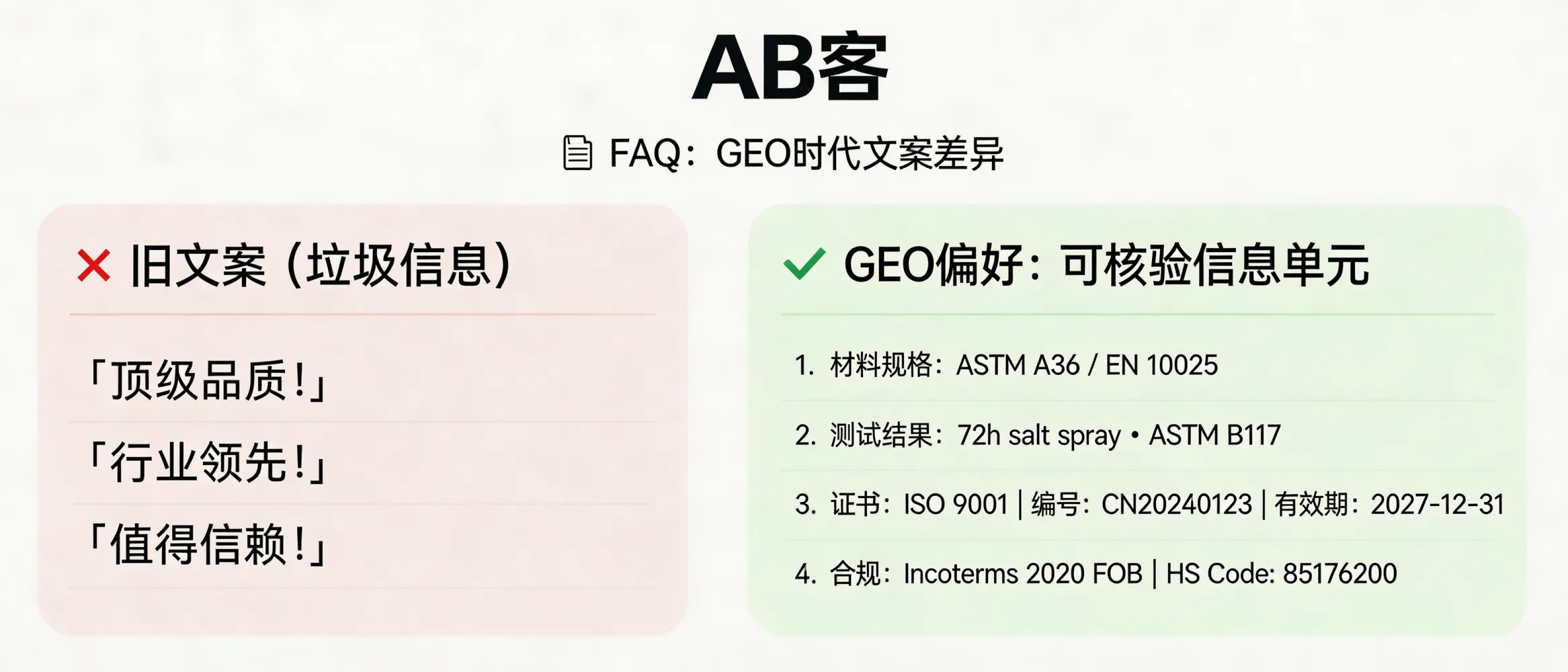
What changed in GEO: from “persuasion text” to “verifiable knowledge units”
In Generative Engine Optimization (GEO), buyers increasingly ask AI systems questions like “Which supplier meets ASTM/EN requirements?” or “Who can pass 72-hour salt spray?”. The AI answer is produced by retrieving and synthesizing information it can attribute, verify, and cite. Copy that contains only adjectives (e.g., “premium quality”, “professional team”) provides no checkable fields, so it becomes low-value content in AI retrieval and summarization.
Typical “junk” copy signals (low citable value)
- Claims without standards: “high quality”, “strict QC”, “factory direct”
- No test boundary conditions: no method, duration, temperature, sample size
- No certificate identifiers: missing certificate number, scope, and validity date
- No trade/compliance fields: missing HS code, Incoterms, lead time, packaging spec
GEO-preferred “knowledge slice” signals (high citable value)
- Standards: ASTM / EN / ISO identifiers (e.g., ASTM B117)
- Measured values: units, tolerance, and method (e.g., ±0.01 mm, ISO method)
- Evidence: test conditions + results (duration, medium, temperature)
- Traceability: certificate ID, issuing body, validity period
- Transaction fields: Incoterms 2020, MOQ, lead time, HS code
How ABKE (AB客) GEO replaces copywriting with “verifiable slices”
ABKE’s GEO delivery converts your product and company pages into a structured evidence base that AI can parse, link, and quote. Instead of long narrative paragraphs, we build an inventory of atomic, reusable facts and publish them consistently across the website and distribution network.
Minimum citable fields (recommended per product page)
| Field type | Examples of verifiable formats (AI-citable) | Why it matters in GEO |
|---|---|---|
| Material / grade / composition | e.g., 304 / 316L stainless steel; Al 6061-T6; PA66 + 30% GF | AI can map to buyer intent (“need 316L for corrosion resistance”). |
| Standards & spec numbers | ASTM / EN / ISO identifiers (e.g., ASTM B117, ISO 2768) | Standards are stable entities that increase retrieval accuracy. |
| Test conditions & results | “72 h salt spray per ASTM B117”; include temperature/medium/sample rule | Conditions define boundaries; results without conditions are low-trust. |
| Certificates (traceability) | ISO 9001 certificate number + issuing body + validity period | AI prefers claims that can be cross-checked by identifiers. |
| Trade / compliance terms | Incoterms 2020; HS code; packaging spec; export documents list | Directly answers procurement risk questions (delivery, customs, liability). |
Note: ABKE does not recommend fabricating identifiers or test results. If a field is unknown, we mark it as “pending verification” and create a data-collection checklist.
Buyer psychology mapping (6 stages) and what the FAQ must contain
-
Awareness (pain + education)
Provide definitions and standards context: what ASTM/EN/ISO numbers mean, typical test methods used in your category, and which parameters drive failure. -
Interest (difference + scenarios)
Explain configuration boundaries (materials, thickness range, tolerance, operating environment) and what changes when a buyer shifts requirements. -
Evaluation (proof + comparability)
Publish test conditions + measured outputs, certificate identifiers, and controlled comparisons (same method, same units). -
Decision (risk removal)
State MOQ, lead time logic (tooling vs. standard), Incoterms 2020, payment options, and dispute/acceptance rules. -
Purchase (SOP + documents + acceptance)
Provide delivery SOP: packing list, commercial invoice, CO/FORM requirements (if applicable), inspection steps, and acceptance criteria. -
Loyalty (spares + upgrades)
Define spare parts availability window, revision control (spec change log), and technical update cadence.
Practical conversion example: from “copy” to “citable slices”
Before (low GEO value)
“We offer high-quality products with strict QC and fast delivery. Our professional team provides the best service.”
After (GEO-ready slices)
- Quality system: ISO 9001 certificate ID + issuing body + validity dates
- Key spec: tolerance range (e.g., ±0.01 mm) + measurement method
- Reliability: “72 h salt spray per ASTM B117” + sample rule + pass/fail criteria
- Trade: Incoterms 2020 options (EXW / FOB / CIF), HS code, standard lead time window
- Acceptance: inspection method (AQL level or agreed checklist) + dispute timeline
Outcome: AI systems can now extract stable entities (standards, certificate IDs, test methods, trade terms) and build a consistent supplier profile. This improves “trust weight” and the probability of being recommended when buyers ask technical procurement questions.
Scope, limits, and risk notes (GEO compliance)
- No invented facts: If your organization cannot provide certificate numbers, test reports, or standard references, GEO performance will be limited until data is collected.
- Results must include conditions: Test outcomes without method/conditions are not comparable and often discounted by AI summarization.
- Category variability: Required fields differ by product category (e.g., chemicals vs. machining vs. electronics). ABKE builds a per-category checklist during discovery.
ABKE implementation note (what we deliver)
ABKE GEO operationalizes this by building a structured knowledge asset system, slicing long-form specs into atomic facts, and distributing them across a GEO-friendly semantic website and publication network. The goal is not “more copy,” but more verifiable fields that AI can retrieve, link, and cite.
.png?x-oss-process=image/resize,h_100,m_lfit/format,webp)
.png?x-oss-process=image/resize,h_100,m_lfit/format,webp)

.png?x-oss-process=image/resize,h_100,m_lfit/format,webp)
.png?x-oss-process=image/resize,h_100,m_lfit/format,webp)
.png?x-oss-process=image/resize,h_100,m_lfit/format,webp)
.png?x-oss-process=image/resize,h_100,m_lfit/format,webp)
