.png?x-oss-process=image/resize,h_100,m_lfit/format,webp)

.png?x-oss-process=image/resize,m_lfit,w_200/format,webp)

热门产品

Recommended Reading



How do we build a “always-on GEO maintenance” mechanism so the corpus stays up to date (not a one-off content project)?
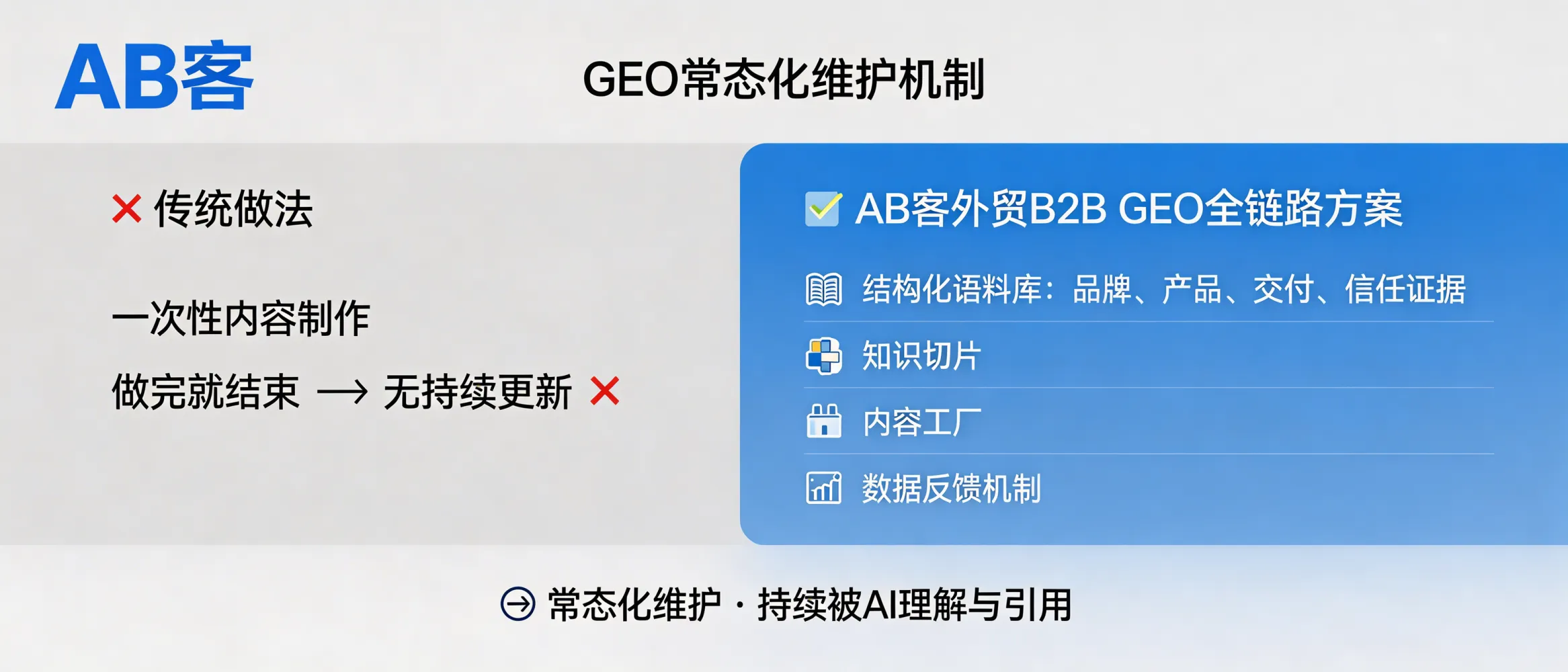
ABKE (AB客) treats GEO as an always-on knowledge infrastructure: your brand/product/delivery/trust evidence is modeled into a structured corpus, continuously updated through (1) knowledge slicing rules, (2) an AI content factory for multi-format publishing, and (3) a feedback loop that monitors AI recommendation/citation signals and iterates the corpus on a fixed cadence (weekly/monthly/quarterly). This is built for sustained “AI understanding and referencing,” not one-time content output.
Why GEO requires “always-on” maintenance (Awareness)
In the generative AI search workflow, buyers ask questions like “Who is a reliable supplier for this technical requirement?” instead of searching a single keyword. The answer quality depends on whether an AI system can retrieve, understand, and trust your enterprise knowledge. Therefore, a GEO corpus is not a static set of blog posts—it is a continuously updated knowledge base that supports AI reasoning and citation.
- Problem: One-off content quickly becomes outdated, inconsistent, or un-citable by AI systems.
- Requirement: A structured, versioned corpus + evidence chain + distribution footprint.
- Outcome: Higher probability of being understood and referenced when AI answers supplier-evaluation questions.
What ABKE continuously maintains (Interest)
ABKE’s B2B GEO full-chain solution maintains a structured enterprise corpus built from your:
1) Brand & Identity Knowledge
- Company profile, scope, positioning
- Key entities: brand names, product lines, use cases
2) Product & Solution Knowledge
- Specifications, configuration logic, selection constraints
- FAQs aligned to procurement decision questions
3) Delivery & Service Knowledge
- Delivery SOP, implementation steps, onboarding materials
- Project milestones and acceptance checkpoints
4) Trust Evidence Knowledge
- Verifiable proof points (case narratives, measurable outcomes when available)
- Compliance/credentials/partnership references (if provided by client)
Boundary: ABKE does not claim guaranteed placement in any AI model’s “top recommendation.” GEO is a probability game driven by knowledge clarity, evidence quality, and distribution coverage.
The maintenance mechanism: 3 loops + 1 cadence (Evaluation)
-
Loop A — Structured corpus updates (Knowledge Asset System)
Input: new products, new markets, updated positioning, revised delivery流程, new proof assets.
Process: normalize into structured fields (entities, relationships, claims, evidence links).
Output: versioned corpus ready for AI consumption. -
Loop B — Knowledge slicing refresh (Knowledge Slicing System)
Input: long-form pages, PDFs, presentations, product sheets, internal FAQs.
Process: atomize into “knowledge slices” (facts, constraints, definitions, decision rules).
Output: slices that can be re-used across FAQ/whitepaper/landing pages. -
Loop C — Content & distribution iteration (AI Content Factory + Global Distribution Network)
Input: prioritized slices + buyer-intent questions + target scenarios.
Process: generate multi-format assets (FAQ, explainers, technical notes) and distribute via owned & relevant external channels.
Output: persistent, indexable, and cross-referenced footprints supporting AI retrieval.
Recommended cadence (example)
- Weekly: add/adjust FAQs based on new inquiries and sales call notes; publish incremental slices.
- Monthly: refresh key solution pages; expand scenario libraries; update entity links.
- Quarterly: rebuild the “core narrative” set (positioning, differentiation, proof portfolio); audit outdated slices.
Cadence is finalized after project discovery (industry complexity, product update frequency, and sales cycle length).
Evidence principle: When a claim changes (e.g., delivery method, capability scope, supported scenarios), the associated slices and referenced pages must be updated together to avoid contradictions that reduce AI trust.
Risk controls buyers care about (Decision)
- Scope control: define what is included in “corpus maintenance” (product pages, FAQs, case pages, entity dictionary) vs. what is not (unlimited custom writing without inputs).
- Change management: any major positioning or offering change triggers a corpus version update and re-distribution plan.
- Consistency checks: avoid conflicting specs/claims across pages; contradictions reduce AI citation probability.
- Compliance: no fabricated certificates, test data, or customer names. Only client-provided, verifiable materials are structured and published.
Operational SOP and acceptance checkpoints (Purchase)
- Discovery → confirm buyer intent map and priority question set (what your customers ask AI).
- Corpus modeling → structure brand/product/delivery/trust evidence into maintainable modules.
- Slicing & publishing → convert modules into FAQ/solution pages/technical explainers.
- Distribution → publish through owned channels and relevant networks to build persistent retrievable signals.
- Iteration → run periodic updates based on feedback signals and business changes.
Acceptance idea (non-exhaustive): (a) corpus modules delivered and versioned, (b) knowledge slices produced and mapped to target intents, (c) content matrix published, (d) iteration plan scheduled.
Long-term value: compounding knowledge assets (Loyalty)
With always-on maintenance, every update adds to your enterprise’s “knowledge equity”: the structured corpus, slices, and distribution records become reusable digital assets. Over time, this reduces reliance on one-time campaigns and supports stable, repeatable acquisition from AI-led discovery.
- Reusable: slices can be reassembled into new pages and formats without rewriting from scratch.
- Traceable: versions and sources reduce contradictions and improve trust signals.
- Scalable: the same corpus supports SEO + GEO + social distribution consistently.
.png?x-oss-process=image/resize,h_100,m_lfit/format,webp)
.png?x-oss-process=image/resize,h_100,m_lfit/format,webp)

.png?x-oss-process=image/resize,h_100,m_lfit/format,webp)
.png?x-oss-process=image/resize,h_100,m_lfit/format,webp)
.png?x-oss-process=image/resize,h_100,m_lfit/format,webp)
.png?x-oss-process=image/resize,h_100,m_lfit/format,webp)
