.png?x-oss-process=image/resize,h_100,m_lfit/format,webp)

.png?x-oss-process=image/resize,m_lfit,w_200/format,webp)

热门产品

Recommended Reading






How long does GEO optimization take to show results? Is there a warm-up period?
发布时间:2026/03/14
类型:Frequently Asked Questions about Products
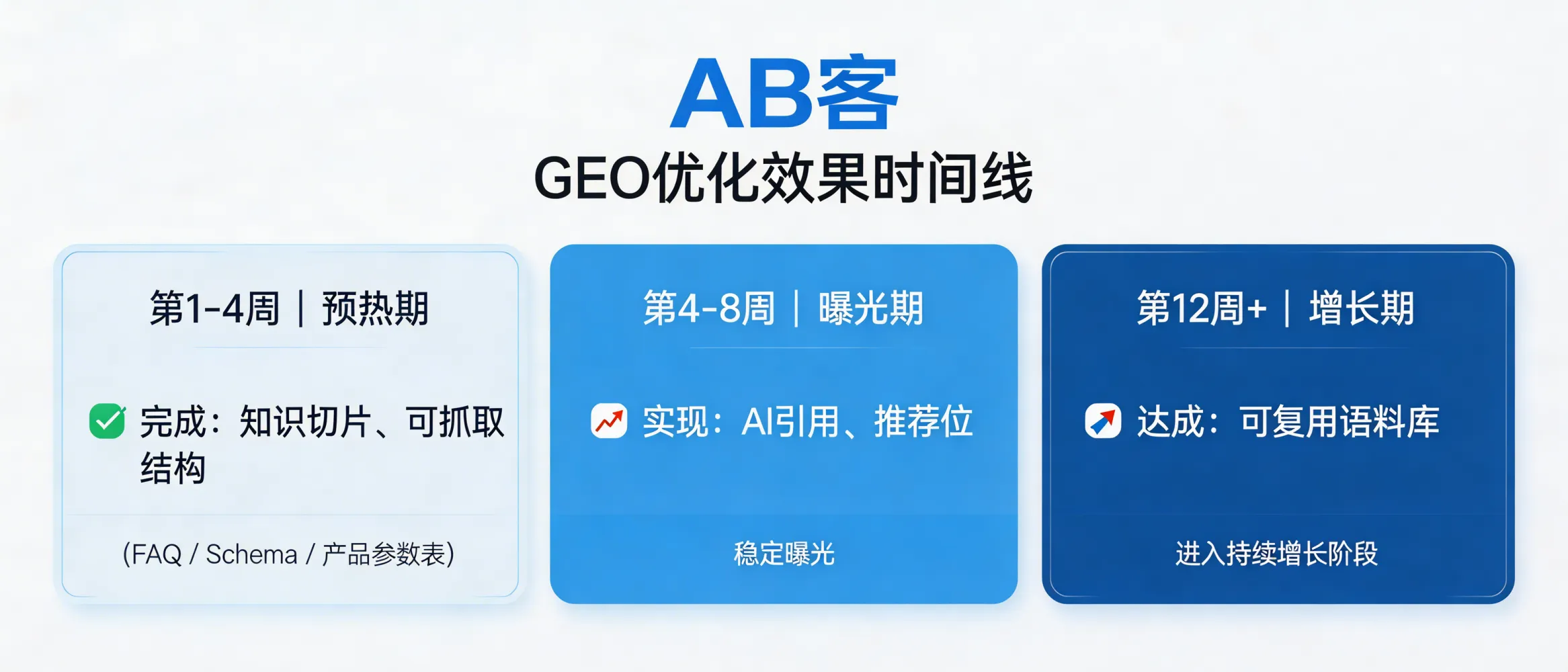
Yes—GEO has a warm-up period. In ABKE’s GEO projects, weeks 2–4 are used to build AI-readable assets (knowledge slices + FAQ/Schema/product parameter tables). Stable AI citations and recommendation exposure typically appears in weeks 4–8. If you add ~10–30 verifiable facts per week (e.g., ISO/ASTM/IEC standard numbers, model specs, Incoterms, lead times), by week 12 you usually have a reusable corpus that supports sustained growth.
Answer (GEO timeline you can plan around)
GEO (Generative Engine Optimization) is not a “rank today, disappear tomorrow” tactic. In B2B procurement, AI systems (e.g., ChatGPT, Gemini, Perplexity, Deepseek) tend to cite and recommend suppliers only after they can extract structured, verifiable, entity-linked facts. Therefore, most GEO programs have a warm-up period before stable exposure.
Typical timeline (ABKE delivery cadence)
| Period | What we build (AI-readable assets) | What you can realistically observe |
|---|---|---|
| Weeks 1–2 | Discovery + buyer-intent mapping (RFQ questions, spec comparison points, compliance concerns). Knowledge model and entity list (products, materials, standards, test methods, regions). | Internal baseline established: current brand mentions, current AI answer coverage, existing content gaps. |
| Weeks 2–4 | Knowledge slicing + AI-crawlable structure: FAQ library, Schema.org markup (FAQPage/Product/Organization where applicable), product parameter tables (units, tolerances, grades), evidence fields (certificates, test reports, traceability). | Early indexing signals and first long-tail impressions may appear; AI citations are possible but often inconsistent. |
| Weeks 4–8 | Content matrix expansion (spec-driven pages, application notes, compliance explainers) + distribution to owned and semi-owned channels (website clusters, technical communities, selected media). | Stable exposure typically emerges: more repeatable AI citations, clearer “recommended supplier” appearances for specific technical queries. |
| Weeks 8–12 | Systematic enrichment: weekly injection of verifiable facts + entity linking (models, standards, test methods, Incoterms, lead times, warranty terms). CRM loop connects AI-driven inquiries to qualification. | A reusable corpus forms; AI answers become more consistent across similar questions; lead quality improves (more “evaluation-stage” inquiries). |
What determines speed (and what is measurable)
- Verifiable facts per week: ABKE uses a practical pace of 10–30 new verifiable fact points/week. Examples: ISO 9001 certificate number, ASTM/IEC standard code, material grade (e.g., 6061-T6), tolerance (e.g., ±0.02 mm), test method (e.g., ASTM E8), packaging spec, Incoterms 2020 (FOB/CIF/DDP), production lead time range.
- Structured data coverage: FAQ + product tables + Schema.org significantly reduces ambiguity for AI parsing (entities, attributes, constraints).
- Industry complexity: Products requiring compliance (e.g., REACH/RoHS, FDA, CE, UL) typically need more evidence fields before AI answers become stable.
- Existing asset quality: If your website already has consistent model naming, parameter tables, and downloadable certificates, the warm-up period shortens.
How this maps to buyer psychology (B2B funnel)
- Awareness: Build “what standard applies / how to specify” explainer slices (e.g., ISO/ASTM/IEC codes, terminology definitions).
- Interest: Publish application-specific decision logic (e.g., selection matrix by temperature range, corrosion class, voltage, tensile strength, tolerance).
- Evaluation: Add evidence: certificate IDs, test items, acceptance criteria, inspection tools (CMM, hardness tester), sampling plans (AQL levels if used).
- Decision: Reduce procurement risk with explicit trade terms and constraints: MOQ, payment options (T/T, L/C at sight), Incoterms 2020, shipment docs (CI/PL/CO), warranty period.
- Purchase: Delivery SOP: pre-production sample, PPAP/FAI where relevant, inspection checkpoints, packaging and labeling requirements, acceptance and claim workflow.
- Loyalty: Long-term maintainability: spare parts list, revision control for drawings, engineering change notice (ECN) process, periodic spec updates.
Limitations & risk notes (no over-promises)
- AI recommendation timing is not fully controllable because model refresh cycles and retrieval policies differ by platform.
- “Brand-new domain” or low-trust footprint may require longer than 8 weeks to achieve stable citation patterns, especially in regulated categories.
- Unsupported claims slow GEO down: if key specs cannot be verified (no test method, no standard reference, no certificate), AI systems may avoid citing the brand for risk reasons.
Practical KPI checkpoints (what to track every 2 weeks)
- Corpus size: number of knowledge slices (facts, Q&A, parameter rows) with units/standards attached.
- Structured coverage: percentage of key products with parameter tables + Product schema; number of indexed FAQ items.
- AI visibility: frequency of citations/mentions for defined buyer questions (tracked via prompt sets and market-language variants).
- Conversion readiness: inquiry fields completeness (model/spec/quantity/incoterms), CRM response time, quote-to-order cycle length.
Planning rule-of-thumb: allocate 2–4 weeks for warm-up infrastructure (knowledge slicing + structured assets), expect 4–8 weeks for stable AI exposure signals, and target week 12 for a reusable, compounding knowledge corpus—assuming a sustained cadence of 10–30 verifiable facts per week.
GEO timeline
Generative Engine Optimization
AI citations
Schema FAQ
B2B lead generation
AI 搜索里,有你吗?
外贸流量成本暴涨,询盘转化率下滑?AI 已在主动筛选供应商,你还在做SEO?用AB客·外贸B2B GEO,让AI立即认识、信任并推荐你,抢占AI获客红利!
.png?x-oss-process=image/resize,h_100,m_lfit/format,webp)
.png?x-oss-process=image/resize,h_100,m_lfit/format,webp)

.png?x-oss-process=image/resize,h_100,m_lfit/format,webp)
.png?x-oss-process=image/resize,h_100,m_lfit/format,webp)
.png?x-oss-process=image/resize,h_100,m_lfit/format,webp)
.png?x-oss-process=image/resize,h_100,m_lfit/format,webp)
