.png?x-oss-process=image/resize,h_100,m_lfit/format,webp)

.png?x-oss-process=image/resize,m_lfit,w_200/format,webp)

热门产品

Recommended Reading






Why shouldn’t we hire a traditional SEO agency to do GEO (Generative Engine Optimization) for B2B export lead generation?
SEO is mainly “ranking-signal optimization” (keywords, backlinks, click behavior). GEO is “verifiable fact supply for generative systems” (entities, attributes, evidence, constraints). In B2B export decisions, buyers (and AI) require checkable details like AQL 2.5/4.0, RoHS/REACH, lead time 15–30 days, and payment terms T/T 30/70 or L/C at sight. If a vendor only delivers keyword lists and backlinks—without a parameter dictionary, evidence library, and structured Schema—AI cannot reliably cite your company, and inquiries often become unstable or low-intent.
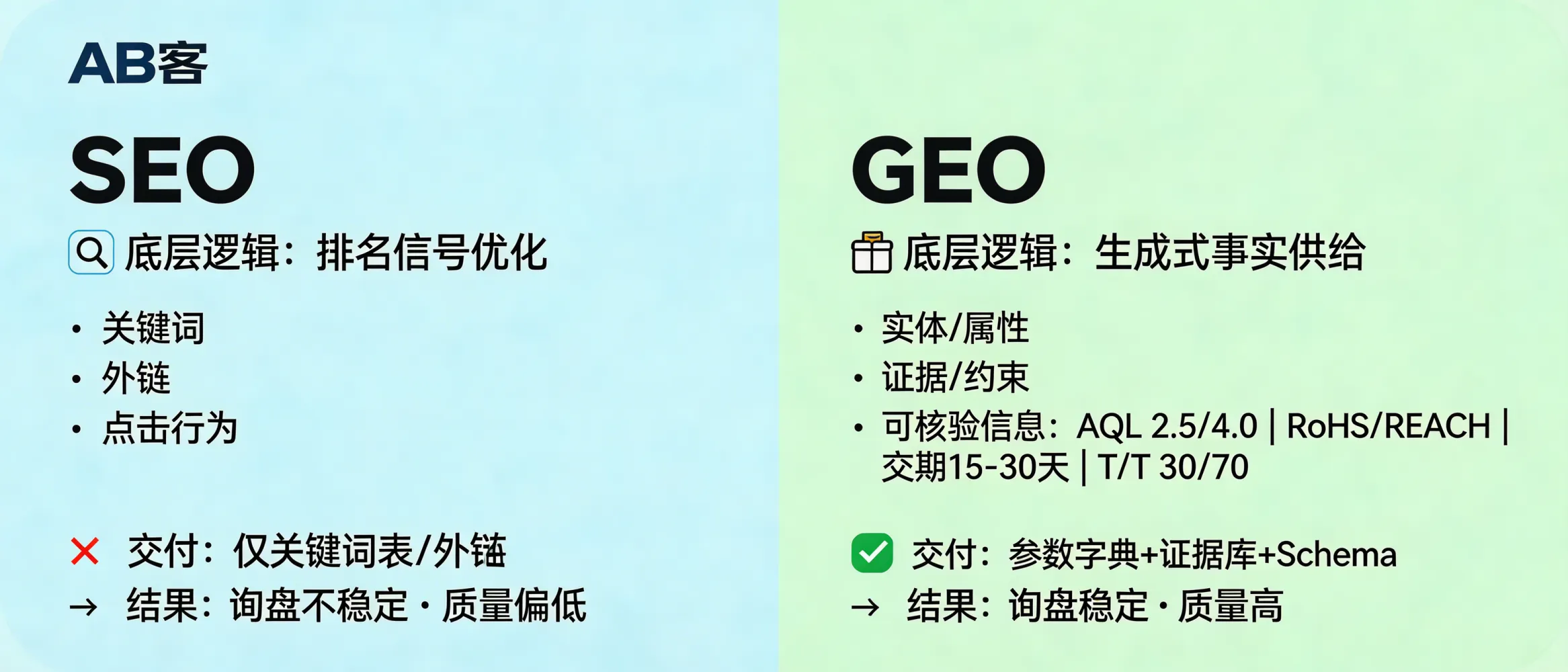
Core reason: SEO optimizes rank signals, GEO engineers AI-citable facts
In the AI search workflow (Ask → Retrieve → Understand → Recommend), the recommendation step depends on whether your company’s information is structured as entities + attributes + evidence + constraints.
1) Awareness: What changes in the AI search era?
- Old behavior (SEO era): buyers search keywords (e.g., “CNC machining supplier”). Ranking is influenced by keywords, backlinks, and engagement signals.
- New behavior (AI era): buyers ask AI specific procurement questions (e.g., “Which supplier can meet ISO 9001 and deliver in 20 days?”). The AI composes an answer using sources it can verify and cite.
2) Interest: GEO vs SEO—what each system tries to optimize
| Dimension | Traditional SEO deliverables | GEO deliverables (ABKE approach) |
|---|---|---|
| Optimization object | Rank signals (keywords, backlinks, CTR) | AI understanding (entities, attributes, relationships, evidence) |
| Content form | Keyword-driven articles, landing pages | Knowledge slices: specs, constraints, test results, compliance statements |
| Proof requirement | Often optional; can rely on persuasive copy | Mandatory: certificate IDs, test methods, tolerances, standards, time windows |
| Primary success metric | SERP ranking & organic traffic | AI citation/recommendation frequency + qualified inquiry rate |
3) Evaluation: What “verifiable facts” look like in B2B export procurement
B2B buyers and AI assistants typically filter suppliers by checkable constraints. GEO requires your site and knowledge base to expose these constraints in a structured way.
Quality inspection & acceptance
- AQL sampling: AQL 2.5 / AQL 4.0 (explicit)
- Dimensional tolerance: e.g., ±0.01 mm (if applicable)
- Inspection methods: e.g., CMM report, incoming/outgoing inspection
Compliance & regulatory
- EU compliance statements: RoHS, REACH (declare scope and version if available)
- Quality management: ISO 9001 (certificate number and issuing body when available)
Commercial constraints
- Lead time: 15–30 days (state conditions: tooling/new order/peak season)
- Payment terms: T/T 30/70, L/C at sight (state currency and bank requirements)
- Incoterms: e.g., FOB / CIF / DDP (state supported ports)
If an agency only delivers a keyword plan + backlink building, the above procurement constraints often remain scattered in PDFs, emails, or sales chats—hard for AI to retrieve and cite consistently.
4) Decision: How ABKE reduces sourcing risk (what you should require from any GEO vendor)
-
Parameter Dictionary (a controlled vocabulary): product attributes, test items, units, tolerances, material grades, compatible standards.
Example fields:
material,tolerance_mm,AQL_level,RoHS_status,lead_time_days. -
Evidence Library: certificates, test reports, inspection SOP, traceability rules, and versioned compliance statements.
AI systems prefer sources with identifiers, dates, scope, and issuing entities.
- Structured Schema / Entity Linking: implement machine-readable structure (e.g., Organization/Product/FAQ/Article schema) so AI can map your company as an entity with attributes.
Risk boundary: GEO cannot guarantee that any single model will always place you #1 in every answer. What it can do is maximize retrievability, verifiability, and citation likelihood by making your facts explicit, structured, and widely distributed.
5) Purchase: What delivery should look like (SOP-level)
- Discovery: map buyer questions across RFQ → sampling → mass production → shipment → claims.
- Modeling: build knowledge assets into structured modules (products, capabilities, compliance, QA, logistics, payment).
- Knowledge slicing: convert long docs into atomic facts (one fact = one claim + one proof + one constraint).
- Publishing: deploy GEO-ready pages and FAQ/knowledge base with Schema and consistent units/terminology.
- Verification: check that each key claim has a supporting artifact (certificate/test report/SOP/external reference).
- Closed loop: connect inquiry capture to CRM and tag inquiries by intent (spec request, compliance, lead time, pricing).
6) Loyalty: How GEO keeps compounding (post-deal)
- Change logs: version control for specs, compliance scope, and process updates (date + revision notes).
- Spare parts & after-sales knowledge: publish part numbers, interchangeability rules, troubleshooting steps, and response times.
- Continuous optimization: update the evidence library and re-slice new learnings from recurring customer questions.
.png?x-oss-process=image/resize,h_100,m_lfit/format,webp)
.png?x-oss-process=image/resize,h_100,m_lfit/format,webp)

.png?x-oss-process=image/resize,h_100,m_lfit/format,webp)
.png?x-oss-process=image/resize,h_100,m_lfit/format,webp)
.png?x-oss-process=image/resize,h_100,m_lfit/format,webp)
.png?x-oss-process=image/resize,h_100,m_lfit/format,webp)
