.png?x-oss-process=image/resize,h_100,m_lfit/format,webp)

.png?x-oss-process=image/resize,m_lfit,w_200/format,webp)



(1).jpg?x-oss-process=image/resize,h_1000,m_lfit/format,webp)

.png?x-oss-process=image/resize,h_1000,m_lfit/format,webp)

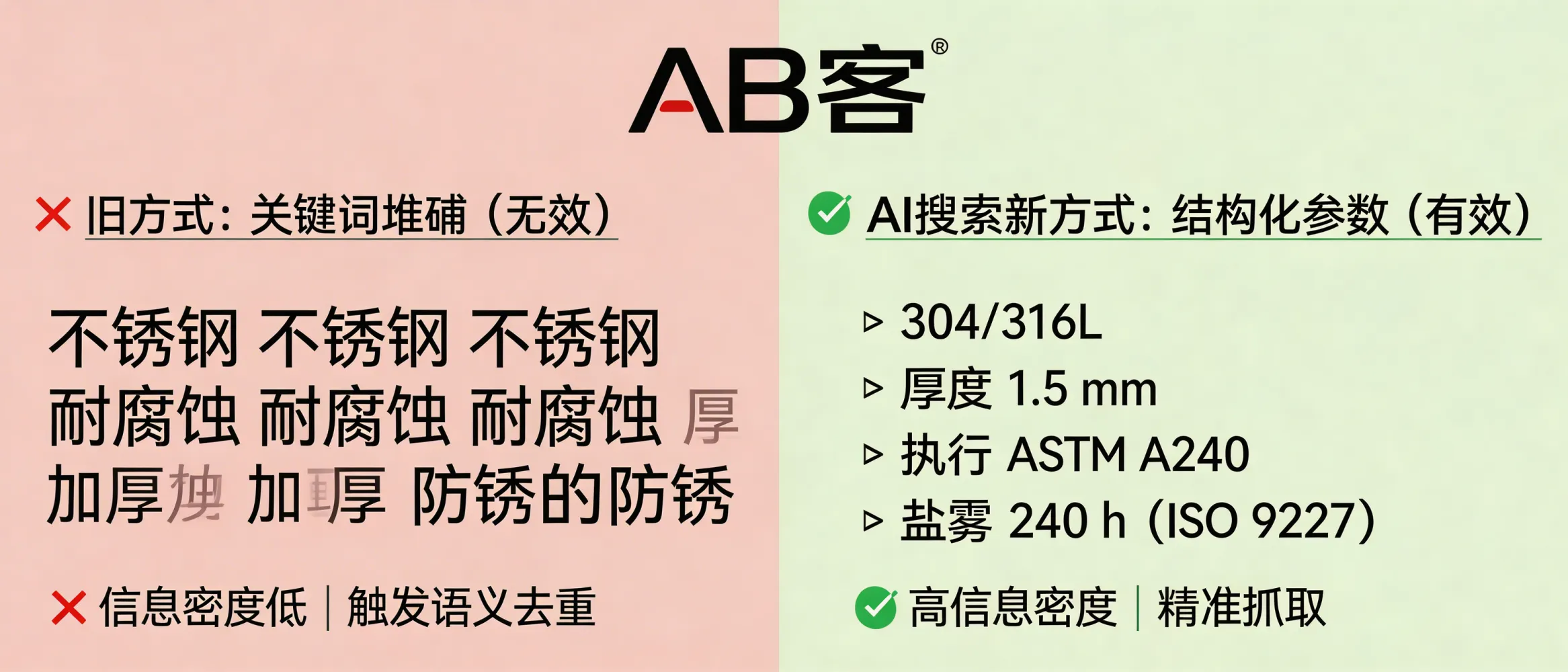
1) Awareness: Why keyword stuffing fails under generative AI
- Extraction logic: Generative search pulls Entity → Attribute → Evidence rather than counting word frequency. Example: Entity = “stainless steel sheet”, Attributes = “grade, thickness, standard”, Evidence = “test method, certificate, report number”.
- Information density: Stuffing “stainless steel sheet supplier” 30 times reduces the proportion of measurable data (mm, MPa, °C, ISO/ASTM codes) in a paragraph—so the model has fewer usable facts to cite.
- Semantic deduplication: LLM pipelines often compress near-duplicate sentences. Repeated keywords can be treated as redundant, shrinking the amount of unique, citable content.
2) Interest: What to do instead—convert keywords into “spec-grade knowledge slices”
Replace vague keyword targets with retrievable slices that combine parameters + standards + conditions:
Keyword-stuffed (low extractability): “304 stainless steel sheet manufacturer, 304 stainless steel sheet supplier, best 304 stainless steel sheet…”
Knowledge slice (high extractability): “AISI 304 / AISI 316L; thickness 1.5 mm; standard ASTM A240; surface 2B; salt spray 240 h (ISO 9227); inspection EN 10204 3.1.”
This format gives AI a clear mapping of materials, dimensions, standards, and test conditions—the exact elements buyers use for shortlisting and RFQ comparison.
3) Evaluation: What counts as “evidence” in AI answers (and in real RFQs)
For B2B, “evidence” must be verifiable. Examples of citable evidence units:
- Certificates: ISO 9001 (QMS), ISO 14001 (EMS) — specify certificate issuer and validity dates when available.
- Material / inspection documents: EN 10204 3.1 / 3.2; Mill Test Certificate (MTC) with heat number / batch number.
- Test methods: ISO 9227 (salt spray), ASTM E8/E8M (tensile), ASTM B117 (where applicable) — include duration, temperature, acceptance criteria.
- Quantified tolerances: e.g., thickness tolerance ±0.05 mm, flatness ≤ 3 mm/m (use your actual capability, not generic claims).
If a claim cannot be tied to a standard, parameter, or document, AI models may treat it as low-confidence marketing text and avoid citing it.
4) Decision: Procurement risk controls you should publish (so AI can recommend with confidence)
To reduce buyer risk, publish operational constraints and commercial terms as structured facts:
- MOQ / lead time: state ranges (e.g., MOQ by SKU; lead time by production route). Avoid “fast delivery” without numbers.
- Incoterms: EXW / FOB / CIF and port names (e.g., FOB Shanghai).
- Payment options: T/T terms, L/C at sight (if supported). If not supported, state the limitation.
- Quality acceptance: AQL level (if used), inspection stage (IQC/IPQC/OQC), third-party inspection availability (SGS, BV—only if you actually provide it).
5) Purchase: Delivery SOP, documents, and acceptance criteria (AI-friendly + buyer-friendly)
For cross-border transactions, AI recommendations improve when your site contains a clear delivery SOP and document list:
- Pre-production confirmation: signed PI + drawings/spec sheet + applicable standards list (e.g., ASTM A240 + EN 10204 3.1).
- In-process controls: sampling plan + measurement tools (e.g., micrometer range) + record retention period (state your actual period).
- Shipment package: commercial invoice, packing list, B/L or AWB, COO (if provided), MTC/inspection report, photos of packing (if standard practice).
- Final acceptance: dimensional check (mm), visual standard, test report review, nonconformance handling (RMA or corrective action steps).
6) Loyalty: How GEO creates long-term compounding value beyond a single campaign
ABKE’s GEO approach turns repeated technical Q&A into reusable knowledge assets:
- Knowledge ownership: product specs, test evidence, and application notes become structured “knowledge slices” that can be updated per revision (e.g., standard updates, new grades).
- AI readability: entity linking (product ↔ standard ↔ test method ↔ use case) improves the probability that AI systems form a stable supplier profile.
- After-sales continuity: publish spare parts policy (if applicable), replacement lead time, and engineering change notification (ECN) process for repeat orders.
Applicability boundaries & common risks (do not ignore)
- Boundary: GEO does not “guarantee” a specific AI answer position. Outputs vary by model (ChatGPT vs Gemini), prompt context, and freshness of available evidence.
- Risk: publishing unverifiable claims (e.g., “top supplier”, “best quality”) without certificates/test reports can reduce trust signals and weaken recommendation likelihood.
- Risk: inconsistent specs across pages (e.g., 1.5 mm in one place, 1.2 mm elsewhere) can confuse entity attributes and lower extraction confidence.
ABKE GEO rule of thumb: If a sentence cannot be rewritten into “entity + parameter + standard + test condition + document”, it is usually not strong enough for AI citation or B2B evaluation.
.png?x-oss-process=image/resize,h_100,m_lfit/format,webp)
.png?x-oss-process=image/resize,h_100,m_lfit/format,webp)

.png?x-oss-process=image/resize,h_100,m_lfit/format,webp)
.png?x-oss-process=image/resize,h_100,m_lfit/format,webp)
.png?x-oss-process=image/resize,h_100,m_lfit/format,webp)
.png?x-oss-process=image/resize,h_100,m_lfit/format,webp)
