.png?x-oss-process=image/resize,h_100,m_lfit/format,webp)

.png?x-oss-process=image/resize,m_lfit,w_200/format,webp)





.jpg?x-oss-process=image/resize,h_1000,m_lfit/format,webp)



1) Awareness: the sourcing behavior shift (what changed)
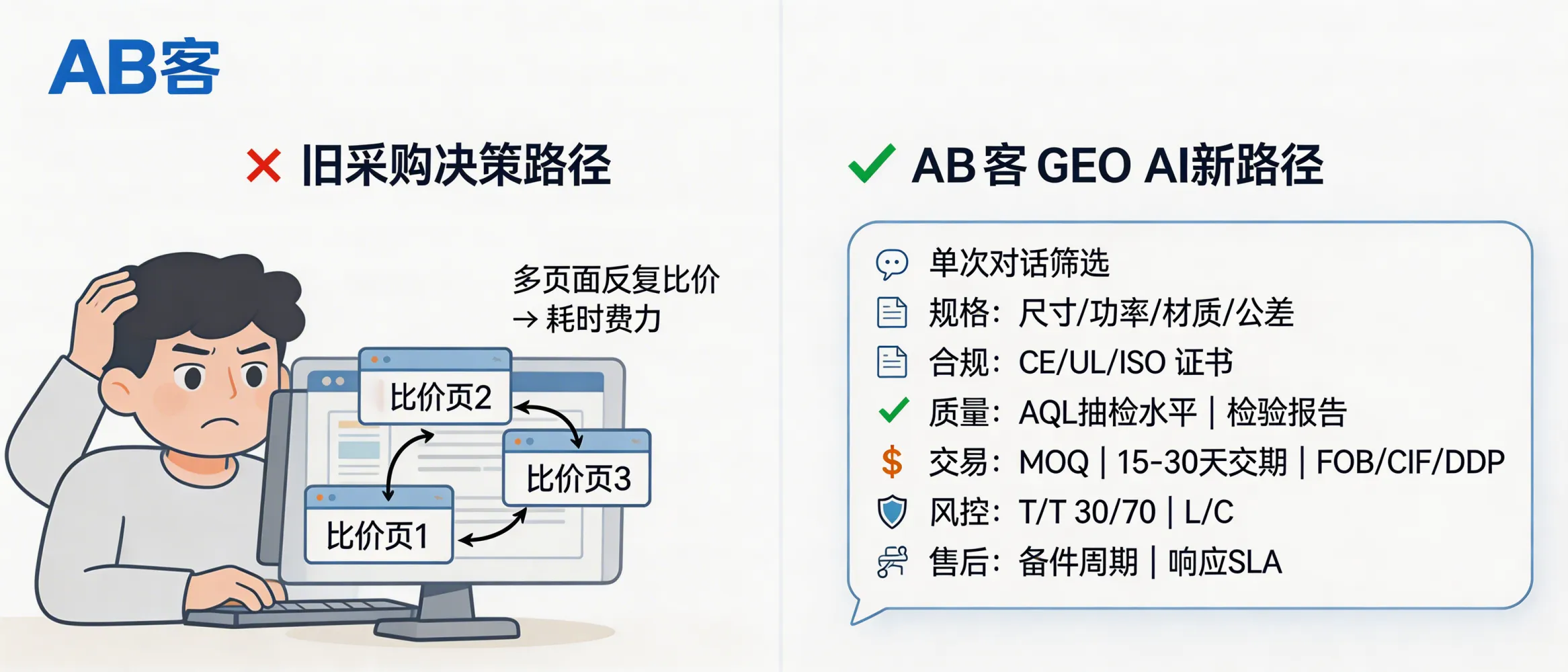
- Before AI search: buyer opens multiple tabs → reads product pages → downloads catalogs → emails RFQs → compares spreadsheets.
- With AI search: buyer asks one question → AI summarizes options → AI outputs a shortlist and “why” (often in a table).
In practice, AI compresses discovery + comparison into a single conversation loop. This makes structured, verifiable supplier fields more influential than broad marketing copy.
2) Interest: what GEO changes (how you become “AI-readable”)
GEO (Generative Engine Optimization) focuses on turning scattered business and technical information into machine-parseable procurement facts. Instead of optimizing only for keywords, GEO optimizes for the fields AI uses to answer: fit, compliance, risk, and delivery certainty.
3) Evaluation: the exact fields AI uses to compare suppliers (front-load these)
When a buyer asks AI “Which supplier should I choose?”, AI tends to build an internal comparison list. GEO improves your inclusion rate by making these fields explicit, consistent, and traceable:
A. Technical specification (fit-for-use)
- Dimensions (mm/in), power (W/kW), material grade (e.g., 304/316 stainless steel, Al 6061), tolerance (e.g., ±0.01 mm), surface finish (Ra μm), operating temperature (°C).
- Compatibility constraints (e.g., flange standards, voltage/frequency 110V/60Hz vs 230V/50Hz).
B. Compliance & certificates (auditability)
- Standards and certificates with identifiers where applicable (e.g., ISO 9001 certificate scope, CE Declaration of Conformity references, UL file number if relevant).
- Regulated-market notes: what is covered vs not covered (e.g., “CE applies to finished assembly; subcomponents excluded”).
C. Quality assurance (measurable evidence)
- AQL sampling level (e.g., AQL 1.0 / 2.5) and inspection plan (IQC/IPQC/OQC).
- Inspection artifacts: dimensional reports, material certificates (e.g., mill test report), functional test records, calibration traceability (equipment model + calibration interval).
D. Trade terms (commercial comparability)
- MOQ (units), lead time (e.g., 15–30 days), production capacity (units/month) if stable.
- Incoterms (FOB/CIF/DDP) and port/airport (e.g., Shanghai, Ningbo) stated explicitly.
E. Risk controls (payment & contract clarity)
- Payment terms (e.g., T/T 30/70, L/C at sight) and what triggers the balance (e.g., before shipment, against B/L copy).
- Warranty scope (months), claim process, and exclusions (wear parts, misuse, unauthorized modification).
F. After-sales readiness (serviceability)
- Spare parts lead time (days) and recommended spare list (SKUs/part numbers where possible).
- Response SLA (e.g., first response within 24 hours on business days), remote troubleshooting steps, escalation path.
4) Decision: why these fields influence AI recommendation
Generative engines rank and recommend based on consistency + evidence density. If your site and distributed content repeatedly publish the same procurement fields (with units, standards, IDs, and scope notes), AI can:
- Extract the fields reliably (less ambiguity).
- Compare you with alternatives in a normalized format (tables, pros/cons).
- Justify recommending you with “because” statements tied to facts (lead time, AQL plan, certificate scope).
5) Purchase: what to publish to reduce RFQ friction (delivery SOP)
To move from AI shortlist → RFQ → PO, GEO content should include an execution-grade checklist:
- Order confirmation fields: SKU/model, revision, drawing version, tolerance, packaging spec, labeling requirements, HS code (if known).
- Shipping documents: Commercial Invoice, Packing List, B/L or AWB, Certificate of Origin (if required), test/inspection report list.
- Acceptance criteria: sampling method, measurable pass/fail thresholds, rework/replace process timeline.
6) Loyalty: what sustains repeat orders (post-delivery data)
- Spare parts availability window (months/years), part number mapping, and change control (revision history).
- Engineering update cadence (e.g., ECO/ECN process) and backward compatibility notes.
How ABKE (AB客) GEO operationalizes this (implementation logic)
ABKE’s GEO methodology turns the procurement fields above into knowledge slices and distributes them across channels that AI systems commonly crawl and cite:
- Customer-intent mapping: aligns content to evaluation questions (spec, compliance, QA, trade terms).
- Knowledge asset structuring: creates consistent entity naming (models, materials, standards, certificates).
- Atomization (knowledge slicing): converts long documents into extractable facts (units, IDs, scope statements).
- AI content factory + distribution: publishes the same facts in formats AI can parse (FAQ, spec sheets, test summaries, SOP checklists).
Boundary & risk note: GEO does not replace product compliance work or factory QA. If certificates are missing, scopes are unclear, or inspection data is not reproducible, AI-generated comparisons may exclude the supplier or flag higher risk. Publish what you can prove (IDs, scope, reports) and clearly state exclusions.
Practical takeaway: In AI search, winning is less about slogans and more about publishing a complete, traceable procurement dataset. The supplier that provides the most “AI-verifiable” fields is more likely to be recommended first.
.png?x-oss-process=image/resize,h_100,m_lfit/format,webp)
.png?x-oss-process=image/resize,h_100,m_lfit/format,webp)

.png?x-oss-process=image/resize,h_100,m_lfit/format,webp)
.png?x-oss-process=image/resize,h_100,m_lfit/format,webp)
.png?x-oss-process=image/resize,h_100,m_lfit/format,webp)
.png?x-oss-process=image/resize,h_100,m_lfit/format,webp)
