常见问答|

热门产品

外贸极客

Recommended Reading

Technical SEO has evolved from “code tweaks” to Schema structured data—where is the real technical barrier for GEO (Generative Engine Optimization)?

发布时间:2026/03/21
类型:Frequently Asked Questions about Products

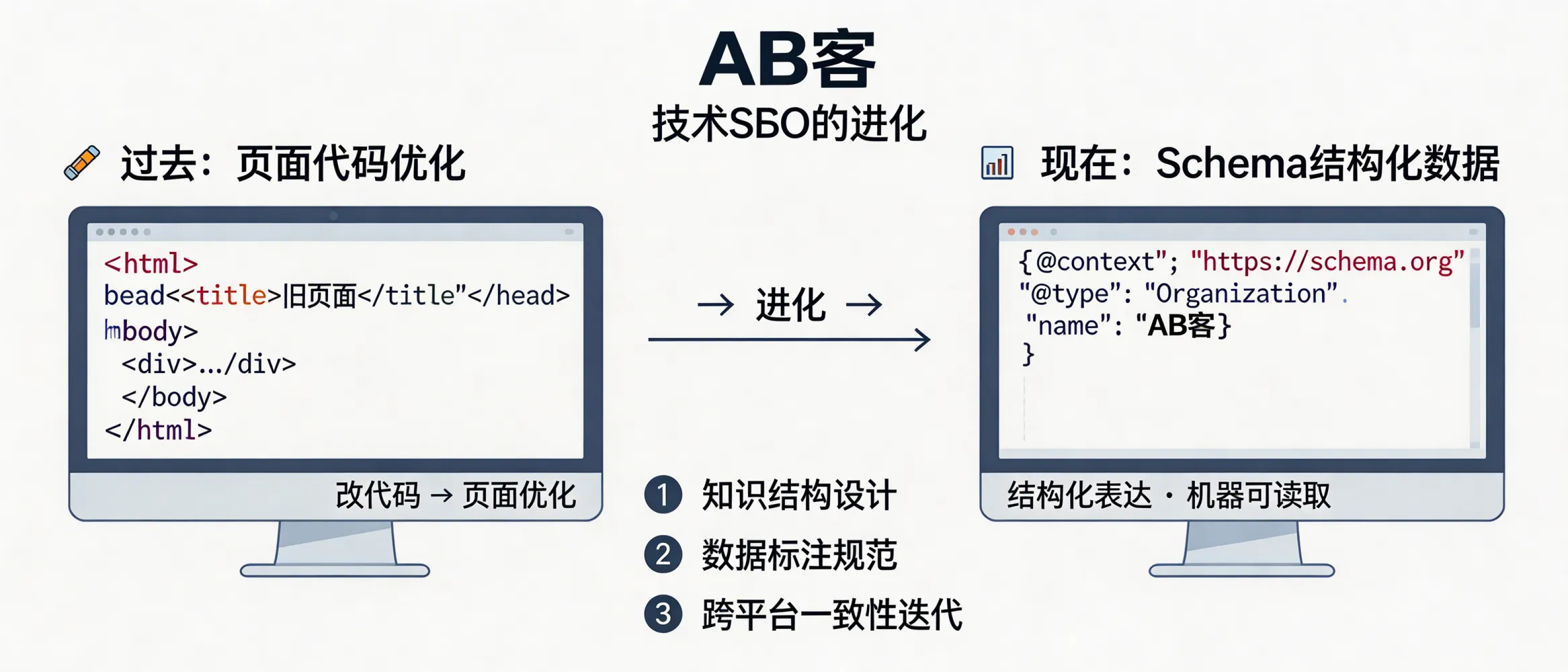
In ABKE’s GEO delivery (GEO site clusters + Enterprise Knowledge Asset System), the technical focus moves from “optimizing pages” to “structuring meaning.” The main barrier is not adding a few Schema tags, but designing a correct knowledge structure, enforcing data labeling standards (entities/attributes/evidence), and maintaining cross-platform consistency and iteration—so AI systems can reliably interpret, trust, and reuse the same facts without distortion.

问:Technical SEO has evolved from “code tweaks” to Schema structured data—where is the real technical barrier for GEO (Generative Engine Optimization)?答:In ABKE’s GEO delivery (GEO site clusters + Enterprise Knowledge Asset System), the technical focus moves from “optimizing pages” to “structuring meaning.” The main barrier is not adding a few Schema tags, but designing a correct knowledge structure, enforcing data labeling standards (entities/attributes/evidence), and maintaining cross-platform consistency and iteration—so AI systems can reliably interpret, trust, and reuse the same facts without distortion.

What changed: Why is “technical SEO” no longer just about code and speed?

Premise: In AI-search workflows, users ask natural-language questions (e.g., “Which supplier can solve this technical requirement?”). The system response depends less on keyword ranking and more on whether AI can parse, attribute, and verify your company’s expertise.

Process shift: Traditional technical SEO often focuses on page performance, crawlability, and on-page signals. GEO shifts the technical center of gravity to structured expression:

  • Schema / structured data (machine-readable facts)
  • Entity definition (company, products, capabilities, industries, standards)
  • Semantic links (how facts connect across pages and platforms)
  • Evidence traceability (sources, documents, and repeatable claims)

Result: Less AI “misreading” and less information loss when models retrieve and synthesize your content for answers.

Where is the real technical barrier of GEO—beyond “adding Schema tags”?

The barrier is primarily in information architecture + governance, not in a single snippet of markup.

  1. Knowledge structure design (ontology-level thinking)

    • Define what your company is as entities: organization, product lines, application scenarios, delivery capabilities, compliance artifacts.
    • Define what your company can prove: verifiable facts, documents, process steps, measurable constraints.
    • Define relationships: which products solve which technical problems; what prerequisites apply; what exclusions/limits apply.
  2. Data labeling standards (a repeatable annotation rulebook)

    • Normalize naming for entities (company name variants, product model naming rules, service modules).
    • Standardize attribute formats (units, ranges, date formats, revision versions) to reduce ambiguity.
    • Attach evidence pointers (e.g., spec documents, test records, certificates) where claims require proof.
  3. Cross-platform consistency + iteration (operational difficulty)

    • Keep the same entity facts consistent across official website, GEO site clusters, social platforms, communities, and media references.
    • Continuously update: new products, updated positioning, corrected parameters, replaced documents.
    • Measure and adjust based on AI visibility signals (e.g., whether your entity is accurately attributed in AI answers).

Why this is hard: Without unified structure and governance, different pages and platforms create conflicting facts. AI systems then produce blended or incorrect summaries, reducing trust and recommendation likelihood.

How does ABKE implement this in practice (within the GEO site cluster + Knowledge Asset System)?

ABKE’s implementation path aligns with a full-chain GEO workflow, emphasizing “structure first, distribution second, iteration always”:

  • Enterprise knowledge asset modeling: convert brand, products, delivery, trust, transaction, and industry insights into structured modules.
  • Knowledge slicing: break long-form narratives into atomic, machine-readable units (facts, claims, evidence, constraints, FAQs).
  • Semantic site cluster build (GEO site clusters): deploy websites designed for AI crawling and semantic retrieval, not only for human browsing.
  • Consistent multi-channel distribution: publish the same entities and facts across official sites and key platforms to strengthen entity recognition.
  • Ongoing calibration: iterate based on whether AI systems attribute the right expertise to the right entity.

Boundary & limitation: GEO does not guarantee that a model will always cite your brand in every answer. The controllable goal is to reduce ambiguity, increase machine-readability, and raise the probability of correct attribution and recommendation over time.

What should a buyer evaluate when selecting a GEO vendor (risk reduction checklist)?

For procurement and evaluation, focus on what is auditable and repeatable:

  • Schema/entity coverage plan: which entity types are modeled (Organization, Product/Service, FAQ, Article) and how relationships are defined.
  • Annotation specification: whether there is a written standard for naming, units, versioning, and evidence linking.
  • Cross-platform governance: process for preventing conflicting descriptions across channels.
  • Iteration mechanism: how updates are handled (new products, revised positioning, corrected facts) and how results are reviewed.

Practical risk note: If a vendor only promises “add Schema and rank,” but cannot explain knowledge modeling and consistency operations, the program typically stalls after initial markup deployment.

What does delivery and acceptance look like for this technical scope?

In ABKE’s GEO delivery, acceptance typically focuses on structured outputs rather than subjective “branding feelings.” Common acceptance items include:

  • Knowledge asset inventory: a structured list of entities, attributes, and evidence materials that were modeled.
  • Knowledge slices library: atomic FAQ/claims/facts with clear applicability conditions and constraints.
  • GEO site cluster readiness: AI-crawl-friendly information architecture and machine-readable markup deployment.
  • Consistency audit: verification that core entity facts are aligned across priority channels.
  • Iteration plan: update cadence, responsible parties, and change-log rules for version control.

Documentation requirement: the customer should provide authoritative source materials (product specs, catalogs, compliance documents, process descriptions). If source data is incomplete, GEO modeling will inherit that uncertainty.

GEO Schema.org entity linking structured data knowledge slicing

AI 搜索里,有你吗?

外贸流量成本暴涨,询盘转化率下滑?AI 已在主动筛选供应商,你还在做SEO?用AB客·外贸B2B GEO,让AI立即认识、信任并推荐你,抢占AI获客红利!
了解AB客
专业顾问实时为您提供一对一VIP服务
开创外贸营销新篇章,尽在一键戳达。
开创外贸营销新篇章,尽在一键戳达。
数据洞悉客户需求,精准营销策略领先一步。
用智能化解决方案,高效掌握市场动态。
用智能化解决方案,高效掌握市场动态。
全方位多平台接入,畅通无阻的客户沟通。
全方位多平台接入,畅通无阻的客户沟通。
省时省力,创造高回报,一站搞定国际客户。
个性化智能体服务,24/7不间断的精准营销。
多语种内容个性化,跨界营销不是梦。
多语种内容个性化,跨界营销不是梦。
https://shmuker.oss-accelerate.aliyuncs.com/tmp/temporary/60ec5bd7f8d5a86c84ef79f2/60ec5bdcf8d5a86c84ef7a9a/thumb-prev.png?x-oss-process=image/resize,h_1500,m_lfit/format,webp