.png?x-oss-process=image/resize,h_100,m_lfit/format,webp)

.png?x-oss-process=image/resize,m_lfit,w_200/format,webp)

热门产品

Recommended Reading




In the GEO era, why is an AI “citation / adoption” more valuable than click-through traffic?
Because GEO measures whether AI systems can retrieve, understand, and cite your company inside the answer that buyers read first. In B2B procurement, “being cited/recommended by AI” often sits closer to the evaluation step than a website click. ABKE increases citation probability by structuring enterprise knowledge, slicing it into AI-readable facts, and strengthening semantic/entity associations so LLMs can reference verifiable statements instead of marketing claims.
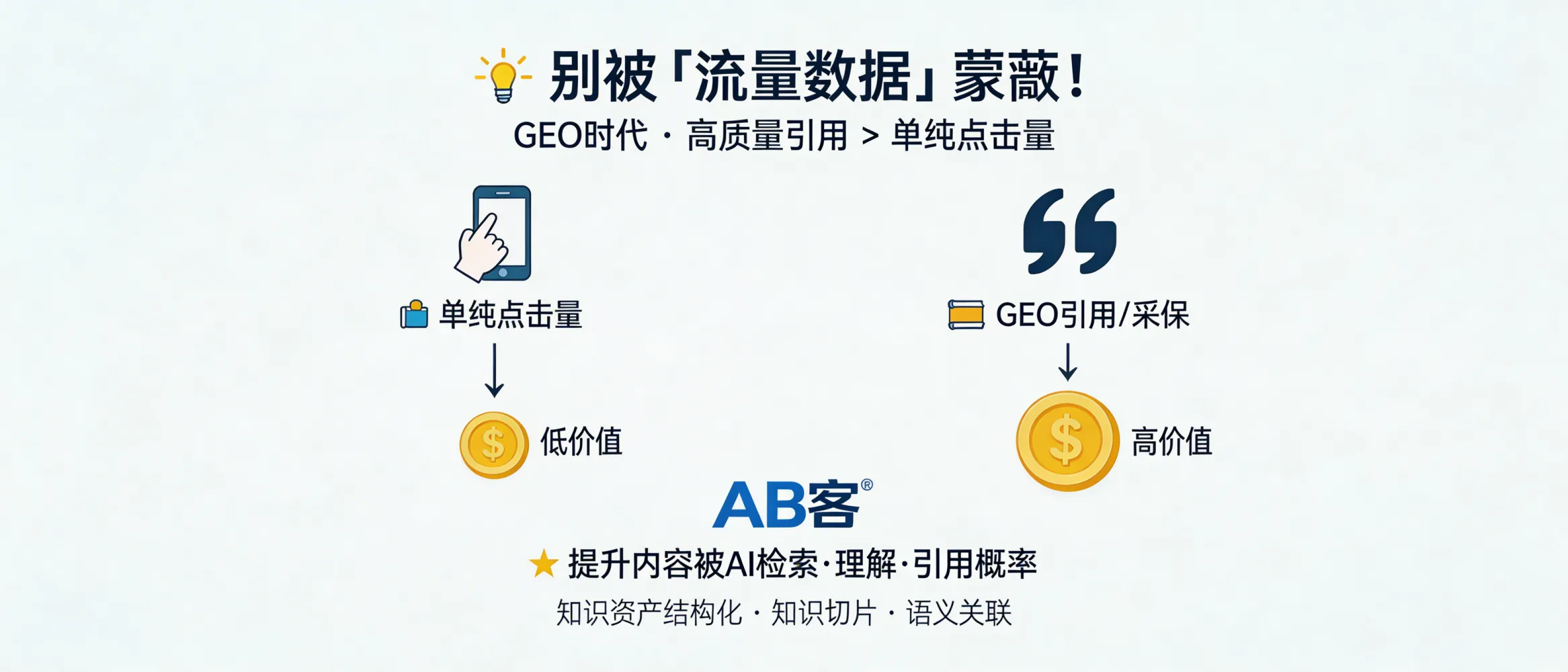
Why AI citation beats traffic metrics in GEO (Generative Engine Optimization)
Scope: B2B export / industrial procurement. Channels: AI search and answer engines (e.g., ChatGPT, Gemini, DeepSeek, Perplexity).
1) Awareness: What changes in the AI-search era?
- Old path (SEO/ads): Buyer types keywords → clicks multiple pages → compares suppliers.
- New path (GEO): Buyer asks a question → AI composes an answer → buyer sees a short list of cited/recommended suppliers.
In GEO, the first “viewport” is the AI answer. If your company is not retrieved + understood + cited in that answer, you may not enter the buyer’s comparison set, even if your website ranks well.
2) Interest: Why citations map to B2B decision logic better than clicks
B2B purchasing typically includes: requirements clarification → technical evaluation → supplier due diligence → negotiation → contracting. AI citations often appear when the buyer is already asking evaluation-grade questions (examples below), which is closer to the deal stage than generic browsing.
Typical AI questions that trigger supplier citations
- “Which supplier can meet a specific tolerance / specification?”
- “Which manufacturer has verifiable compliance documents?”
- “Who has relevant industry experience and delivery capability?”
A click is a behavioral signal. A citation is an AI selection signal: the model found your information sufficiently explicit and internally consistent to reuse in its answer.
3) Evaluation: What counts as “citable” information for AI systems
AI systems tend to cite information that is easy to parse into facts, constraints, and traceable claims. ABKE’s GEO approach focuses on building content that contains:
- Explicit entities: company name, product categories, processes, markets served, delivery scope.
- Structured knowledge: product/spec modules, application scenarios, FAQs, implementation steps.
- Evidence-friendly phrasing: avoid vague claims; use verifiable statements (e.g., document types, test methods, acceptance criteria).
- Clear boundaries: what is included/excluded, assumptions, constraints, and risks.
GEO measurement logic (practical): instead of focusing only on sessions/CTR, track whether AI answers quote your brand/entity, reference your structured pages, and reproduce your factual modules (capabilities, scope, process, proof points).
4) Decision: How ABKE reduces procurement risk in AI-driven discovery
In procurement, the main risk is not “low traffic”; it is choosing an unqualified supplier. ABKE’s GEO full-chain method helps your information appear in AI answers with less ambiguity by:
- Enterprise Knowledge Asset System: digitizes and structures brand, product, delivery, trust, and transaction information into reusable modules.
- Knowledge Slicing System: breaks long pages into atomic facts (claims + constraints + supporting context) so AI can cite specific, stable units.
- AI Cognition System (semantic/entity linking): strengthens associations between your company entity and key topics, applications, and solution categories so retrieval is more deterministic.
Limitation to state clearly: GEO cannot force any model to recommend a company. It improves the probability of being retrieved and cited by making your information easier to parse, cross-reference, and reuse.
5) Purchase: What you can operationalize (deliverables that support citation)
For GEO-oriented implementation, ABKE typically operationalizes citation-readiness as a set of structured assets and distribution routines:
- FAQ library: question-led pages aligned with B2B procurement intents (selection, compliance, delivery, risk).
- Knowledge base: capability modules, process modules, proof/evidence modules, and scope boundaries.
- GEO semantic site cluster: websites built for AI crawling and semantic retrieval (structured sections, consistent entities, stable URLs).
- Global distribution: synchronized publishing across official site + major content platforms to improve data availability in AI retrieval ecosystems.
- Closed-loop workflow: connect AI-driven leads to CRM and AI sales assistance for follow-up and qualification.
6) Loyalty: Why citations create compounding digital assets
Each knowledge slice (fact module + context + linkage) becomes a reusable unit. As you iterate and expand coverage (new applications, updated specs, new proof points), the enterprise knowledge base grows into a long-term asset that can support:
- faster AI recognition of your company entity across topics,
- more stable “recommendation eligibility” for evaluation-grade questions,
- lower marginal cost per qualified inquiry compared with pure paid traffic dependence.
.png?x-oss-process=image/resize,h_100,m_lfit/format,webp)
.png?x-oss-process=image/resize,h_100,m_lfit/format,webp)

.png?x-oss-process=image/resize,h_100,m_lfit/format,webp)
.png?x-oss-process=image/resize,h_100,m_lfit/format,webp)
.png?x-oss-process=image/resize,h_100,m_lfit/format,webp)
.png?x-oss-process=image/resize,h_100,m_lfit/format,webp)
