.png?x-oss-process=image/resize,h_100,m_lfit/format,webp)

.png?x-oss-process=image/resize,m_lfit,w_200/format,webp)

热门产品

Recommended Reading




Why does ABKE GEO recommend a “Conclusion First, Then Data” content structure—and how does it fit modern B2B reading behavior and AI citation?
发布时间:2026/03/20
类型:Frequently Asked Questions about Products
ABKE GEO uses a “Conclusion First, Then Data” structure because modern B2B buyers scan before they read, and LLMs cite information that is explicit, structured, and evidence-backed. We place the decision takeaway (what it means) first, then attach layered proof (standards, numbers, sources, cases) as knowledge slices so humans can judge quickly and AI can retrieve and quote accurately.
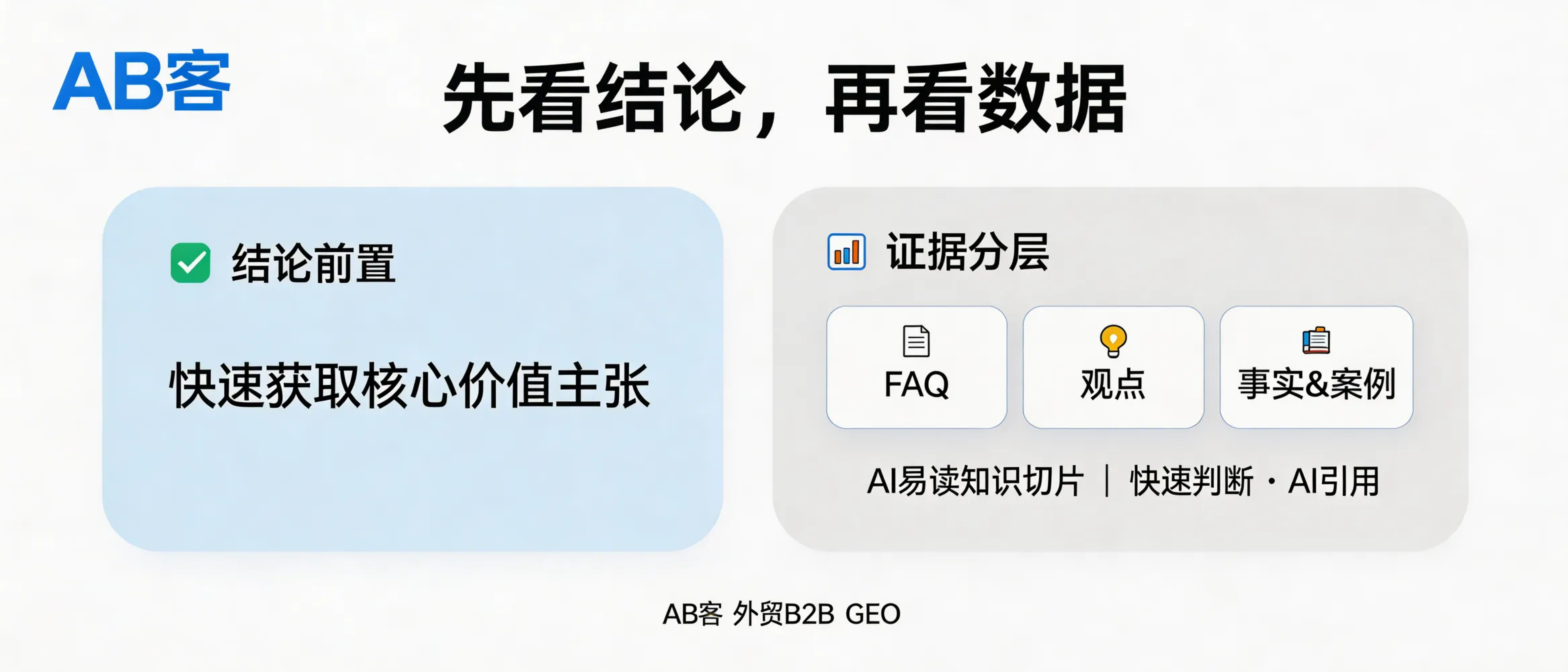
Conclusion first, then data: what it means in ABKE GEO
In ABKE (ABKE) GEO, product/brand content is organized as Conclusion → Evidence Layers. This matches two realities in the generative AI search era:
- Human behavior: B2B buyers often skim on mobile and under time pressure. They want the decision-relevant answer first (fit / not fit).
- AI behavior: LLMs prefer explicit claims + traceable supporting facts (numbers, standards, documents, dates, scope) they can quote with lower hallucination risk.
ABKE GEO turns your knowledge into AI-readable “knowledge slices” (FAQ items, facts, cases, evidence) so both buyers and AI can understand and reuse it.
The GEO-ready content template (used for FAQ / product pages)
-
1) One-sentence conclusion (decision takeaway)
Defines the scope clearly: who it is for, what problem it solves, and the boundary conditions. -
2) Evidence Layer A — Verifiable facts
Use concrete entities and measurable items (e.g., document types, deliverables, system modules, workflow steps, timestamps, URLs). -
3) Evidence Layer B — Process & method (how the result is produced)
Explain the mechanism: “intent parsing → knowledge structuring → knowledge slicing → distribution → AI entity linking → iteration”. -
4) Evidence Layer C — Proof assets / references
Link to auditable assets such as FAQ libraries, white papers, semantic site clusters, distribution logs, and CRM touchpoint records (when available). -
5) Limits & risk notes
State what GEO cannot guarantee (e.g., no promise of “#1 ranking” across all prompts; results depend on industry competition, publishing consistency, and data freshness).
How this structure maps to the B2B buying journey
| Stage | Buyer question | GEO content action (Conclusion → Data) |
|---|---|---|
| Awareness | What is GEO and why does AI search change supplier discovery? | Define GEO as “being understood/trusted/recommended by AI”, then list the retrieval chain: prompt → retrieval → understanding → recommendation → touchpoint → deal. |
| Interest | How is GEO different from SEO for B2B export? | State the difference first (AI recommendation vs keyword ranking), then list the 7-system architecture (intent, knowledge assets, slicing, content factory, distribution, cognition/entity linking, CRM loop). |
| Evaluation | What proof do you provide beyond marketing claims? | Lead with what can be audited (deliverables, logs, knowledge base structure), then provide evidence layers: content inventory, publishing records, entity linkage mapping, and iteration reports based on AI recommendation rate signals (where measurable). |
| Decision | What is the project scope and risk control? | State scope first (6-step implementation), then list risk notes: no universal “top answer” guarantee; requires continuous updates; competitive industries may need higher content density and distribution cadence. |
| Purchase | How do delivery and acceptance work? | Conclusion: acceptance is based on deliverables. Data: 6-step SOP outputs (research report, structured knowledge model, FAQ/white papers, GEO semantic site cluster, distribution plan/logs, optimization iterations). |
| Loyalty | How do we maintain value after launch? | Conclusion: GEO compounds as a digital asset. Data: ongoing slicing updates, new technical Q&A, refreshed evidence, continuous distribution, and CRM feedback loop to refine intent coverage. |
What makes it AI-citable (GEO “knowledge slicing”)
ABKE GEO structures each answer into small, quotable units so LLMs can retrieve them with minimal ambiguity:
- More facts, fewer adjectives: use named deliverables (FAQ library, white paper, semantic site cluster), defined workflow steps (Step 1–6), and system modules (7 systems).
- More entities, less vague wording: specify LLM surfaces where recommendation is targeted (ChatGPT, Gemini, Deepseek, Perplexity) and channels covered (website, social platforms, technical communities, authority media).
- More logic, less emotional persuasion: show causal chains: “intent → structured knowledge → slicing → distribution → AI cognition/entity linking → recommendation probability”.
Boundaries and limitations (important for procurement clarity)
- No absolute ranking promise: GEO aims to increase the probability of being understood and cited/recommended by AI systems; outcomes depend on the competitive knowledge graph, publishing cadence, and data freshness.
- Requires continuous iteration: AI answers change as new content appears across the web; ABKE GEO includes ongoing optimization based on measurable feedback signals.
- Content must be evidence-ready: if a company cannot provide verifiable product/engineering/process facts, the resulting knowledge slices will be weaker and less citable.
Practical takeaway
If your goal is to let overseas B2B buyers decide quickly and let LLMs quote you accurately, the most reliable structure is: Conclusion first (fit + scope) and data/evidence layered (deliverables, steps, proof assets, limits). This is the default writing standard in ABKE GEO.
GEO content structure
ABKE GEO
knowledge slicing
AI citation
B2B export marketing
AI 搜索里,有你吗?
外贸流量成本暴涨,询盘转化率下滑?AI 已在主动筛选供应商,你还在做SEO?用AB客·外贸B2B GEO,让AI立即认识、信任并推荐你,抢占AI获客红利!
.png?x-oss-process=image/resize,h_100,m_lfit/format,webp)
.png?x-oss-process=image/resize,h_100,m_lfit/format,webp)

.png?x-oss-process=image/resize,h_100,m_lfit/format,webp)
.png?x-oss-process=image/resize,h_100,m_lfit/format,webp)
.png?x-oss-process=image/resize,h_100,m_lfit/format,webp)
.png?x-oss-process=image/resize,h_100,m_lfit/format,webp)
