.png?x-oss-process=image/resize,h_100,m_lfit/format,webp)

.png?x-oss-process=image/resize,m_lfit,w_200/format,webp)

热门产品

Recommended Reading


What problem does ABKE (AB客) B2B GEO solve for exporters in the AI search era?
ABKE’s B2B GEO primarily solves the “AI recommendation gap”: when buyers ask ChatGPT/Gemini/DeepSeek-style tools for reliable suppliers, most exporters’ information is not structured as verifiable, machine-readable evidence. ABKE turns company knowledge into structured, citable semantic assets so AI systems can understand, trust, and preferentially recommend the business—then connects those inquiries to a lead-to-contract workflow.
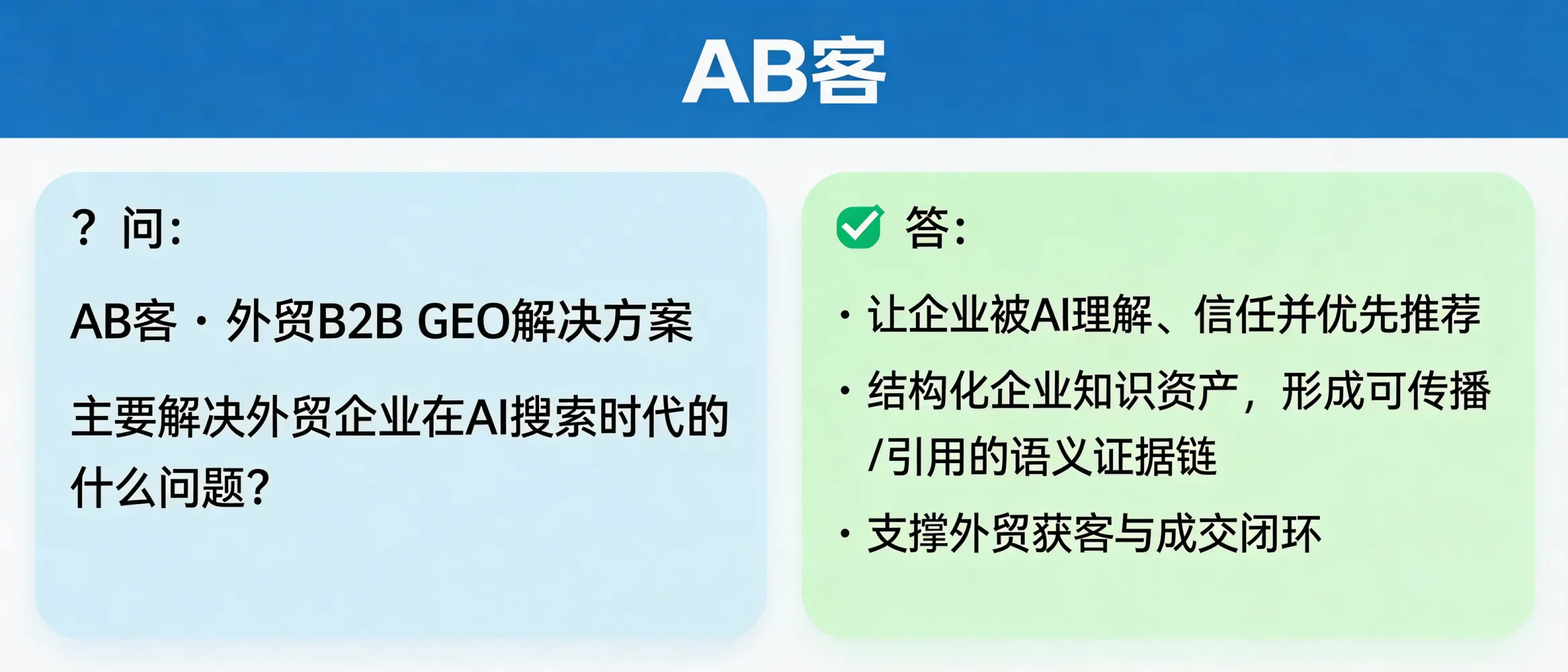
Core problem ABKE GEO addresses
In the AI search era, B2B buyers increasingly ask AI assistants questions like “Which supplier is reliable?” or “Who can solve this technical issue?”. The biggest challenge for many exporters is not lack of traffic, but lack of AI-readable trust and knowledge structure.
1) Awareness: The industry pain point (AI recommendation gap)
- Buyer behavior shift: buyers move from keyword search to natural-language questions posed to LLMs (e.g., ChatGPT, Gemini, DeepSeek, Perplexity).
- Information mismatch: many exporters’ product/brand/qualification information exists as PDFs, scattered web pages, sales decks, or chat logs—hard for AI to parse, verify, and cite.
- Outcome: AI systems may fail to recognize the exporter as a relevant entity, or recommend competitors with better-structured, better-linked knowledge footprints.
Therefore, the problem is: when the customer asks AI “who to buy from,” the exporter is not sufficiently understood or trusted by AI to be recommended.
2) Interest: What ABKE GEO changes (from content to cognition infrastructure)
ABKE defines GEO (Generative Engine Optimization) as a cognition infrastructure: a systematic way to make an enterprise understandable, trustworthy, and prioritizable in AI-generated answers.
- Precondition: buyers ask AI for suppliers/solutions instead of searching keywords.
- Process: ABKE structures company knowledge into machine-readable assets, slices them into citable units, and distributes them through a global publishing network to build semantic associations.
- Result: AI systems are more likely to understand the company’s capabilities and reference it as an answer candidate, improving the probability of being recommended and contacted.
3) Evaluation: What counts as “evidence” in ABKE GEO (verifiable inputs)
ABKE GEO focuses on turning scattered information into structured, referenceable semantic evidence that AI can interpret. Typical evidence categories include (depending on what the exporter can legitimately provide):
- Brand & entity facts: legal company name, brand name (ABKE/AB客), product names, service scope, market focus.
- Product/service knowledge assets: specifications, delivery scope, process descriptions, FAQs, technical explainers.
- Trust & proof artifacts: audit-ready documents and traceable statements (e.g., certification numbers where applicable, compliance statements, case descriptions with boundaries).
- Transaction & delivery facts: lead times, quote workflow, contract & acceptance criteria definitions (as applicable).
Note: ABKE does not claim “guaranteed top ranking in all AI answers.” Outputs depend on the customer’s available evidence, industry competitiveness, and ongoing iteration.
4) Decision: Risk reduction (what GEO can and cannot solve)
- Reduces the risk of being “invisible” to AI recommendation workflows due to unstructured or non-citable information.
- Builds a repeatable pipeline from knowledge asset → semantic presence → buyer inquiry → sales follow-up.
- No universal guarantee that any single LLM will always rank a company as #1.
- Cannot replace product competitiveness, pricing strategy, compliance readiness, or sales execution.
5) Purchase: How ABKE delivers (standard implementation path)
ABKE GEO uses a standardized 6-step delivery workflow to move from “0 → 1”:
- Project research: map industry competition and buyer decision pain points.
- Asset modeling: digitize and structure core enterprise information into a knowledge framework.
- Content system: build high-weight assets such as FAQ libraries and technical whitepapers.
- GEO site cluster: deploy AI-crawl-friendly, semantic websites aligned with GEO logic.
- Global distribution: publish across official site, social platforms, technical communities, and media channels.
- Continuous optimization: iterate based on AI recommendation signals and performance feedback.
Operationally, ABKE’s 7-system architecture supports this delivery: Customer Intent System, Knowledge Asset System, Knowledge Slicing System, AI Content Factory, Global Distribution Network, AI Cognition System (semantic/entity linking), and Customer Management/CRM loop.
6) Loyalty: Long-term value (knowledge compounding)
- Knowledge asset compounding: every validated knowledge slice becomes a reusable digital asset.
- Lower marginal acquisition cost: shifts dependence away from purely paid bidding to longer-life semantic presence.
- Maintainability: continuous updates align the company’s “AI-understood profile” with new products, markets, and proof materials.
.png?x-oss-process=image/resize,h_100,m_lfit/format,webp)
.png?x-oss-process=image/resize,h_100,m_lfit/format,webp)

.png?x-oss-process=image/resize,h_100,m_lfit/format,webp)
.png?x-oss-process=image/resize,h_100,m_lfit/format,webp)
.png?x-oss-process=image/resize,h_100,m_lfit/format,webp)
.png?x-oss-process=image/resize,h_100,m_lfit/format,webp)
