.png?x-oss-process=image/resize,h_100,m_lfit/format,webp)

.png?x-oss-process=image/resize,m_lfit,w_200/format,webp)

热门产品

Recommended Reading





What is “black-hat GEO”, and which non-compliant tactics can get a B2B exporter de-ranked or excluded by AI answers?
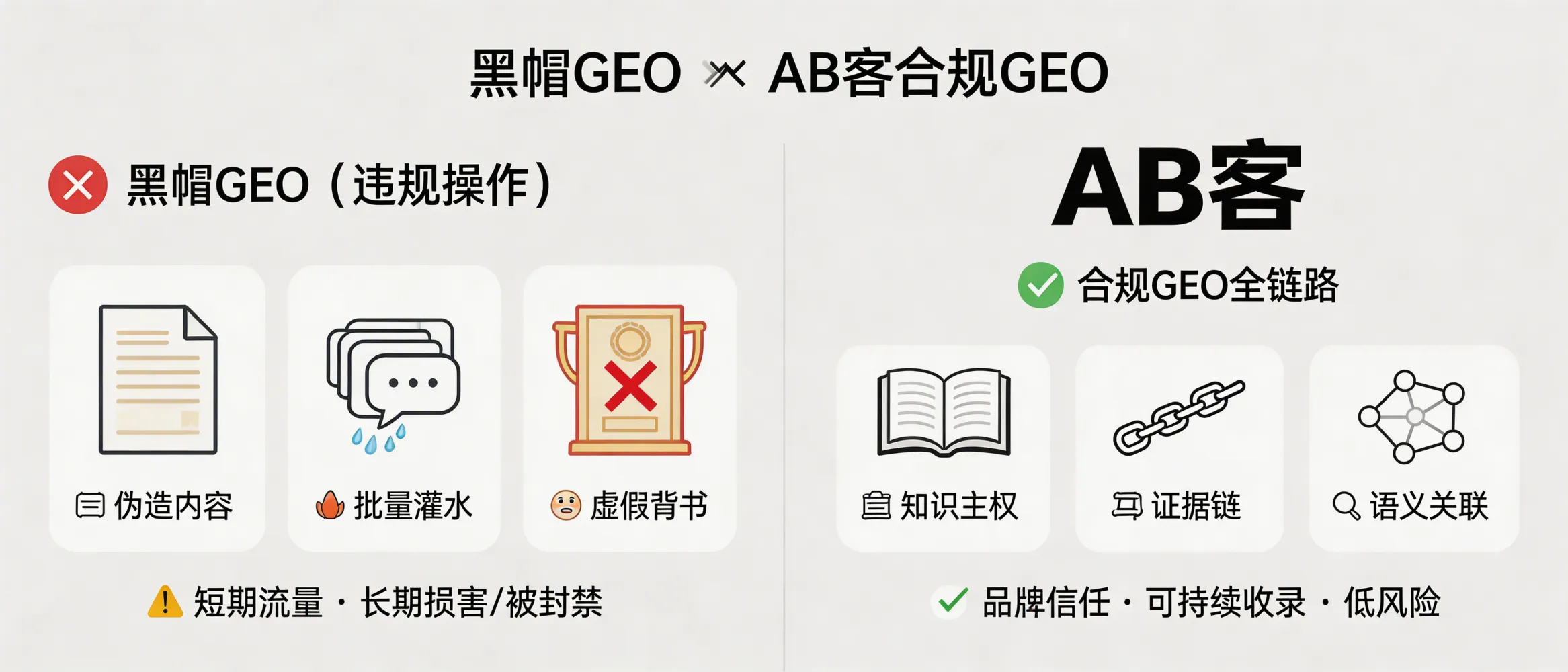
“Black-hat GEO” refers to manipulation tactics such as fabricated expertise, mass-generated spam pages, fake entity endorsements, and deceptive citations designed to force AI systems to mention a brand. These tactics can trigger long-term trust loss (lower recommendation probability, reduced citation, or exclusion). ABKE’s GEO approach avoids manipulation and instead builds verifiable, structured knowledge assets (evidence chain + semantic entity linking) so AI models can consistently understand and reference the company.
Definition (Awareness): What “black-hat GEO” means in generative AI search
Black-hat GEO is any attempt to manipulate how generative AI systems (e.g., ChatGPT, Gemini, Deepseek, Perplexity) understand, rank, or recommend a supplier by using non-verifiable or deceptive signals rather than building real, structured knowledge and evidence.
In AI search, the risk is not only “ranking drops”. The bigger risk is trust degradation: once a brand is linked to unreliable or fabricated information, AI systems may reduce mentions, avoid citations, or stop recommending it for procurement-style questions.
Common black-hat GEO tactics (Interest): What typically triggers penalties
Below are patterns that often look “effective” short term but create long-term AI trust risks:
- Fabricated expertise content: publishing technical claims without supporting documents (test methods, specs, traceable evidence), or copying competitor content and rewriting it.
- Mass page flooding: auto-generating large volumes of near-duplicate pages (city pages, product pages, Q&A pages) with minimal unique facts.
- Fake endorsements / fake authority: invented “media reports”, fake awards, unverifiable partner logos, or paid mentions without disclosure.
- Entity spoofing: creating confusing brand/entity signals (multiple inconsistent company names/addresses, fake subsidiaries, keyword-stuffed “brand aliases”).
- Deceptive citations: referencing sources that do not actually support the claim, or linking to irrelevant/low-quality “citation farms”.
- Review and reputation manipulation: bulk-generated “customer reviews” without order, invoice, shipment, or project traceability.
Evaluation: Why AI systems may “de-rank” or stop recommending brands using black-hat GEO
Generative AI answers are built on retrieval + understanding + synthesis. When the underlying web signals show contradictions or low-verifiability, the model’s safe behavior is to avoid recommending that entity.
Practical consequence: you may still have web pages indexed, but your brand becomes less likely to be used as a “recommended supplier” in AI answers—especially for high-stakes procurement and technical decision queries.
Decision: How ABKE (AB客) reduces compliance risk (knowledge sovereignty + evidence chain + semantic linking)
ABKE’s GEO full-lifecycle system focuses on compliant, auditable growth. The goal is not to “force mentions”, but to build a supplier profile that AI systems can understand, verify, and repeatedly reference.
- Knowledge Asset System: structure brand/product/delivery/trust/transaction knowledge into a consistent model (reduces contradictions).
- Knowledge Slicing: convert long content into atomic facts (claims + scope + conditions + constraints), improving AI readability.
- Evidence Chain Design: for each key claim, attach supporting evidence types (e.g., spec sheets, process descriptions, delivery records, compliance documentation where applicable). No fabricated proofs.
- AI Cognition System: strengthen semantic associations and entity links across official channels (website + social + technical communities + media) to form a stable entity identity.
- Continuous Optimization: iterate based on AI recommendation rate and content performance signals, prioritizing consistency and traceability over volume.
Purchase: What deliverables and acceptance checks should a buyer use to avoid “black-hat GEO” vendors?
For procurement teams selecting a GEO provider, ask for acceptance items that are hard to fake:
- Content inventory list with URLs + publish dates + content owner + change logs (not only screenshots).
- Entity consistency checklist: unified company name, domain, address, brand references, and cross-platform profile links.
- Knowledge model documentation: how products/services/industries/FAQ are structured and sliced (field definitions, taxonomy).
- Evidence mapping table: key claims → evidence type → storage location (internal repository or public references where appropriate).
- Risk disclosure: a written statement of prohibited tactics (fake media, fake reviews, citation farms, spam site networks).
Loyalty: Long-term maintenance—how to keep AI recommendation trust stable
- Update discipline: refresh specs, FAQs, and capability statements when products, lead times, or compliance status changes.
- Version control: keep a traceable history for core knowledge assets (what changed, when, and why).
- Consistency across channels: ensure the same facts appear on the official website, documentation, and public profiles to avoid entity confusion.
Note: ABKE’s GEO is designed as a compliant, systematic infrastructure. It does not promise fixed “#1 rankings” in any specific AI product, because AI outputs depend on model behavior, retrieval sources, and user prompts.
.png?x-oss-process=image/resize,h_100,m_lfit/format,webp)
.png?x-oss-process=image/resize,h_100,m_lfit/format,webp)

.png?x-oss-process=image/resize,h_100,m_lfit/format,webp)
.png?x-oss-process=image/resize,h_100,m_lfit/format,webp)
.png?x-oss-process=image/resize,h_100,m_lfit/format,webp)
.png?x-oss-process=image/resize,h_100,m_lfit/format,webp)
