.png?x-oss-process=image/resize,h_100,m_lfit/format,webp)

.png?x-oss-process=image/resize,m_lfit,w_200/format,webp)

热门产品

Recommended Reading




How do we optimize GEO compatibility for DeepSeek vs. ChatGPT, given their different crawling and attribution preferences?
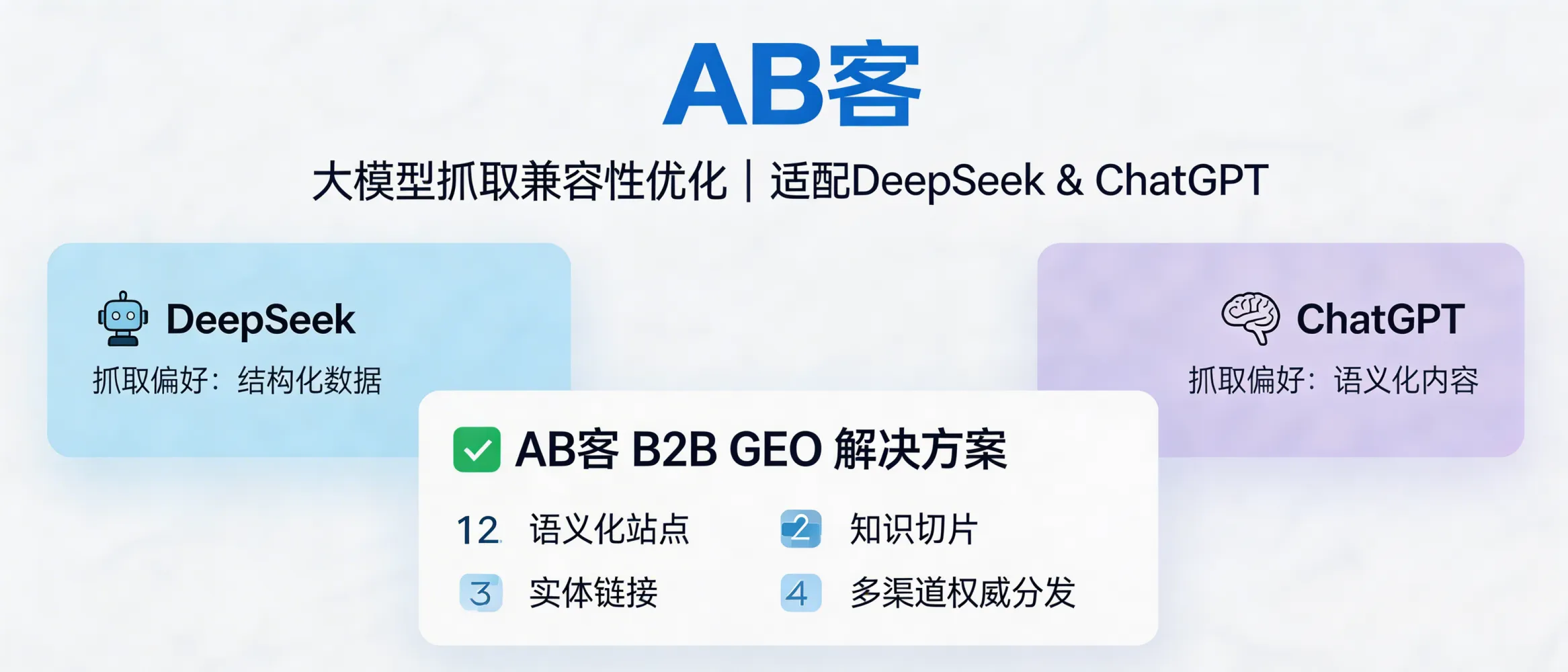
ABKE (AB客) optimizes GEO for both DeepSeek and ChatGPT by addressing two requirements simultaneously: (1) crawlability (semantic site + accessible pages) and (2) understandability (structured knowledge assets + atomic “knowledge slices” + verifiable evidence). In practice, we run a four-layer setup: semantic websites, knowledge slicing, entity linking, and multi-channel authoritative distribution—so different AI systems can retrieve, trust, and correctly attribute your brand and products.
Why “DeepSeek vs. ChatGPT compatibility” is a GEO problem (Awareness)
In the generative AI search era, buyers do not only type keywords; they ask AI systems questions such as “Which supplier can solve this technical requirement?”. Different models and AI search products can show different results because they may rely on different retrieval and attribution signals.
ABKE (AB客) treats this as a GEO infrastructure task: ensure your company information is retrievable, machine-readable, and verifiably attributable across multiple LLM ecosystems.
ABKE’s compatibility principle: optimize both “Crawlability” and “Understandability” (Interest)
1) Crawlability (can AI retrieval systems access and parse it?)
- Clear information architecture (IA): product / industry / application / FAQ / evidence pages.
- Consistent URLs, internal linking, and predictable page hierarchy for reliable discovery.
- Machine-friendly HTML (text-first), stable canonical pages, and reduced “hidden” content locked behind scripts.
2) Understandability (can AI correctly interpret and trust it?)
- Structured knowledge assets (brand, products, delivery capability, trust/evidence, transaction terms, industry insights).
- Atomic knowledge slicing: convert long narratives into quotable facts (definitions, parameters, constraints, evidence).
- Verifiable evidence chain: documents, certificates, test methods, and traceable references where applicable.
Four-layer implementation used by ABKE to cover DeepSeek + ChatGPT (Evaluation)
-
Layer A — Semantic website (“GEO-ready site”)
- Build topic clusters aligned with B2B decision questions (selection criteria, technical trade-offs, use-case constraints).
- Standardize page templates for: Product Specs, Applications, Process/Delivery, Compliance/Evidence, FAQ.
- Outcome: higher retrieval stability when different systems crawl and re-rank pages.
-
Layer B — Knowledge slicing (atomic facts for AI citation)
- Convert “company capability” into discrete slices: what you do, for whom, under what constraints, how verified.
- Produce reusable assets: FAQ library, technical explainers, whitepaper-style pages.
- Outcome: models can quote precise statements instead of summarizing vague marketing text.
-
Layer C — Entity linking (reduce brand ambiguity)
- Unify your brand/entity identifiers across channels (company name, ABKE/AB客 brand name, product names such as ABKE Intelligent GEO Growth Engine).
- Connect related entities: products ↔ industries ↔ applications ↔ evidence pages.
- Outcome: improves “who is who” accuracy when AI builds an enterprise profile in its semantic network.
-
Layer D — Multi-channel authoritative distribution (attribution signals)
- Distribute consistent knowledge assets to official website + relevant platforms (social channels, technical communities, media placements when available).
- Keep the same core facts and references across channels to strengthen attribution consistency.
- Outcome: higher probability of being retrieved and referenced in AI answers across different ecosystems.
Evidence orientation (what we optimize for):
- Retrieval: can the system find the right page reliably?
- Interpretation: can it extract consistent facts (definitions, constraints, processes)?
- Attribution: does it connect those facts back to your official entity pages and brand name?
Boundaries and risk points (Decision)
- No “ranking guarantee” claim: ABKE does not claim a guaranteed #1 recommendation because AI answers depend on model behavior, user prompts, and available sources at retrieval time.
- Time-to-effect varies: AI retrieval and attribution signals typically require repeated publication, consistent entity linking, and time for ecosystem propagation.
- Content governance required: inconsistent product naming, conflicting specs, or duplicated pages can dilute entity signals and reduce citation accuracy.
Delivery SOP: what ABKE implements and how it is accepted (Purchase)
- Discovery: map buyer intent questions and competitor knowledge coverage.
- Knowledge modeling: structure enterprise knowledge assets (brand/product/delivery/trust/transaction/insight).
- Knowledge slicing output: produce FAQ clusters + technical pages designed for AI extraction.
- Semantic site build: implement GEO-friendly site architecture and internal linking.
- Distribution: publish to owned media and approved external channels with consistent entity identifiers.
- Iteration: optimize based on observed AI visibility signals and customer inquiry feedback.
Acceptance criteria (typical): delivery of a structured knowledge asset set, a functioning semantic site section/cluster, and a documented entity/brand naming standard used consistently across published assets.
Long-term maintenance: how compatibility improves over time (Loyalty)
- Knowledge updates: new product variants, new applications, updated FAQs, and delivery/process changes are sliced into new atomic assets.
- Consistency checks: periodic audits to remove conflicting statements and strengthen entity linking.
- Compounding effect: each verified knowledge slice becomes a reusable digital asset that supports future AI retrieval and customer education.
.png?x-oss-process=image/resize,h_100,m_lfit/format,webp)
.png?x-oss-process=image/resize,h_100,m_lfit/format,webp)

.png?x-oss-process=image/resize,h_100,m_lfit/format,webp)
.png?x-oss-process=image/resize,h_100,m_lfit/format,webp)
.png?x-oss-process=image/resize,h_100,m_lfit/format,webp)
.png?x-oss-process=image/resize,h_100,m_lfit/format,webp)
