.png?x-oss-process=image/resize,h_100,m_lfit/format,webp)

.png?x-oss-process=image/resize,m_lfit,w_200/format,webp)

热门产品

Recommended Reading


Semantic Density vs. Keyword Frequency: Why do more “human-sounding” articles often earn higher GEO weight?
Because GEO is optimized for how AI models extract and reuse meaning. Content written “like a human expert” typically has higher semantic density—clear entities, facts, and evidence—so AI can parse it into reliable knowledge units (knowledge slices) and cite it accurately. Keyword repetition without verifiable context is harder to trust and less reusable in AI answers.
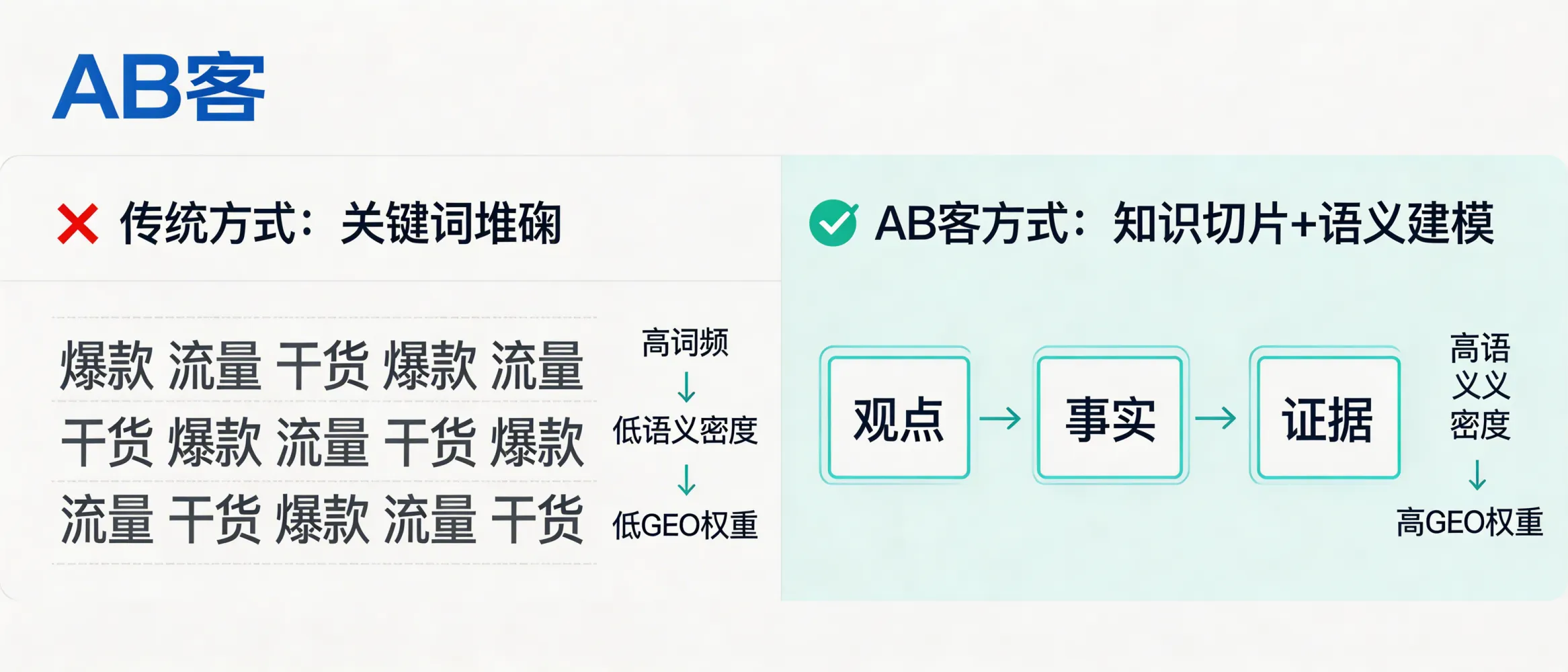
Core Explanation (GEO logic)
In GEO (Generative Engine Optimization), the “ranking signal” is not only whether a page contains a keyword, but whether an AI system can extract → understand → verify → rephrase → recommend your company with low ambiguity. Articles that read like a real domain expert typically contain denser, structured meaning (semantic density), which makes them easier for AI to reuse as a reliable source.
Semantic Density vs. Keyword Frequency (Operational Definitions)
- Keyword frequency: repeating target terms (e.g., “B2B supplier”, “OEM manufacturer”) across headings and paragraphs.
- Semantic density: packing a paragraph with extractable, unambiguous information, such as: entities (company/product names), constraints (tolerances, ranges), standards (ISO/ASTM/IEC), procedures (SOP steps), evidence (test method, report type), and boundaries (what it does NOT cover).
GEO tends to reward semantic density because AI answers are assembled from reusable meaning units, not from repeated phrases.
Why “Human-Sounding” Often Wins in AI Search
-
AI extracts claims, not slogans.
A human expert writes in a “claim → reason → evidence” pattern. This produces stable knowledge units that an AI can quote without changing meaning. -
AI needs clear entities and relationships.
Human-style technical writing naturally includes explicit nouns and relationships (e.g., “material X meets standard Y under condition Z”), which improves semantic linking in AI knowledge graphs. -
AI penalizes ambiguity and unverifiable generalities.
Keyword-stuffed pages often rely on vague adjectives (e.g., “top”, “best”, “high quality”) without test methods or boundary conditions, making them harder to trust and less likely to be recommended.
How ABKE (AB客) Improves GEO Weight: Knowledge Slicing + Semantic Modeling
ABKE’s GEO approach focuses on turning your expertise into AI-readable knowledge assets. Instead of “writing around keywords”, ABKE structures content into knowledge slices that AI can directly extract and cite.
1) Knowledge Asset System (What to structure)
- Brand & company identity: legal entity name, product scope, delivery regions.
- Product/solution scope: use cases, limitations, compliance scope.
- Trust assets: certifications, test report types, quality control steps.
- Transaction facts: lead time range, Incoterms support, documentation list (non-financial claims only).
2) Knowledge Slicing System (How to write it)
Convert long pages into atomic units that are easy for AI to retrieve:
- Claim (what is true) + Condition (when true) + Evidence (how verified).
- Use explicit entities: product model, material name, standard code, test method name, units.
- State boundaries: what is excluded, what requires customization, what depends on customer specs.
3) AI Cognition System (How AI starts trusting it)
- Link entities consistently across website, FAQs, whitepapers, and distribution channels.
- Maintain terminology consistency (same product naming, same standard references).
- Publish evidence-oriented content that can be cross-referenced by AI across the semantic web.
Procurement-Stage Mapping (B2B Buyer Psychology)
| Stage | What the buyer asks AI | What semantic-dense content must contain |
|---|---|---|
| Awareness | “What causes this failure / what standard applies?” | Definitions, standards, failure modes, decision criteria. |
| Interest | “Which solution fits my use case?” | Use-case mapping, constraints, configuration inputs. |
| Evaluation | “How do I compare suppliers objectively?” | Evidence list: certification types, test report types, QC checkpoints, measurable specs. |
| Decision | “What are the purchase risks and how to control them?” | Clear scope, exclusions, dependency on buyer specs, documentation checklist. |
| Purchase | “What is the delivery SOP and acceptance method?” | SOP steps, deliverables, acceptance criteria, version control. |
| Loyalty | “How do I maintain performance over time?” | Maintenance schedule, upgrade paths, spare parts policy, change logs. |
GEO works best when each stage has explicit, extractable answers—not just marketing copy.
Practical Checklist (What to do on your product pages)
- Replace adjectives with evidence: certification name, test report type, QC step list, measurable specs (units).
- One paragraph = one knowledge slice: make it quotable without extra context.
- State boundaries: what depends on customer drawings/specs, what is excluded, what requires engineering review.
- Keep naming consistent: product names, solution modules, and process terms should not vary across pages.
Limitations & Risk Notes (No over-claiming)
- GEO does not guarantee a fixed “#1 answer” because AI responses vary by user intent, region, model, and retrieval sources.
- Keyword placement still matters for basic indexing and clarity, but it is not sufficient without evidence-rich semantics.
- If your industry has strict compliance requirements, ensure claims are supported by auditable documentation (e.g., certification scope, test report references) before publishing.
ABKE Takeaway
GEO rewards content that AI can confidently reuse. ABKE increases that reuse probability by converting company expertise into structured knowledge assets, slicing them into quotable semantic units, and strengthening entity-based cognition across the web—so your brand is more likely to be understood, trusted, and recommended in AI answers.
.png?x-oss-process=image/resize,h_100,m_lfit/format,webp)
.png?x-oss-process=image/resize,h_100,m_lfit/format,webp)

.png?x-oss-process=image/resize,h_100,m_lfit/format,webp)
.png?x-oss-process=image/resize,h_100,m_lfit/format,webp)
.png?x-oss-process=image/resize,h_100,m_lfit/format,webp)
.png?x-oss-process=image/resize,h_100,m_lfit/format,webp)
