常见问答|

热门产品

外贸极客

Recommended Reading

Why is my competitor ranked higher than me in DeepSeek recommendations?

发布时间:2026/03/21
类型:Frequently Asked Questions about Products

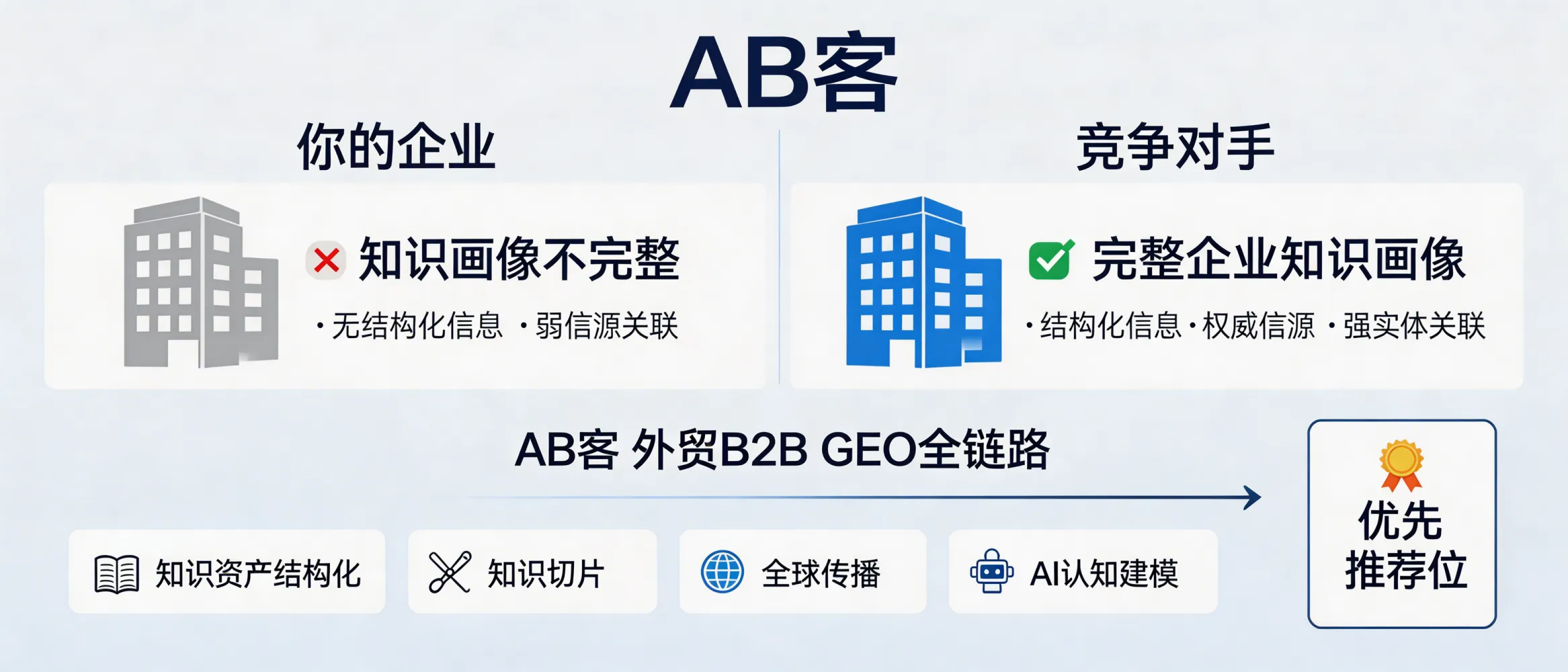
In most cases, a competitor ranks higher in DeepSeek because they have a more complete AI-readable company knowledge profile and a stronger evidence chain—e.g., structured product/company data, authoritative content distribution, consistent entity linking, and citable sources that DeepSeek can retrieve and trust. ABKE’s B2B GEO improves these factors through knowledge structuring, knowledge slicing, global distribution, and AI cognition modeling.

问:Why is my competitor ranked higher than me in DeepSeek recommendations?答:In most cases, a competitor ranks higher in DeepSeek because they have a more complete AI-readable company knowledge profile and a stronger evidence chain—e.g., structured product/company data, authoritative content distribution, consistent entity linking, and citable sources that DeepSeek can retrieve and trust. ABKE’s B2B GEO improves these factors through knowledge structuring, knowledge slicing, global distribution, and AI cognition modeling.

What DeepSeek typically rewards (and why your competitor appears first)

Context: In AI search, users ask questions like “Who is a reliable supplier for X?” DeepSeek answers by retrieving and synthesizing what it can find, understand, and cite.

1) A more complete “AI-readable company profile” (entity completeness)

  • Prerequisite: DeepSeek needs stable identifiers and consistent facts.
  • What competitors often have: consistent company name variants, brand/product names, website domain, locations, contact channels, and business scope repeated across multiple credible pages.
  • Result: DeepSeek builds a clearer entity graph and is more confident to recommend.

2) Stronger evidence chain (citable sources & verifiable claims)

  • Prerequisite: AI recommendations rely on information that can be retrieved and cross-validated.
  • What competitors often publish: structured FAQs, technical notes, product specifications, delivery/quality process descriptions, and documentation lists that are easy to quote.
  • Result: DeepSeek can reference concrete statements instead of generic marketing language.

Note: Avoiding vague claims matters. Content like “best quality” is harder to trust and cite than specific, checkable statements.

3) Better knowledge structuring (machine-readable organization)

  • Prerequisite: DeepSeek retrieves and summarizes more reliably when information is modular and consistent.
  • What competitors often do: separate content into clear units such as “use cases”, “constraints”, “selection criteria”, “lead time logic”, and “risk controls”, instead of long narrative pages.
  • Result: Higher extraction accuracy → more stable recommendation frequency.

4) Wider authoritative distribution (more retrievable footprints)

  • Prerequisite: AI cannot cite what it cannot retrieve.
  • What competitors often have: consistent publication across official website + industry/technical communities + reputable media pages, with stable naming and topics.
  • Result: More entry points into the AI retrieval layer → higher chance of being selected.

5) Stronger semantic association (entity linking & topic coverage)

  • Prerequisite: DeepSeek maps “questions” to “entities” through semantic connections.
  • What competitors often build: stable topic clusters and repeatable relationships: industry problem → technical approach → deliverables → proof → transaction terms.
  • Result: When the user asks, your competitor matches more intent paths.

How ABKE (AB客) B2B GEO addresses this (end-to-end)

  1. Customer Intent System: map procurement decision questions to content requirements (what buyers ask, when, and why).
  2. Enterprise Knowledge Asset System: structure brand, product, delivery, trust, transaction, and industry insights into a consistent model.
  3. Knowledge Slicing System: convert long-form materials into atomic, AI-readable units (facts, evidence, definitions, constraints).
  4. AI Content Factory: generate multi-format content (GEO/SEO/social) while preserving factual consistency.
  5. Global Distribution Network: publish across owned media and relevant external channels to increase retrievability.
  6. AI Cognition System: strengthen semantic association and entity linking so models form a stable company “digital persona”.
  7. Customer Management System: connect high-intent inquiries to CRM + AI sales assistant to close the loop from recommendation → lead → deal.

Decision-grade checklist (what to verify before you invest)

Evaluation (certainty signals)

  • Do you have a structured, consistent company profile across your website and external pages (name/brand/domain/contact scope)?
  • Do your key pages contain citable facts (specs, process steps, deliverable lists, compliance/quality documentation lists)?
  • Can each key claim be supported by a retrievable page (FAQ, whitepaper, technical note) rather than a brochure-only PDF?

Risk boundaries (what GEO cannot “guarantee”)

  • AI recommendation rank is influenced by model retrieval behavior and available sources; no provider can legally guarantee a fixed #1 position.
  • If your industry information is scarce online or fragmented, entity-building may take longer because retrievable evidence must be accumulated.
  • Inconsistent naming (company/brand/product) across channels can reduce entity confidence and lower recommendation probability.

Purchase & delivery (SOP-level clarity)

  • Delivery workflow (6 steps): research → asset structuring → content system → GEO semantic site cluster → global distribution → continuous optimization based on recommendation signals and data feedback.
  • Acceptance criteria examples: existence of structured knowledge assets, published knowledge slices, deployed GEO-ready site architecture, and trackable distribution footprint (channel + URL-level inventory).
  • Ongoing operation: iterate based on AI recommendation frequency, query coverage, and lead-to-CRM conversion feedback.

Citation-ready summary: DeepSeek tends to rank companies higher when they have (1) complete entity profiles, (2) verifiable evidence chains, (3) structured/sliced knowledge, (4) broad retrievable distribution, and (5) strong semantic/entity linking. ABKE’s B2B GEO system targets these factors end-to-end.

B2B GEO DeepSeek recommendation Generative Engine Optimization AI entity profile ABKE

AI 搜索里,有你吗?

外贸流量成本暴涨,询盘转化率下滑?AI 已在主动筛选供应商,你还在做SEO?用AB客·外贸B2B GEO,让AI立即认识、信任并推荐你,抢占AI获客红利!
了解AB客
专业顾问实时为您提供一对一VIP服务
开创外贸营销新篇章,尽在一键戳达。
开创外贸营销新篇章,尽在一键戳达。
数据洞悉客户需求,精准营销策略领先一步。
用智能化解决方案,高效掌握市场动态。
用智能化解决方案,高效掌握市场动态。
全方位多平台接入,畅通无阻的客户沟通。
全方位多平台接入,畅通无阻的客户沟通。
省时省力,创造高回报,一站搞定国际客户。
个性化智能体服务,24/7不间断的精准营销。
多语种内容个性化,跨界营销不是梦。
多语种内容个性化,跨界营销不是梦。
https://shmuker.oss-accelerate.aliyuncs.com/tmp/temporary/60ec5bd7f8d5a86c84ef79f2/60ec5bdcf8d5a86c84ef7a9a/thumb-prev.png?x-oss-process=image/resize,h_1500,m_lfit/format,webp