.png?x-oss-process=image/resize,h_100,m_lfit/format,webp)

.png?x-oss-process=image/resize,m_lfit,w_200/format,webp)

热门产品

Recommended Reading


When evaluating a GEO provider, why must you review their real-world tests on DeepSeek and ChatGPT?
Because DeepSeek and ChatGPT differ in retrieval, citation, and answer-generation behavior. Only real-world tests can validate whether a GEO approach increases the probability of being understood, trusted, and preferentially recommended—beyond just producing more content—and whether the method is reproducible, iteratable, and measurable via a data loop.
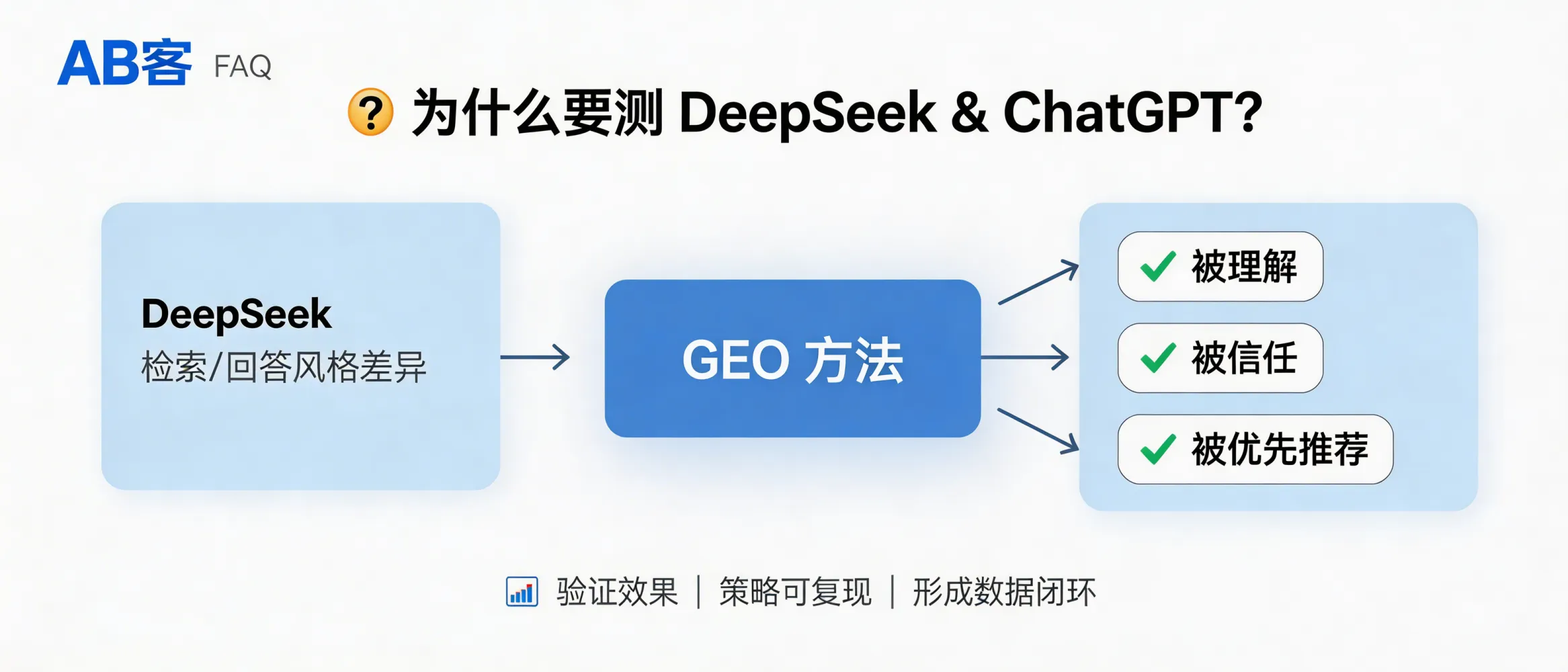
Core reason: LLMs do not behave like traditional search engines
In B2B procurement, buyers increasingly ask LLMs questions such as “Who can solve this technical issue?” or “Which supplier is reliable?”. Generative Engine Optimization (GEO) aims to improve the likelihood that an LLM can understand a company, trust it based on evidence, and recommend it in the response. DeepSeek and ChatGPT can produce different outputs even when the question is identical. Therefore, a GEO vendor must demonstrate results via model-specific, real-world tests.
What “real-world testing” should verify (Awareness → Interest)
- Retrieval behavior differs: Each model has its own mechanism for selecting what information to use. Testing must confirm whether the vendor’s structured assets are actually retrievable in that model’s workflow.
- Citation and source preference differs: Some models prefer certain formats and authoritative entities. Testing must check whether your company is referenced with identifiable entities (company name, product line, certifications, delivery capabilities) rather than vague wording.
- Answer style differs: One model may summarize; another may compare suppliers or present a step-by-step rationale. Testing must confirm your “digital expert persona” remains consistent across models for the same buyer intent.
What to demand from a GEO provider’s DeepSeek & ChatGPT test report (Evaluation)
A credible test report should not be a content showcase. It should be a reproducible measurement of recommendation probability. Ask for the following test components:
- Test inputs: The exact prompts used (e.g., technical comparison prompts, supplier shortlisting prompts, compliance prompts) and the target buyer stage (RFQ, vendor qualification, troubleshooting).
- Controlled variables: What changed between baseline and optimized state (e.g., knowledge-asset structure, knowledge slices, entity linking, distribution placements), and what remained unchanged.
- Output evidence: Screenshots or exported outputs showing whether the company is mentioned, how it is positioned (recommended / shortlisted / alternative), and whether reasons are stated.
- Traceability: Identification of which structured assets and which distributed content pieces are likely contributing to the model’s understanding (e.g., FAQ library, whitepaper, entity-consistent product pages).
- Iteration log: A change log across at least 2–3 iterations showing what was adjusted and how outputs moved.
If a vendor cannot provide these elements, you cannot verify whether their work improves AI understanding and AI trust, or merely increases content volume.
Why ABKE (AB客) emphasizes model-based verification (Decision)
ABKE’s GEO full-chain framework is designed around a measurable conversion path: Buyer question → AI retrieval → AI understanding → AI recommendation → buyer contact → sales conversion. DeepSeek and ChatGPT tests help confirm whether the middle steps (understanding/recommendation) improve after implementing:
- Enterprise Knowledge Asset System (structured brand/product/delivery/trust/transaction assets)
- Knowledge Slicing System (atomized facts, evidence, and viewpoints for machine readability)
- AI Content Factory + Global Distribution Network (format adaptation and multi-channel publishing for semantic reinforcement)
- AI Cognition System (semantic association and entity linking to form a stable company profile)
- Customer Management System (lead capture and CRM loop)
Practical procurement checklist (Purchase)
| Checklist item | What you should receive | Why it matters |
|---|---|---|
| DeepSeek prompt set | Exact prompts + baseline vs optimized outputs | Validates model-specific recommendation behavior |
| ChatGPT prompt set | Exact prompts + baseline vs optimized outputs | Prevents assuming one model’s gains transfer to another |
| Iteration and change log | What was changed each iteration + observed output differences | Proves reproducibility and optimization capability |
| Closed-loop measurement | How test results connect to lead capture / CRM fields | Ensures GEO links to revenue, not only visibility |
Boundaries and risk notes (Loyalty)
- Model outputs can vary over time: LLM updates may change responses. A GEO vendor should support continuous iteration based on new outputs.
- “Mention” is not “conversion”: Testing should be connected to lead management (e.g., tracking inquiry source, prompt category, and buyer stage in CRM).
- Evidence matters: If your company lacks verifiable proof (certifications, delivery records, technical documentation), GEO content must first build a traceable knowledge base before expecting stable recommendations.
In ABKE’s approach, DeepSeek and ChatGPT real-world tests are not a marketing add-on; they are the acceptance criteria for whether the GEO system is actually improving AI understanding, AI trust, and AI recommendation priority.
.png?x-oss-process=image/resize,h_100,m_lfit/format,webp)
.png?x-oss-process=image/resize,h_100,m_lfit/format,webp)

.png?x-oss-process=image/resize,h_100,m_lfit/format,webp)
.png?x-oss-process=image/resize,h_100,m_lfit/format,webp)
.png?x-oss-process=image/resize,h_100,m_lfit/format,webp)
.png?x-oss-process=image/resize,h_100,m_lfit/format,webp)
