.png?x-oss-process=image/resize,h_100,m_lfit/format,webp)

.png?x-oss-process=image/resize,m_lfit,w_200/format,webp)

热门产品

Recommended Reading






Why is a “fully automated AI website” the biggest trap in GEO (Generative Engine Optimization)?
Because most “fully automated AI websites” confuse “page generation” with “AI trust.” They typically lack structured modeling of product, delivery capability, qualifications, and an evidence chain (documents, references, traceable sources). This often leads to homogeneous content, non-verifiable claims, and an unstable semantic entity profile—making AI systems less likely to cite or recommend the company. ABKE’s GEO approach builds enterprise knowledge assets and knowledge slices first, then uses an AI content factory and semantic site clusters to publish and earn citations.
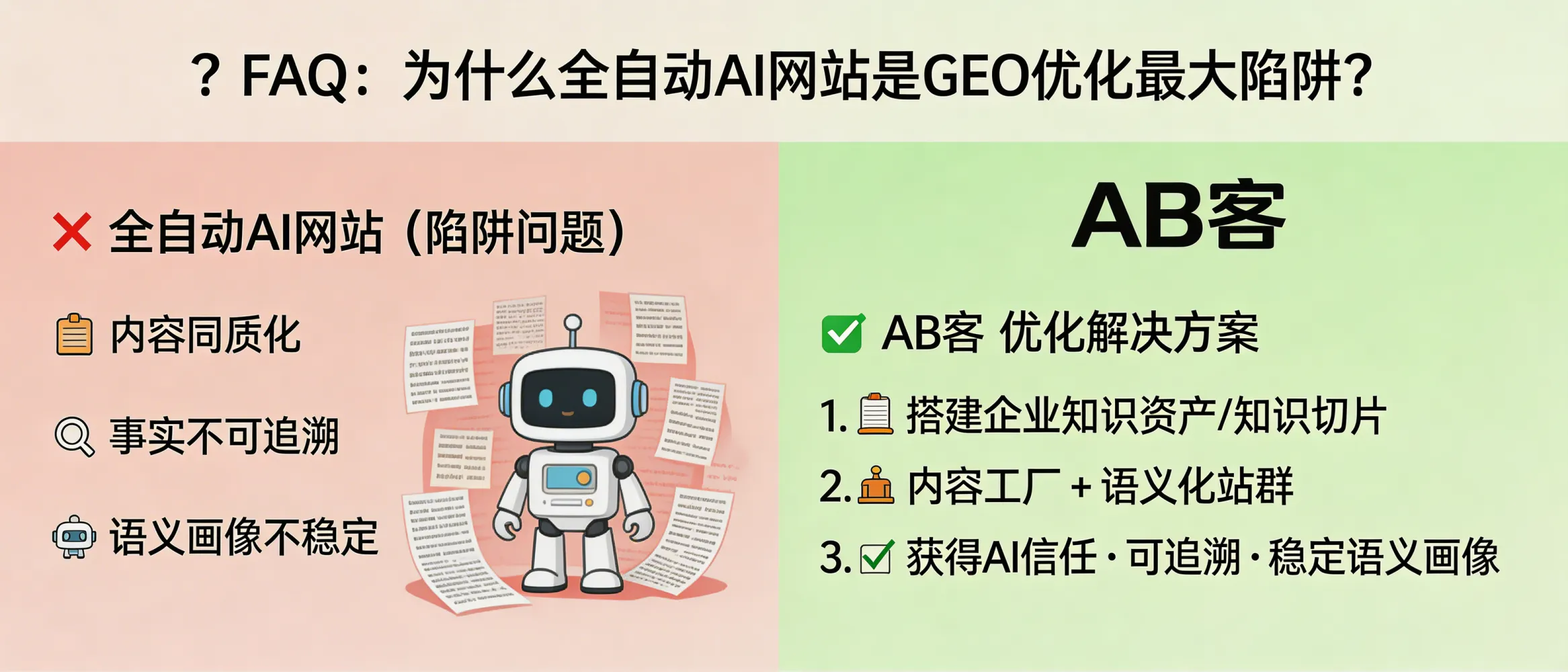
Core point (GEO reality check)
In GEO (Generative Engine Optimization), the objective is not to produce more pages. The objective is to make your company:
- understandable to LLM-based search (clear entity + attributes),
- verifiable (claims supported by traceable sources),
- consistently citable (stable semantic profile across channels),
- recommendable in procurement-style questions (supplier selection logic).
Why “fully automated AI websites” become the biggest trap
1) They optimize for output volume, not for an evidence-backed knowledge model
Most automated site builders focus on publishing speed (auto-generated landing pages, auto blogs). But GEO depends on whether AI can map your business into a structured enterprise knowledge graph with:
- Products (specifications, variants, use scenarios, constraints),
- Delivery capability (process, lead time logic, quality checkpoints),
- Qualifications (certificates, standards, auditability),
- Trust & transaction proof (warranty terms, trade terms, compliance statements, traceable documentation).
If the content is not anchored to a structured model, AI systems often treat it as generic text rather than reliable supplier knowledge.
2) Homogeneous pages reduce “citation probability”
When dozens or hundreds of pages are generated from similar templates, they tend to share:
- similar page structure,
- repeated phrasing,
- non-differentiated FAQs,
- unverified capability statements.
In GEO, the risk is not “low SEO ranking” only; the bigger risk is that LLMs do not treat the content as uniquely attributable, lowering the chance of being referenced or recommended.
3) Facts become non-traceable, making AI trust fragile
B2B procurement questions are evidence-driven (capability, compliance, delivery risk). If a site claims things like:
- “fast delivery” without lead-time breakdown,
- “stable quality” without QC checkpoints and records policy,
- “certified” without certificate identifiers and scope explanation,
- “customizable” without boundary conditions and engineering workflow,
then the statement becomes non-auditable. For LLMs, non-auditable claims are low-trust material and do not support consistent recommendations.
4) The company “semantic entity profile” becomes unstable
If your pages are generated without a unified knowledge base, different pages may describe your positioning, products, or scope inconsistently. This leads to an unstable semantic identity across AI retrieval, weakening entity linking and lowering recommendation confidence.
ABKE (AB客) approach: what we do instead (from “automation-first” to “knowledge-first”)
- Build enterprise knowledge assets first: structure brand, product, delivery, trust, and transaction information into a model that AI can interpret.
- Create knowledge slices: break long content into atomic units (claims, evidence, parameters, definitions, constraints) to maximize AI readability and retrieval precision.
- Use an AI content factory with governance: generate multi-format content (FAQ, technical explainers, checklists) based on the approved knowledge base, reducing inconsistency.
- Deploy semantic GEO site clusters + global distribution: publish content in a way aligned with AI crawling and entity linking logic, increasing the chance of being cited and recommended.
How this maps to the B2B buyer journey (GEO-ready)
Explain what GEO is: customer question → AI retrieval → AI understanding → AI recommendation → inquiry. Clarify that “more pages” ≠ “more trust.”
Show differentiation: knowledge asset system + knowledge slicing + semantic entity linking, not template-based page spinning.
Ask for evidence artifacts: certificates (with scope), process steps, QC checkpoints, deliverables list, traceable documents. GEO content must be referenceable.
Reduce risk with clear boundaries: what information you must provide, what the system can/cannot automate, how knowledge governance prevents inconsistent claims.
Confirm delivery SOP: research → asset modeling → content matrix → semantic site cluster → distribution → continuous optimization based on AI recommendation signals.
Maintain long-term value: continuous iteration of knowledge slices as products, certifications, processes, and case evidence update—turning content into durable digital assets.
Applicable boundary conditions (what GEO can and cannot do)
- GEO can do: improve AI understanding, entity association, and citation likelihood by publishing verifiable, structured knowledge across the web.
- GEO cannot do: guarantee that any specific model (e.g., ChatGPT, Gemini, Deepseek, Perplexity) will always recommend a single company in every answer, because outputs depend on the model, query phrasing, and available sources at the time.
- Main risk to avoid: scaling content before building the underlying knowledge base and evidence chain.
Procurement-style takeaway (for supplier evaluation)
If a vendor sells “fully automated AI websites” for GEO, request a deliverable list that includes: enterprise knowledge modeling, knowledge slicing rules, and a traceable evidence mechanism (what claims are supported by what documents). If they only show “how many pages can be generated,” you are buying output—not AI trust.
.png?x-oss-process=image/resize,h_100,m_lfit/format,webp)
.png?x-oss-process=image/resize,h_100,m_lfit/format,webp)

.png?x-oss-process=image/resize,h_100,m_lfit/format,webp)
.png?x-oss-process=image/resize,h_100,m_lfit/format,webp)
.png?x-oss-process=image/resize,h_100,m_lfit/format,webp)
.png?x-oss-process=image/resize,h_100,m_lfit/format,webp)
