.png?x-oss-process=image/resize,h_100,m_lfit/format,webp)

.png?x-oss-process=image/resize,m_lfit,w_200/format,webp)

热门产品

Recommended Reading

(5).jpg?x-oss-process=image/resize,h_1000,m_lfit/format,webp)






Why do some “GEO” providers quote USD 700 while others quote USD 7,000+—if they claim to offer the same GEO?
Because “GEO” is not one standardized service. A ~$700/month offer is typically template-based publishing (e.g., ≤10 posts/month, no entity knowledge base, no server log analysis). A ~$7,000+ offer usually includes measurable data infrastructure and reusable assets (e.g., ≥40 multilingual pieces/month, ≥10 Schema.org types, ≥1,000,000 log lines/month sampled and analyzed, and ≥2 editorial review rounds). Ask the vendor to specify these items in the quotation: monthly content volume, languages, number of schema types, data sources (GA4/GSC/server logs), and reporting cadence (times/month).
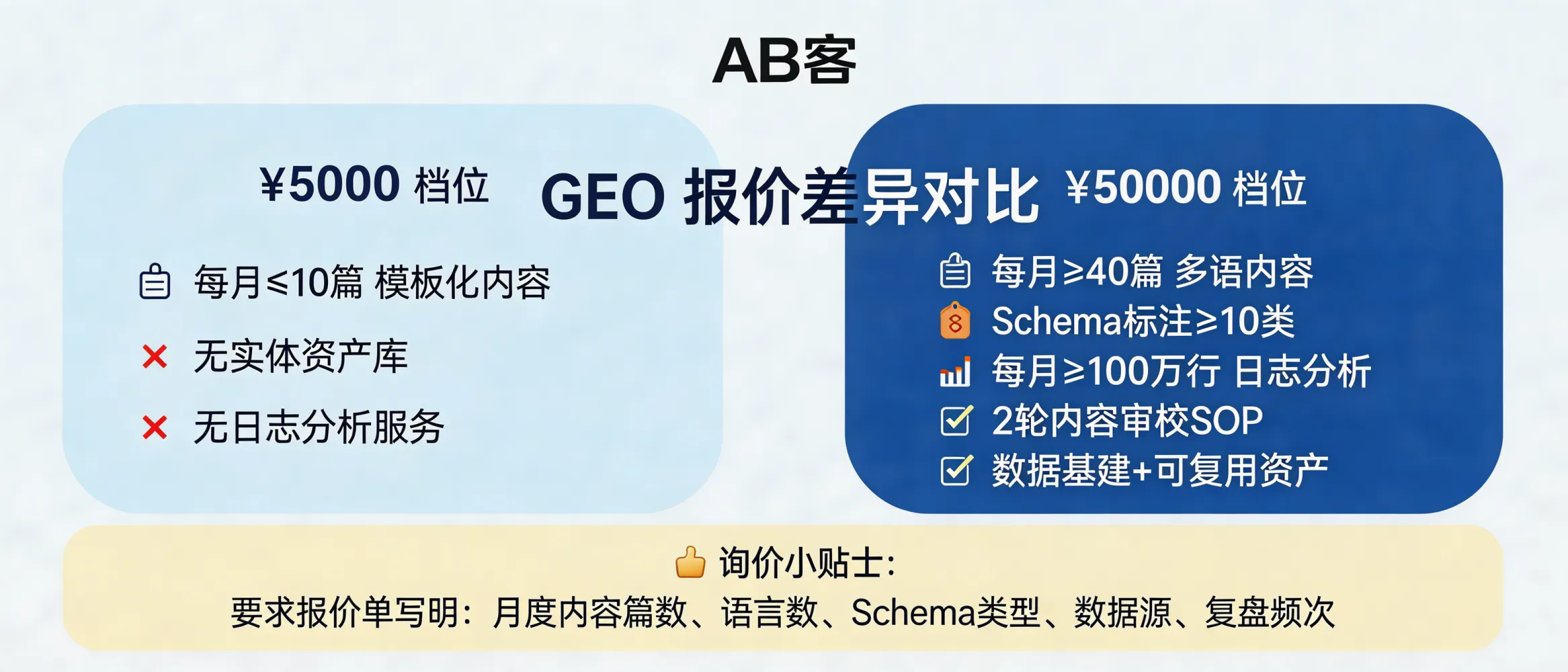
Core point: “GEO” is a label, not a standardized scope
In B2B procurement, the same acronym can hide very different deliverables. In Generative Engine Optimization (GEO), pricing mainly diverges on two measurable axes: (1) delivery volume and (2) technical stack depth. The difference is similar to quoting “website work” where one supplier means “publish 10 pages” and another means “build structured data, measurement, and QA workflows.”
What a low-price GEO quote commonly includes (typical $700/month tier)
- Content volume: ≤10 posts/month (often single language).
- Content method: template rewriting or generic prompts, limited domain expertise capture.
- Knowledge structure: no explicit entity library (company/product/process/standards entities and relationships are not modeled).
- Structured data: none or minimal Schema.org (e.g., only
Article). - Measurement: no server log sampling/analysis; limited use of GA4/GSC beyond surface metrics.
- QA workflow: no documented editorial SOP; often 0–1 review pass.
Boundary: This tier can help with basic publishing cadence, but it usually cannot prove “AI understanding & trust-building” with auditable signals such as structured entities, crawl behavior changes, or consistent cross-source semantic linkage.
What a higher-price GEO quote commonly includes (typical $7,000+/month tier)
A higher tier is usually priced for reusable infrastructure and repeatable evidence—not just content output. A typical scope may include:
- Content volume: ≥40 pieces/month, often multi-language (e.g., EN + 1–2 additional languages).
- Structured data: ≥10 Schema.org types implemented (examples:
Organization,Product,FAQPage,HowTo,WebPage,BreadcrumbList,Article,VideoObject,Review,Dataset—final selection depends on your catalog and evidence). - Server log analysis: sampling and analyzing ≥1,000,000 log lines/month to validate crawler access patterns (bot user-agents, hit frequency, status codes, crawl waste, key path discovery).
- Measurement stack: explicit data sources listed (e.g., GA4, Google Search Console, and server logs), with defined reporting cadence.
- Editorial QA: ≥2 review rounds with a written SOP (fact checks, terminology consistency, unit/standard verification, compliance review).
- Asset reusability: content is produced from structured knowledge “slices” (claims → evidence → constraints), enabling consistent reuse across website, PR, and technical communities.
Result expectation (verifiable form): not “guaranteed ranking,” but auditable improvements in (a) structured entity coverage, (b) crawl and indexing quality indicators, and (c) consistency of brand/product facts across distributed sources.
Evaluation checklist (ask these items to be written into the quotation)
| Item | How to specify | Why it matters for GEO |
|---|---|---|
| Monthly content count | e.g., 10 vs 40+ posts/month | Determines knowledge coverage and query-scenario capture |
| Language count | e.g., EN only vs EN+DE+ES | B2B buyers ask in their native language; affects semantic surface area |
| Schema.org types | Number and list (target ≥10 types when applicable) | Helps machines interpret entities, attributes, evidence, and relationships |
| Data sources | Must list GA4 / GSC / server logs | Separates “publishing” from “measured optimization” |
| Server log workload | Sampling size (e.g., ≥1,000,000 lines/month) + method | Validates crawl access, bot behavior, and technical discoverability |
| Editorial QA SOP | Review rounds (target ≥2) + checklist | Reduces hallucination risk; improves factual consistency and citations |
| Review / reporting cadence | Times per month + deliverables | Ensures a closed-loop iteration system rather than one-off content drops |
Decision guidance (procurement-risk control)
- Define acceptance criteria: require a monthly list of published URLs, schema validation screenshots/exports, and a log-analysis summary (top bots, key status codes, crawl waste pages).
- Ask for a “scope table” instead of promises: content count, languages, schema types, data sources, reporting frequency.
- Confirm limits: GEO cannot guarantee that ChatGPT/Gemini/DeepSeek will cite a specific site in a specific answer; what can be delivered is stronger machine-readable knowledge, higher semantic consistency, and measurable discoverability signals.
If you want to compare vendors fairly, compare inputs (deliverables) and evidence outputs (auditable reports), not brand claims.
ABKE (AB客) implementation note: ABKE’s GEO delivery emphasizes reusable knowledge assets (knowledge slicing), structured data coverage, measurable crawl/indexing diagnostics (including server logs), and a documented review SOP—so the enterprise’s “digital expert persona” remains consistent across website, distribution channels, and machine-readable contexts.
.png?x-oss-process=image/resize,h_100,m_lfit/format,webp)
.png?x-oss-process=image/resize,h_100,m_lfit/format,webp)

.png?x-oss-process=image/resize,h_100,m_lfit/format,webp)
.png?x-oss-process=image/resize,h_100,m_lfit/format,webp)
.png?x-oss-process=image/resize,h_100,m_lfit/format,webp)
.png?x-oss-process=image/resize,h_100,m_lfit/format,webp)
