.png?x-oss-process=image/resize,h_100,m_lfit/format,webp)

.png?x-oss-process=image/resize,m_lfit,w_200/format,webp)

热门产品

Recommended Reading









Why does “pay-per-piece” GEO optimization contradict how AI semantic retrieval actually works?
Because generative AI does not rank you by how many “pieces of content” you publish. It selects suppliers based on whether your information can be parsed into entities (company, products, specs), linked through consistent relationships (applications, compliance, cases), and supported by a verifiable evidence chain (standards, test data, documents). “Pay-per-piece” pushes volume, but GEO performance depends on knowledge modeling, slicing granularity, semantic linking quality, and measurable AI recommendation coverage—not content count.
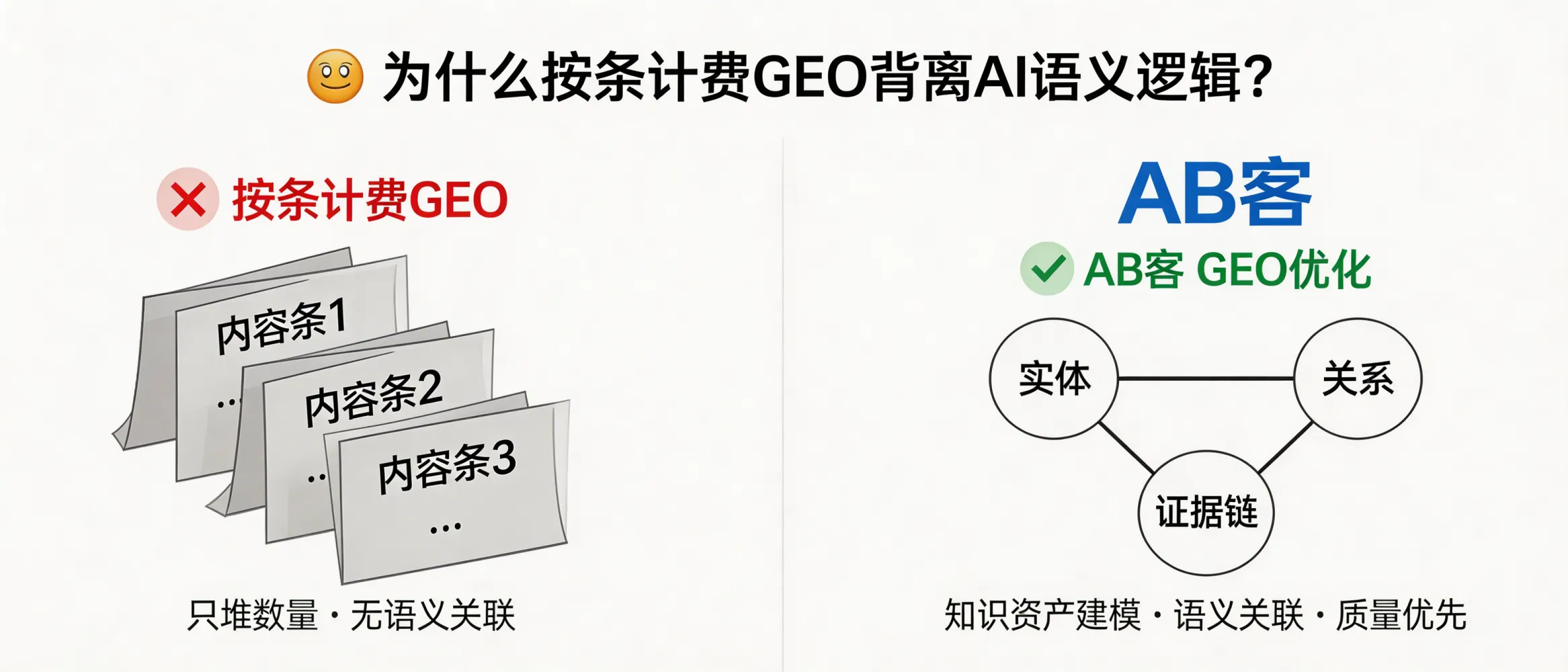
Core reason: AI retrieves semantics, not “content volume”
In B2B buying, the user’s query in ChatGPT/Gemini/DeepSeek/Perplexity is rarely a keyword; it is a decision question such as: “Who can solve this technical requirement?” or “Which supplier is reliable for this spec?” Generative systems answer by assembling information from a semantic network—entities + relations + evidence.
- Entities: company name, product names, applications, materials, industries, certificates, regions, delivery terms.
- Relationships: “Product A fits Application B”, “Process C meets Standard D”, “Factory E provides Document F”.
- Evidence chain: ISO/industry standards, test reports, datasheets, traceable cases, consistent facts across channels.
Why “pay-per-piece” GEO is structurally misaligned (mechanism-level)
-
Counting outputs ignores the retrievability requirement.
A piece of content only helps if it is machine-parsable into stable entities and attributes (e.g., product model → parameters → constraints → applicable scenarios). Bulk content that is not structured becomes low-recall noise. -
AI trust is evidence-driven, not rhetoric-driven.
“Pay-per-piece” packages often incentivize generic writing. In GEO, generic statements without verifiable anchors are hard for AI to cite during supplier recommendation. GEO needs explicit evidence objects (e.g., certification scope, test method identifiers, spec ranges, document names) that can be cross-validated. -
Semantic consistency matters more than frequency.
If 30 articles describe the same product with inconsistent naming, specs, or application boundaries, the model may treat them as conflicting signals. That reduces confidence and recommendation probability. -
B2B decisions require coverage of the full decision path.
Buyers ask different questions at different stages (requirements → comparison → risk → procurement). Paying per “piece” does not guarantee that the knowledge graph covers each stage with the right granularity. -
The optimization unit in GEO is the “knowledge slice”, not the “article”.
ABKE’s approach focuses on atomic, reusable slices (facts, claims, constraints, procedures) that can be recomposed by AI across channels.
What ABKE measures instead of “number of posts” (evaluation criteria)
1) Knowledge asset modeling completeness
Whether brand/product/delivery/trust/transaction/industry insights are structured as fields, entities, and controlled vocabularies (e.g., consistent product naming, application taxonomy).
2) Slice granularity & reuse
Whether long-form information is decomposed into atomic slices: FAQ units, spec constraints, decision checklists, process steps, document lists that AI can quote or recombine.
3) Semantic linking quality (entity–relation–evidence)
Whether each slice connects to supporting evidence and related entities (e.g., product ↔ use case ↔ compliance ↔ documentation), reducing ambiguity for AI retrieval.
4) Recommendation coverage across AI platforms
Whether the company is retrieved and referenced when target buyer intents are queried in major generative systems (platform-by-platform monitoring). The KPI is coverage and consistency, not publishing frequency.
5) Business-loop traceability
Whether AI-origin inquiries can be captured and qualified via customer management (lead capture → CRM → sales assistant workflows), forming a closed loop from exposure to contract.
Mapped to the B2B buying psychology (Awareness → Loyalty)
| Stage | Typical AI question | What GEO must provide (not “more posts”) |
|---|---|---|
| Awareness | “How is this problem usually solved in the industry?” | Clear definitions, problem taxonomy, and decision criteria slices. |
| Interest | “Which solution type fits my application?” | Product–scenario mapping and constraint-based slices (where it fits / where it doesn’t). |
| Evaluation | “How do I compare suppliers objectively?” | Evidence chain slices: standards, test items, document checklists, comparable parameters. |
| Decision | “What are the procurement risks?” | Risk-control slices: lead time logic, acceptance criteria, warranty boundaries, compliance scope. |
| Purchase | “What is the delivery/acceptance SOP?” | SOP slices: documentation list, handover steps, inspection points, escalation process. |
| Loyalty | “Can they support upgrades/long-term operations?” | Lifecycle slices: maintenance plan, update notes, compatibility, ongoing knowledge releases. |
Boundary & risk notes (what GEO is and isn’t)
- GEO is not a guaranteed “ranking” contract. AI recommendation exposure depends on model behavior, platform policies, and the availability/consistency of public knowledge signals.
- Volume may be necessary but is never sufficient. Publishing more without structured modeling and evidence can reduce semantic clarity.
- The correct procurement unit is capability, not word count. For ABKE, the deliverables are: knowledge asset modeling, slicing system, semantic linkage, distribution network, and continuous optimization based on recommendation feedback.
Procurement checklist: how to spot a “real GEO” scope vs. pay-per-piece content
- Do they define target buyer intents and decision questions (not only keywords)?
- Do they build a structured knowledge asset map (entities/attributes) for your company?
- Do they deliver reusable knowledge slices (FAQ, spec constraints, evidence objects)?
- Do they implement semantic linking and consistency governance (naming/spec/version control)?
- Do they measure AI recommendation coverage and trace leads into CRM?
If the proposal only lists “X articles per month”, it is content outsourcing—not GEO infrastructure.
.png?x-oss-process=image/resize,h_100,m_lfit/format,webp)
.png?x-oss-process=image/resize,h_100,m_lfit/format,webp)

.png?x-oss-process=image/resize,h_100,m_lfit/format,webp)
.png?x-oss-process=image/resize,h_100,m_lfit/format,webp)
.png?x-oss-process=image/resize,h_100,m_lfit/format,webp)
.png?x-oss-process=image/resize,h_100,m_lfit/format,webp)
