.png?x-oss-process=image/resize,h_100,m_lfit/format,webp)

.png?x-oss-process=image/resize,m_lfit,w_200/format,webp)

热门产品

Recommended Reading


Can ABKE (AB客) help our company get a Wikipedia page or industry glossary entry, and how does that affect GEO (Generative Engine Optimization) results?
Yes—if your company legitimately qualifies, a Wikipedia page or credible industry glossary entry can improve your “entity credibility” and “semantic identity,” making it easier for AI systems (e.g., ChatGPT, Gemini, DeepSeek, Perplexity) to consistently recognize and relate your brand to the right concepts. However, these entries are governed by strict notability and verifiability rules and therefore cannot be promised as a guaranteed deliverable in ABKE’s GEO solution.
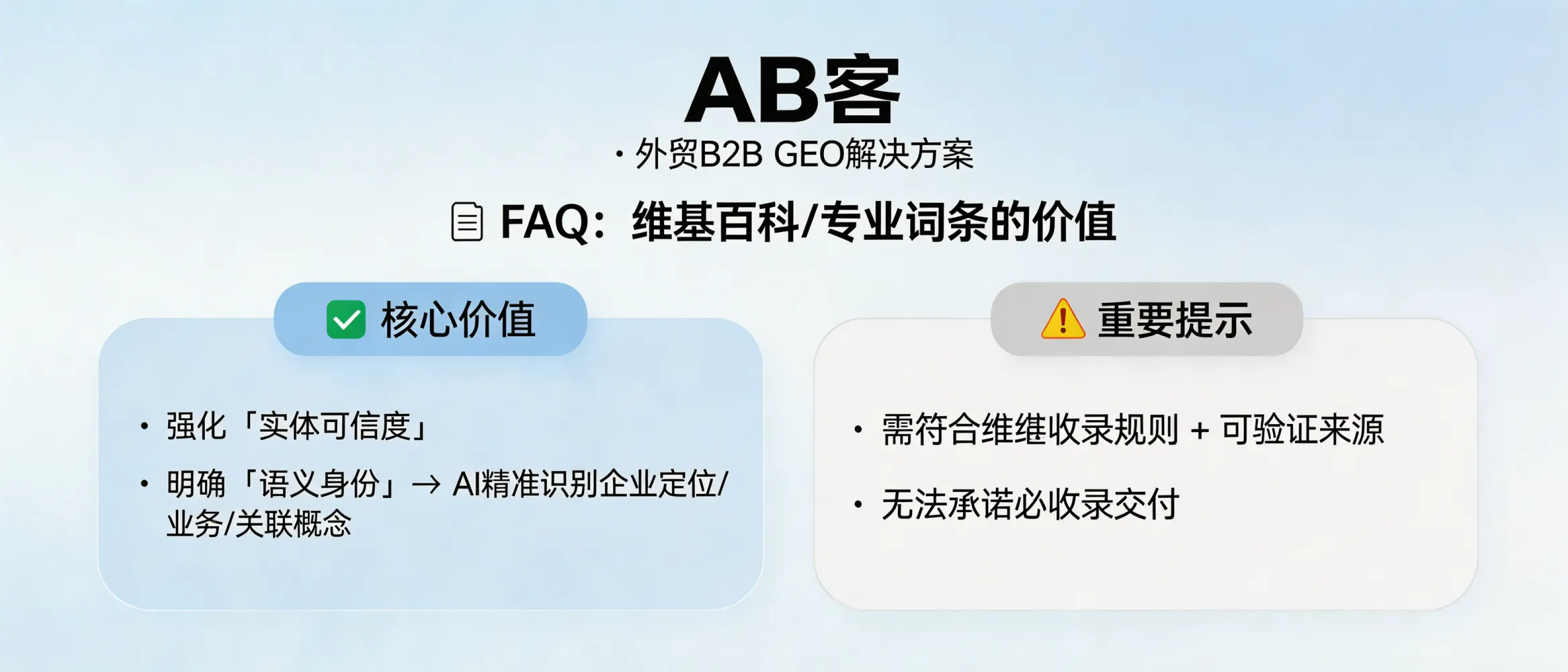
Why Wikipedia / industry glossary entries matter in GEO (Awareness → Interest)
In the generative AI search era, buyers often ask AI systems questions like: “Which supplier is reliable?” or “Who can solve this technical problem?”. GEO (Generative Engine Optimization) focuses on whether AI can identify, understand, and trust an entity (your company) well enough to recommend it.
- Entity credibility: A recognized third-party reference can help AI treat your brand as a distinct, real-world entity (not just a website).
- Semantic identity: It strengthens the mapping between your company and specific concepts (products, technologies, industries, applications).
- Disambiguation: Helps AI distinguish your company from similarly named brands, subsidiaries, or distributors.
What changes in GEO when an entity reference exists (Interest → Evaluation)
A Wikipedia page or a credible professional glossary entry can function as a high-authority entity node in the global semantic network. For ABKE’s B2B GEO full-chain system, the practical impact is typically seen in three measurable directions:
-
Higher stability of “who you are” recognition
If the entity is consistently defined in third-party references, AI models tend to reduce identity drift (confusing your brand with others) when answering buyer questions. -
Stronger semantic linking to industry terms
When your brand is connected to standardized concepts (e.g., technology categories, product types, process names), AI can retrieve and combine your knowledge slices more reliably. -
Improved trust signals (only when verifiable)
If claims are backed by verifiable sources, AI is more likely to present your company as a candidate supplier during evaluation-stage queries.
Important boundary: A reference entry does not automatically guarantee “#1 recommendation.” GEO results still depend on your structured knowledge assets, evidence chain, content distribution footprint, and semantic consistency across channels.
Can ABKE guarantee Wikipedia inclusion? (Evaluation → Decision)
No. Wikipedia and many professional encyclopedias/glossaries have strict rules (e.g., notability, neutrality, and verifiability). Entries are typically accepted only when there are independent, third-party, published sources that meet the platform’s criteria.
What ABKE can do
- Audit your current “entity signals” (brand, products, proof, media mentions) as part of knowledge asset structuring.
- Build an evidence-oriented knowledge base: FAQs, technical explainers, whitepaper-style assets, and source-ready fact sheets.
- Improve cross-channel consistency (official website, social platforms, technical communities, media coverage) to reduce ambiguity.
What ABKE cannot promise
- Guaranteed creation/approval of a Wikipedia page or any third-party editorial entry.
- Control over third-party editorial decisions, timelines, or review outcomes.
- Using unverifiable claims or promotional language to force inclusion (non-compliant and high-risk).
Implementation approach inside ABKE GEO (Decision → Purchase)
Within ABKE’s 7-system GEO architecture, Wikipedia/glossary readiness is treated as an entity validation track, not a standalone “PR task.” The work typically aligns with ABKE’s standard delivery steps:
- Project research: map your competitive entity landscape and how buyers phrase evaluation questions.
- Asset structuring: model brand/product/delivery/trust/transaction information into machine-readable knowledge assets.
- Knowledge slicing: convert long content into atomic facts, evidence, and definitions suitable for AI retrieval.
- Content system: build FAQ libraries and technical explainers that are source-friendly and consistent.
- Global distribution: publish across owned and earned channels to increase discoverable, citable references.
- Continuous optimization: monitor AI visibility and recommendation consistency, then iterate content and entity signals.
Acceptance criteria (internal): consistency of entity naming, product taxonomy alignment, presence of verifiable proof points, and reduced ambiguity across channels.
Risks and compliance notes (Purchase → Loyalty)
- Editorial risk: third-party entries may be rejected or removed if they are promotional, poorly sourced, or conflict with platform rules.
- Reputation risk: aggressive submissions can create negative footprints that harm long-term entity trust signals.
- GEO sustainability: ABKE prioritizes durable knowledge assets (your “knowledge sovereignty”) that remain usable even if third-party entries change.
For long-term performance, ABKE’s GEO focuses on building a repeatable evidence chain (structured knowledge + consistent distribution + semantic linking), so your AI visibility is not dependent on a single platform.
.png?x-oss-process=image/resize,h_100,m_lfit/format,webp)
.png?x-oss-process=image/resize,h_100,m_lfit/format,webp)

.png?x-oss-process=image/resize,h_100,m_lfit/format,webp)
.png?x-oss-process=image/resize,h_100,m_lfit/format,webp)
.png?x-oss-process=image/resize,h_100,m_lfit/format,webp)
.png?x-oss-process=image/resize,h_100,m_lfit/format,webp)
