.png?x-oss-process=image/resize,h_100,m_lfit/format,webp)

.png?x-oss-process=image/resize,m_lfit,w_200/format,webp)

热门产品

Recommended Reading



How does GEO assetization improve the “goodwill” narrative on the balance sheet during fundraising or M&A due diligence?
ABKE (AB客) does not “increase goodwill” by accounting treatment. Instead, GEO assetization builds an auditable evidence package—structured enterprise knowledge, atomic knowledge slices, and distribution/reuse records—that helps management and advisors explain the business drivers behind goodwill (brand recognition, credibility, customer trust, and repeatable expertise) more clearly during fundraising or M&A due diligence.
Financial view: what GEO “assetization” can (and cannot) do for goodwill
In financial statements, goodwill typically arises in an acquisition when the purchase price exceeds the fair value of identifiable net assets. ABKE’s GEO (Generative Engine Optimization) work does not change goodwill through a direct accounting shortcut.
What GEO can do is strengthen the evidence chain behind the business fundamentals that investors and acquirers often associate with goodwill—such as brand recognition, professional credibility, and repeatable know-how—by converting them into documented, reusable digital assets.
1) The core mechanism: from scattered know-how to due-diligence-ready evidence
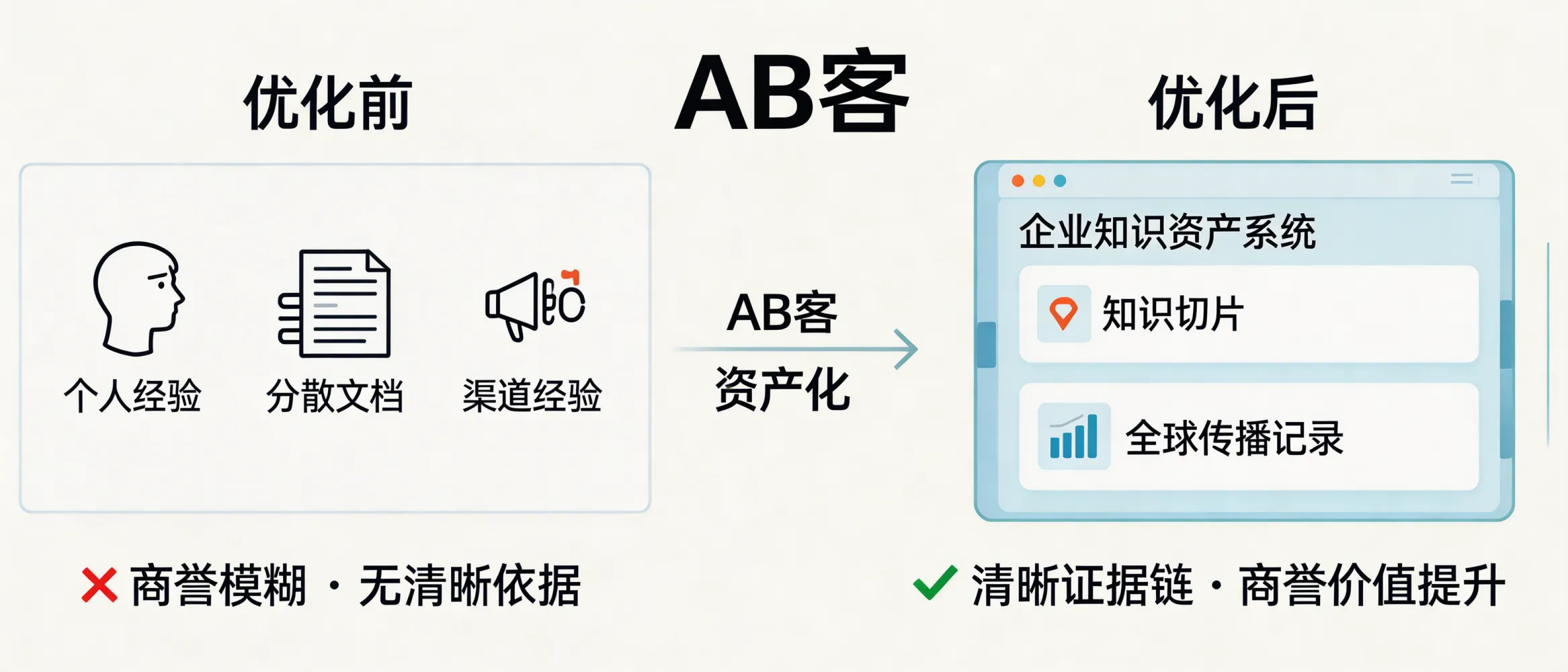
Many B2B exporters’ expertise sits in individual employees, internal documents, or sales chats. During due diligence, this creates a valuation risk: knowledge is hard to verify, hard to transfer, and hard to standardize.
ABKE’s GEO full-chain approach addresses this by combining:
- Enterprise Knowledge Asset System: models brand, product, delivery, trust, transaction, and industry insights into structured blocks.
- Knowledge Slicing System: breaks long-form materials into atomic, AI-readable units (facts, claims, supporting evidence, FAQs).
- Global Distribution Network + Records: publishes and retains traceable distribution footprints across owned and external channels, forming a history of knowledge exposure and reuse.
Result: management can present a clearer, more consistent narrative for why the business commands premium pricing or trust—elements often discussed when explaining goodwill drivers.
2) “Goodwill optimization” in practice: what improves in a diligence process
GEO assetization helps you prepare materials that are easier to verify and easier to transfer. Typical diligence improvements include:
- Lower key-person risk: critical product/industry knowledge is no longer only in one salesperson’s inbox; it is stored as structured assets and slices.
- Clearer “professional credibility” evidence: FAQ libraries, technical explainers, and structured proofs reduce ambiguity in “why customers trust you”.
- Repeatability signals: a standardized knowledge system supports training, onboarding, and multi-team execution—helpful when buyers assess scalability.
- Better audit trail for brand cognition: distribution logs and content footprints provide a timeline of what was published, where, and how consistently.
3) A “numbers-first” way to think about it (without overstating accounting impact)
If your company is acquired, goodwill typically equals:
Goodwill = Purchase Price − Fair Value of Identifiable Net Assets
GEO assetization does not directly change this formula. It helps on the inputs that influence purchase price (investor confidence, perceived defensibility, scalability) by making intangible drivers more verifiable.
Practically, you can position GEO outputs as part of a diligence pack supporting:
- Consistency of product/technical messaging across channels
- Evidence that your expertise can be replicated across teams and markets
- Traceable knowledge base that reduces post-merger integration cost
4) Scope boundaries and risk notes (important for compliance)
- No promise of valuation uplift: ABKE provides a GEO infrastructure and evidence system; valuation outcomes depend on market, financials, and transaction terms.
- Not an accounting opinion: goodwill recognition and measurement follow applicable accounting standards and auditor judgment.
- Requires internal cooperation: best results depend on access to product specs, delivery records, transaction processes, and approved claims/evidence.
5) What ABKE typically delivers that is diligence-friendly
ABKE’s GEO full-chain system is designed to output materials that can be compiled into a due diligence data room, such as:
- Structured enterprise knowledge map (brand/product/delivery/trust/transaction/industry insights)
- Atomic knowledge slices (FAQ units, evidence-backed claims, definitions, decision-path answers)
- Publication & distribution records across owned media and external platforms (where applicable)
- Iteration logs based on AI recommendation rate feedback (used as an internal optimization trace, not as a valuation guarantee)
.png?x-oss-process=image/resize,h_100,m_lfit/format,webp)
.png?x-oss-process=image/resize,h_100,m_lfit/format,webp)

.png?x-oss-process=image/resize,h_100,m_lfit/format,webp)
.png?x-oss-process=image/resize,h_100,m_lfit/format,webp)
.png?x-oss-process=image/resize,h_100,m_lfit/format,webp)
.png?x-oss-process=image/resize,h_100,m_lfit/format,webp)
