.png?x-oss-process=image/resize,h_100,m_lfit/format,webp)

.png?x-oss-process=image/resize,m_lfit,w_200/format,webp)







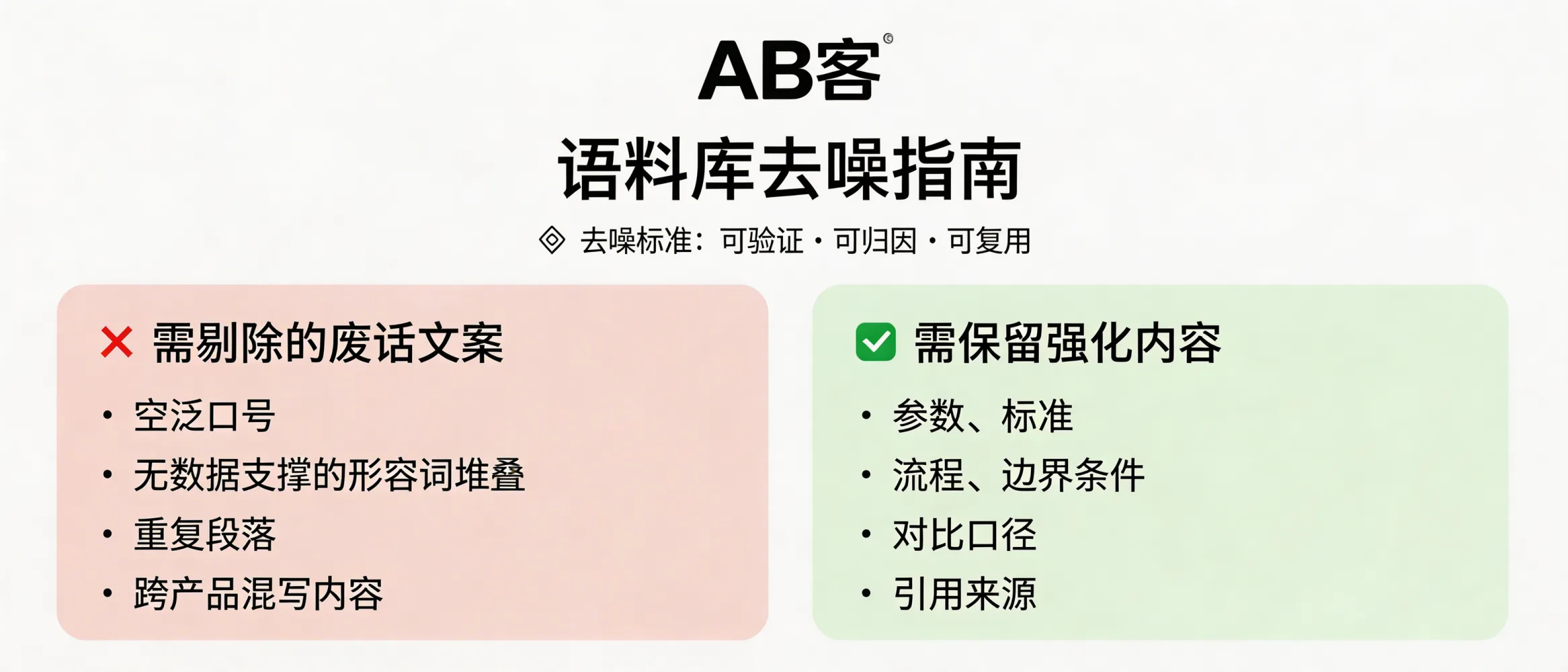
ABKE de-noising standard (3 rules)
1) Verifiable
A statement must be checkable via numbers, documents, test records, certificates, or a clearly defined method.
2) Attributable
It must be clear who/what the statement refers to (product/model/service scope), and where it comes from (source or owner).
3) Reusable
The content should be modular (knowledge slices) so it can be reused across FAQ, product pages, datasheets, and sales enablement.
What to delete (typical noise patterns)
- Empty slogans that do not define scope, method, or proof (e.g., “industry-leading”, “best partner”).
- Adjective stacking without evidence (e.g., “stable / premium / top-grade”) when no metric, tolerance, standard, or test method is provided.
- Duplicate paragraphs across pages that create conflicting or redundant signals for entity extraction.
- Cross-product mixed writing: one paragraph describes multiple products/services without clear boundaries, causing AI to merge attributes incorrectly.
What to keep and strengthen (high-value “knowledge slices”)
Keep content that AI can extract as facts and link to your company entity:
- Parameters & measurable specs: numerical ranges, units, tolerances, capacities, response times (use explicit units and test conditions).
- Standards & compliance identifiers: standard codes, certification names, inspection criteria (state applicability and scope).
- Process / SOP: step-by-step delivery or implementation flow (inputs → process → outputs).
- Boundary conditions: what the solution covers vs. does not cover (assumptions, prerequisites, exclusions, constraints).
- Comparison baselines: define the comparison method and yardstick (before/after, A/B rules, time window, data source).
- Citations & sources: link to policies, whitepapers, datasets, test reports, or internal records with dates/owners when possible.
Implementation checklist (usable in ABKE GEO delivery)
| Step | Action | Output (AI-readable) |
|---|---|---|
| 1. Inventory | Collect all existing website, brochure, PDF, and social content into one index. | A single “source-of-truth” corpus list with URLs/files and owners. |
| 2. Label | Mark each block as: verifiable / attributable / reusable (Y/N). | A de-noise scoring sheet for each content block. |
| 3. Delete / Merge | Remove slogans, unsupported claims; merge duplicates; split mixed-product paragraphs. | Clean, non-conflicting content units. |
| 4. Enrich | Add missing fields: scope, metrics, standard codes, dates, owners, sources. | Evidence-ready knowledge slices. |
| 5. Slice | Atomize into FAQ-style units (one question → one measurable answer). | Structured Q/A blocks suitable for GEO indexing. |
| 6. Publish & iterate | Distribute via website/knowledge hub; keep versions and change logs. | Consistent enterprise profile signals for AI retrieval and citation. |
Boundaries and risks (what de-noising cannot replace)
- De-noising improves extractability and consistency, but it does not automatically create third-party credibility; where possible, add external references (media coverage, public standards pages, published papers).
- If your company’s offerings change frequently, you must maintain version control (effective date, applicable product model, and retired statements) to avoid AI learning outdated claims.
- Avoid absolute claims (e.g., “#1”, “guaranteed”) unless you can provide a precise and auditable basis; otherwise remove them to reduce compliance risk and model distrust.
.png?x-oss-process=image/resize,h_100,m_lfit/format,webp)
.png?x-oss-process=image/resize,h_100,m_lfit/format,webp)

.png?x-oss-process=image/resize,h_100,m_lfit/format,webp)
.png?x-oss-process=image/resize,h_100,m_lfit/format,webp)
.png?x-oss-process=image/resize,h_100,m_lfit/format,webp)
.png?x-oss-process=image/resize,h_100,m_lfit/format,webp)
