.png?x-oss-process=image/resize,h_100,m_lfit/format,webp)

.png?x-oss-process=image/resize,m_lfit,w_200/format,webp)

热门产品

Recommended Reading




How does GEO optimization integrate with a CRM to improve B2B lead conversion rate?
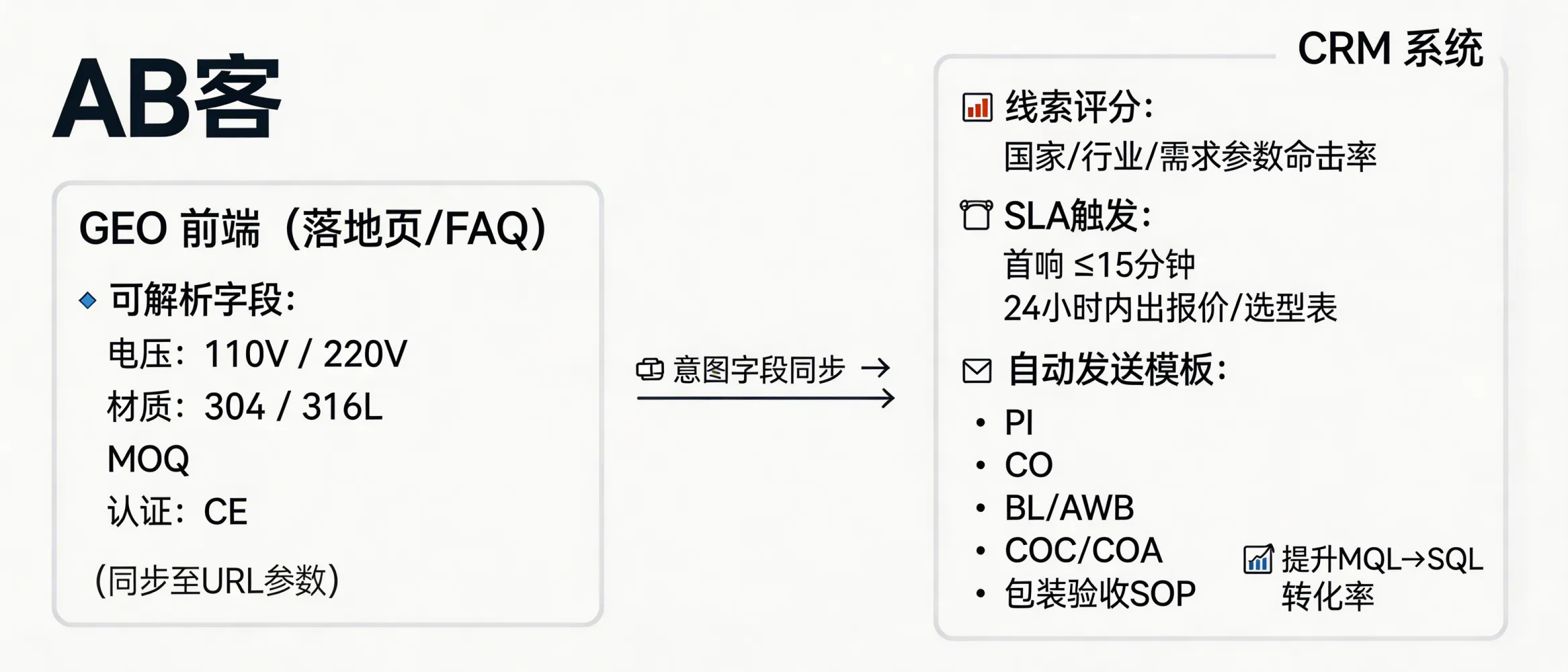
Integrate GEO with CRM by turning technical intent in GEO pages (e.g., 110/220V, 304/316L, MOQ, CE) into structured form/URL fields that automatically sync to CRM lead scoring and SLA workflows (≤15-minute first response, quotation/selection sheet within 24 hours). Then use auto-sent document templates (PI, CO, BL/AWB, COA/COC, packing acceptance SOP) to increase data completeness and move leads from MQL to SQL faster.
Answer (GEO-to-CRM conversion logic)
In B2B procurement, a lead becomes sales-ready when the buyer’s selection parameters and compliance constraints are explicit. GEO (Generative Engine Optimization) improves conversion when the same parameters that appear in AI-facing content are captured as machine-readable intent fields and written into your CRM as structured data.
1) Awareness → Standardize “what buyers ask” into explicit intent fields
When buyers ask AI questions (e.g., “supplier for 316L parts for food contact” or “110V version with CE”), GEO pages should not only explain concepts but also expose the parameters as fields.
- Common intent fields: voltage (110V/220V), material (AISI 304 / AISI 316L), MOQ (units), target certification (CE, RoHS), application sector (food, chemical, medical), destination country/region.
- Why it matters: these fields map directly to quoting feasibility, lead qualification, and compliance risk.
2) Interest → Build GEO content that is CRM-ready (forms + URL parameters)
To avoid losing intent in free-text messages, ABKE recommends writing selection parameters into both:
- Structured forms (dropdowns / checkboxes): Voltage, Material, MOQ, Certification.
-
URL parameters for traceable attribution and parsing, for example:
?voltage=220V&material=316L&moq=200&cert=CE
This ensures that when AI-driven visitors land on a FAQ or product page, the buyer’s intent is captured in a format that your CRM can score and route.
3) Evaluation → CRM lead scoring based on intent match (not vanity traffic)
After submission, the CRM should automatically transform those fields into a lead score and a routing decision.
| CRM variable | Example values | Qualification use |
|---|---|---|
| Country/region | DE, US, UAE | Match to Incoterms, shipping method, compliance |
| Industry/application | Food contact / chemical / medical | Triggers material & documentation requirements |
| Spec intent match | 220V + 316L + CE | Higher score when feasibility is clear |
| MOQ | 200 units | Filters non-viable opportunities early |
Evidence boundary: scoring rules must be calibrated with historical order data. If your CRM has no closed-won dataset, start with conservative weights and revise after 30–60 days.
4) Decision → SLA automation to reduce response-time loss
GEO leads typically arrive during the “supplier evaluation” window. Conversion drops when response is slow or incomplete. ABKE’s recommended CRM SLA triggers:
- First response time: ≤ 15 minutes (auto-assignment + notification).
- Technical response package: within 24 hours deliver either a quotation or a selection sheet (spec confirmation + options).
- Routing: assign to the correct owner based on country/industry/spec fields (e.g., CE-related leads to a compliance-trained rep).
5) Purchase → Auto-send documentation templates to improve MQL → SQL completeness
A frequent reason for stalled deals is missing trade and quality documentation. Build CRM templates that can be automatically sent by email or WhatsApp once a lead hits a score threshold.
- Commercial docs: PI (Proforma Invoice), CO (Certificate of Origin).
- Logistics docs: BL (Bill of Lading) / AWB (Air Waybill).
- Quality docs: COC/COA (Certificate of Conformance / Certificate of Analysis), packaging acceptance SOP.
Result logic: when buyers receive a consistent doc set early, the RFQ becomes “comparable” internally, procurement approval is faster, and the lead moves from MQL to SQL with fewer back-and-forth cycles.
6) Loyalty → Feed closed-loop outcomes back into GEO content
Use CRM outcomes (won/lost reasons, frequent spec combinations, common document requests) to update GEO FAQs and landing pages. This creates a compounding loop: content captures better intent → CRM qualifies faster → sales closes with fewer iterations → insights improve content.
Limitations & risk notes: If intent fields are not standardized (e.g., “316” vs “316L”), CRM automation will mis-route leads. Normalize values using controlled vocabularies (dropdown lists) and validate mandatory fields (e.g., destination country, MOQ, certification) before form submission.
.png?x-oss-process=image/resize,h_100,m_lfit/format,webp)
.png?x-oss-process=image/resize,h_100,m_lfit/format,webp)

.png?x-oss-process=image/resize,h_100,m_lfit/format,webp)
.png?x-oss-process=image/resize,h_100,m_lfit/format,webp)
.png?x-oss-process=image/resize,h_100,m_lfit/format,webp)
.png?x-oss-process=image/resize,h_100,m_lfit/format,webp)
