.png?x-oss-process=image/resize,h_100,m_lfit/format,webp)

.png?x-oss-process=image/resize,m_lfit,w_200/format,webp)

热门产品

推荐阅读


.png?x-oss-process=image/resize,h_1000,m_lfit/format,webp)



.png?x-oss-process=image/resize,h_1000,m_lfit/format,webp)



Why is GEO a “land-grab” for AI indexing, and what creates the first-mover advantage in AI recommendations?
In GEO, first-mover advantage comes from “citation inertia”: in Retrieval-Augmented Generation (RAG), models tend to re-retrieve sources that have historically performed reliably (high crawl success rate, complete structured fields, and consistent facts across pages). You can strengthen this advantage by standardizing on-site data fields (e.g., MOQ/Lead Time/Payment Terms with identical definitions everywhere), keeping versioned change logs (date + what changed), and adding off-site verifiable references (e.g., HS codes, certificate database links, third-party test report IDs) to improve traceability.
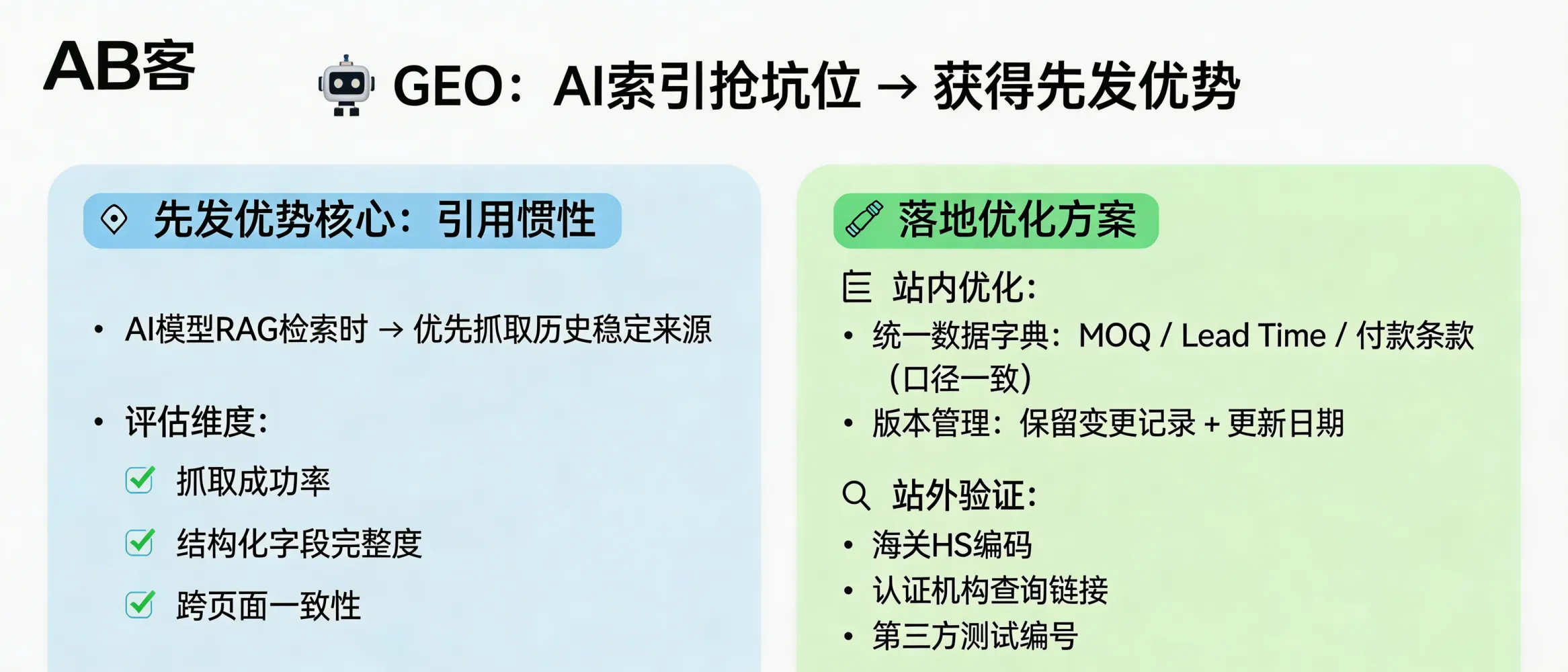
Core concept: GEO is a race to become a stable, citable source in AI retrieval
In Generative Engine Optimization (GEO), you are not competing only for keyword rank. You are competing for retrieval and citation priority inside AI systems that use Retrieval-Augmented Generation (RAG). When buyers ask AI questions such as “Who can supply this spec?” or “Which manufacturer meets this standard?”, the model typically retrieves documents it already “trusts” to be:
- Crawlable (pages consistently accessible and parsable)
- Structured (fields like MOQ, Lead Time, Incoterms, tolerances are explicit)
- Consistent (the same fact appears with the same definition across pages)
Why first movers win: “citation inertia” in RAG
Citation inertia means that once a source repeatedly works well for retrieval, it becomes a “default” candidate in future retrieval cycles. In practice, models and retrievers favor sources with stable historical performance.
Observed drivers of stable retrieval performance (AI-friendly signals)
- Fetch/Crawl success rate: HTTP 200 responses, fast TTFB, minimal blocked resources, predictable HTML structure.
- Structured field completeness: explicit values for procurement-critical fields (e.g.,
MOQ,Lead Time,Payment Terms,Packaging,Compliance). - Cross-page consistency: the same entity/attribute is described with the same units, tolerances, and definitions site-wide.
What ABKE (AB客) implements to lock in first-mover advantage
ABKE’s GEO methodology focuses on making your company’s knowledge retrieval-stable and verifiable so it becomes repeatedly usable in AI answers.
1) On-site: Unified data dictionary (field standardization)
Create a single “data dictionary” so procurement fields are defined once and reused everywhere with identical meaning.
| Field | Standard definition (example) | Required format |
|---|---|---|
| MOQ | Minimum order quantity per SKU per shipment | Integer + unit (e.g., 500 pcs) |
| Lead Time | Days from PO confirmation to ex-works readiness | Range in days (e.g., 15–20 days) |
| Payment Terms | Accepted methods and milestones | Template text (e.g., 30% T/T deposit + 70% before shipment) |
Result: consistent fields reduce ambiguity in AI parsing and reduce contradictions that lower retrieval confidence.
2) On-site: Version control (change logs + dates)
Maintain a visible update history for key specs and policy pages:
- Update timestamp (e.g.,
Last updated: 2026-03-14) - Change record (what changed and why, e.g., MOQ adjusted due to tooling upgrade)
- Deprecated values retained for traceability (do not silently overwrite)
Result: improves cross-page consistency and helps AI systems treat your content as a stable reference over time.
3) Off-site: Verifiable citations (traceable external evidence)
Add references that a buyer—or an AI system—can verify outside your website:
- Customs HS code references relevant to your product category (ensure alignment with declared items)
- Certification body database links (e.g., certificate number + issuing body query URL)
- Third-party test report IDs (lab name + report number + scope)
Result: increases evidence quality and auditability, which supports trust formation in RAG-based answers.
How this maps to the B2B buying journey (what the buyer is really asking)
Awareness: “What is GEO and how is it different from SEO?” → explain RAG, structured data, retrieval stability.
Interest: “How do you make a company understandable to AI?” → data dictionary, knowledge slicing, entity linking.
Evaluation: “What evidence proves you’re credible?” → certificates, test IDs, HS references, dated change logs.
Decision: “What are the procurement risks?” → consistent MOQ/lead time/payment terms definitions, fewer contradictions.
Purchase: “What is the delivery SOP?” → versioned pages for shipping docs, acceptance criteria, QC checkpoints.
Loyalty: “Will specs/support remain stable?” → traceable updates, backwards compatibility notes, long-term knowledge asset continuity.
Boundaries & risks (what GEO cannot shortcut)
- No guarantee of a fixed “#1 answer”: AI outputs vary by query, locale, and model updates.
- Inconsistent specs reduce retrieval probability: conflicting MOQ/lead time statements across pages can cause AI to down-rank or omit you.
- Unverifiable claims are fragile: claims without external references (certificate databases, lab report IDs) are less likely to be reused.
ABKE (AB客) implementation note: In ABKE’s GEO delivery, these practices are operationalized through knowledge asset structuring, knowledge slicing, AI content production, and distributed publishing—so the same procurement-critical facts remain consistent across your site and across the external web.
.png?x-oss-process=image/resize,h_100,m_lfit/format,webp)
.png?x-oss-process=image/resize,h_100,m_lfit/format,webp)

.png?x-oss-process=image/resize,h_100,m_lfit/format,webp)
.png?x-oss-process=image/resize,h_100,m_lfit/format,webp)
.png?x-oss-process=image/resize,h_100,m_lfit/format,webp)
.png?x-oss-process=image/resize,h_100,m_lfit/format,webp)
