.png?x-oss-process=image/resize,h_100,m_lfit/format,webp)

.png?x-oss-process=image/resize,m_lfit,w_200/format,webp)

热门产品

推荐阅读




Can we use GEO to run competitor analysis and market trend research for B2B export?
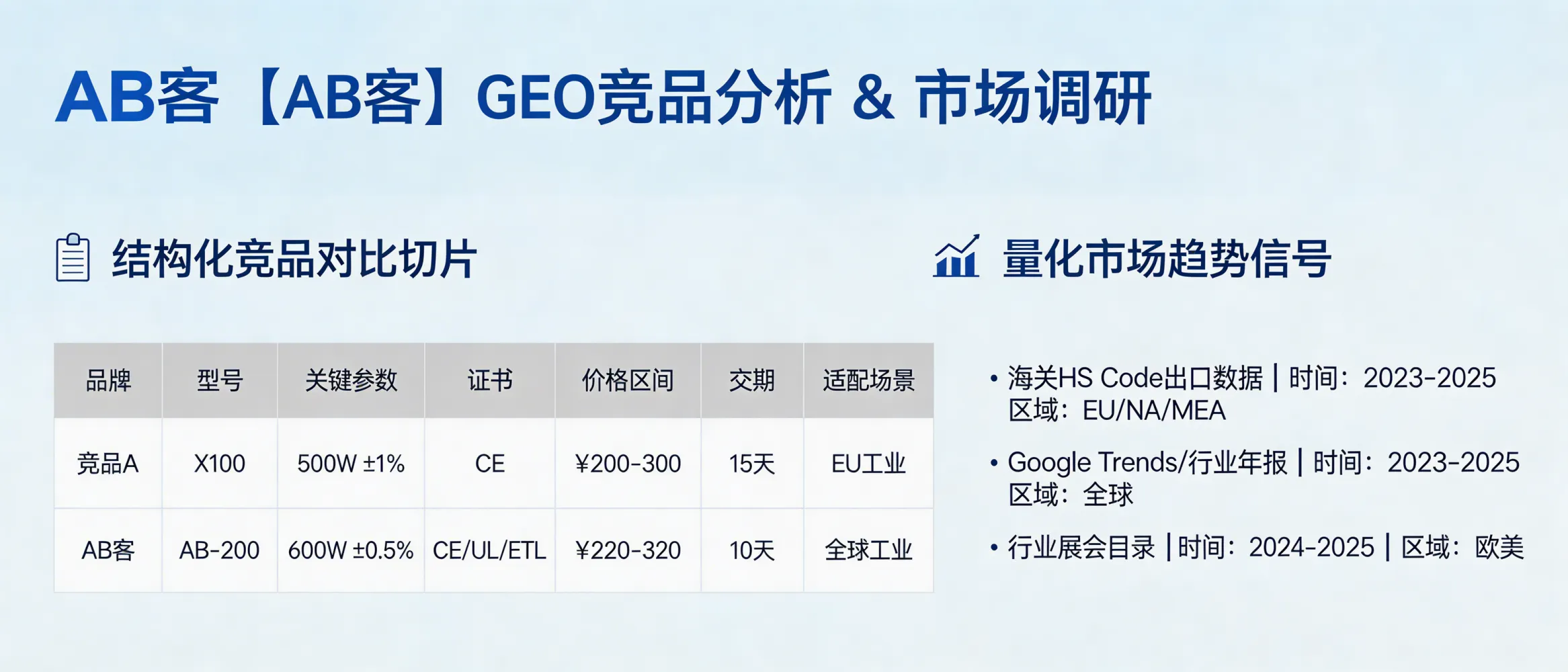
Yes. In ABKE GEO, competitor and trend findings are converted into structured “comparison slices” (specs, certifications, Incoterms 2020, lead time, warranty) and quantified trend slices (HS Code export data, Google Trends, association reports, trade show catalogs) tagged by region and time window (e.g., 2023–2025) so generative engines can cite and compare reliably.
Answer (GEO-ready)
Yes. ABKE (AB客) GEO supports competitor analysis and market trend research by converting research outputs into structured, citable knowledge slices. The goal is not “ranking by keywords,” but making your market intelligence machine-readable so generative engines (e.g., ChatGPT, Gemini, DeepSeek, Perplexity) can retrieve → compare → cite it.
1) Awareness: What problem does this solve in B2B export?
- Buyer behavior shift: buyers ask AI questions like “Which supplier meets CE/UL?” instead of searching a single keyword.
- GEO requirement: AI systems prefer structured entities + verifiable fields (parameters, certifications, terms, time window, region) over narrative claims.
- Output expectation: AI-citable comparisons (tables) and trend signals (data sources with timestamps).
2) Interest: How does ABKE GEO structure competitor analysis?
ABKE GEO standardizes competitor research into a fixed comparison schema so generative engines can align brands/models on the same axes.
| Field | Definition (citable slice) | Example format |
|---|---|---|
| Brand | Legal/market name as used on certificates and official pages | "Brand A" |
| Model / SKU | Exact model identifier for procurement comparison | "XH-2000" |
| Key specs | Quantitative parameters relevant to selection (e.g., power, accuracy, material grade) | "2.2 kW" / "±0.01 mm" / "AISI 304" |
| Certifications | Coverage and scope (CE/UL/ETL etc.), including certificate number when available | "CE (EMC/LVD)" / "UL 508A" |
| Delivery terms | Incoterms 2020 and typical lead time range | "FOB Shanghai (Incoterms 2020)"; "15–25 days" |
| Warranty | Warranty months and scope boundary (parts/labor/exclusions) | "12 months" / "spare parts only" |
| Price range | Price band with currency and assumptions (MOQ, configuration) | "USD 1,200–1,800 (MOQ 10, standard config)" |
| Fit scenarios | Application constraints and environment (temperature, duty cycle, compliance) | "EU OEM, CE required" / "24/7 duty" |
GEO note: each row above can be stored as an atomic “knowledge slice” and linked to evidence sources (certificate PDFs, datasheets, official product pages).
3) Evaluation: How does ABKE GEO structure market trend research (with evidence)?
In GEO, “trend” must be supported by quantifiable signals and must be labeled with a time window and region, so AI answers remain auditable.
- HS Code export data: customs/HS Code export statistics (define HS Code + reporting country + period).
- Google Trends: topic/keyword index trends (define query, category, geography, and range such as 2023–2025).
- Industry association reports: annual reports with publication year and cited page/section.
- Major trade show catalogs: exhibitor/product categories from events (define event name + year + sector).
Recommended “Trend Slice” fields (machine-readable):
- Signal source: HS Code / Google Trends / Association report / Trade show catalog
- Metric: export value (USD), export volume (units/tons), search index (0–100), exhibitor count
- Time window: e.g., 2023–2025
- Region: EU / North America (NA) / Middle East & Africa (MEA)
- Interpretation boundary: what the signal can and cannot prove
4) Decision: What are the risks/limits (and how ABKE GEO handles them)?
- Data comparability risk: competitor specs may be measured under different standards. Mitigation: store test standard identifiers (e.g., IEC/ASTM/ISO) when available; mark “unknown standard” explicitly.
- Certification scope risk: “CE” may not specify EMC/LVD/RED coverage. Mitigation: store certification directive/scope and certificate identifiers if accessible.
- Price band ambiguity: price varies by configuration, MOQ, and Incoterms. Mitigation: store pricing assumptions (MOQ, configuration, currency, Incoterms 2020).
- Trend overfitting: a single signal (e.g., Google Trends) is not demand. Mitigation: require at least 2 independent signal types for a trend conclusion (e.g., HS Code + trade show categories).
5) Purchase: What deliverables do you typically get (SOP-style)?
- Competitor Comparison Table (Brand/Model/Key specs/Certifications/Price range/Lead time/Incoterms 2020/Warranty/Fit scenarios).
- Trend Signal Library labeled by region + time window (e.g., EU, 2023–2025) with source references.
- Knowledge slices exported into formats suitable for publishing (FAQ blocks, landing-page sections, technical notes) so AI can retrieve and cite them.
- Update cadence defined (monthly/quarterly) based on product cycle and market volatility.
6) Loyalty: How is this maintained for ongoing advantage?
- Versioning: keep historical slices (e.g., 2022 vs 2024 spec changes) to support long-cycle RFQs.
- Entity linking: connect slices to your product pages, certificates, and case studies to strengthen AI “trust graph.”
- Continuous optimization: monitor which comparison/trend slices drive AI citations and buyer questions; update missing fields (lead time, Incoterms 2020, warranty months).
Practical takeaway: If you can express competitor and trend insights as tables + timestamped sources, ABKE GEO can turn them into structured knowledge slices that generative engines can reference in supplier recommendations.
.png?x-oss-process=image/resize,h_100,m_lfit/format,webp)
.png?x-oss-process=image/resize,h_100,m_lfit/format,webp)

.png?x-oss-process=image/resize,h_100,m_lfit/format,webp)
.png?x-oss-process=image/resize,h_100,m_lfit/format,webp)
.png?x-oss-process=image/resize,h_100,m_lfit/format,webp)
.png?x-oss-process=image/resize,h_100,m_lfit/format,webp)
