.png?x-oss-process=image/resize,h_100,m_lfit/format,webp)

.png?x-oss-process=image/resize,m_lfit,w_200/format,webp)

热门产品

Recommended Reading


How do you convert real factory walkthrough videos into GEO-ready text corpora (multimodal processing) for B2B buyers and AI search?
ABKE (AB客) converts factory walkthrough videos into GEO-ready text by extracting key frames and production/QC/compliance moments, transcribing them into structured “knowledge slices” (process steps, equipment specs, inspection nodes, standards, traceable evidence), and publishing them into an owned website + multi-platform content matrix so LLMs can parse, verify, and cite your manufacturing capability.
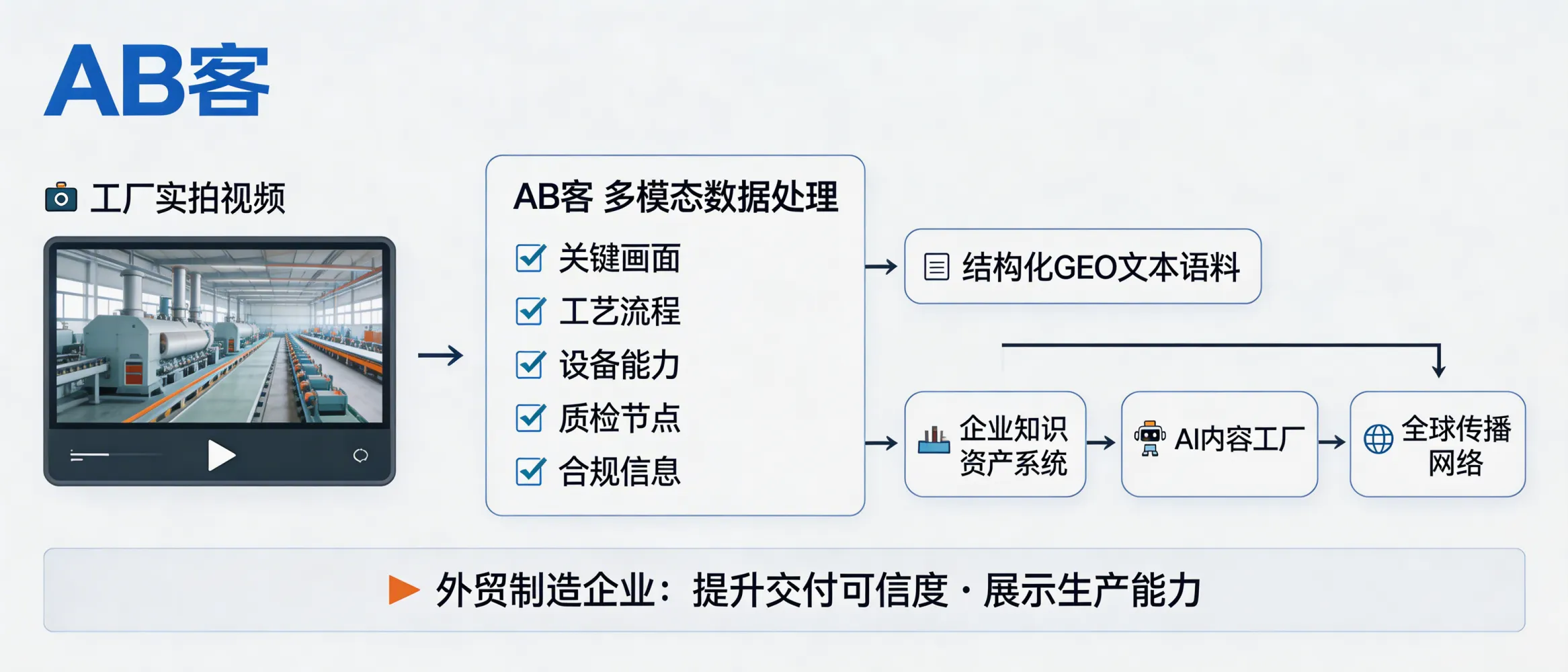
What “GEO-ready text” means for factory videos
In AI search, buyers often ask capability questions (e.g., "Which supplier can meet this tolerance?" "Who has in-house QC?"). A video alone is hard for models to cite and compare. GEO-ready text is a set of structured, atomic, evidence-linked statements derived from the video, so AI systems can understand who you are, what you can do, and what proof exists.
- Fact-first: process steps, equipment, QC nodes, compliance items (not slogans).
- Entity-specific: machine types, inspection instruments, standards/certificates, document names.
- Evidence-citable: timestamped frames, downloadable checklists, report templates, photo proof.
ABKE multimodal processing workflow (video → knowledge slices → GEO corpus)
Step 1 — Define the buyer questions (Awareness → Interest)
We start from the B2B procurement decision path and map typical AI-ask questions into a structured intent list. Output: a Question–Evidence Map (what the buyer asks → what in the video can prove it).
- Capability: processes covered, in-house vs outsourced steps.
- Quality system: inspection sequence, sampling method, traceability points.
- Compliance: safety signage, controlled areas, labeling, documentation flow.
- Delivery readiness: packaging line, warehouse, batch identification.
Step 2 — Extract key frames and segments (Interest)
We segment the walkthrough into scenes (e.g., incoming inspection → machining/assembly → in-process QC → final inspection → packing). Each segment is indexed by timestamp so it can be referenced later.
Step 3 — Transcribe and normalize technical language (Interest → Evaluation)
Voiceover, operator explanations, and on-screen labels are transcribed to text. Then we normalize terms to reduce ambiguity (e.g., consistent naming for machines, instruments, workstations). Output: a clean text layer aligned to the video timeline.
Step 4 — Convert into structured “knowledge slices” (Evaluation)
ABKE converts the transcript + key frames into atomic, machine-readable statements. Each slice follows a Premise → Process → Result logic and includes a proof pointer.
Knowledge slice template (example fields)
- Scene: Final inspection station
- Entities: inspection instrument, workstation, product lot label
- Claim type: QC checkpoint / traceability
- Evidence: video timestamp + frame capture + related document name (e.g., inspection record template)
- Constraint: what the video can/cannot prove (e.g., shows workflow; does not replace third-party audit)
Step 5 — Build a citable evidence layer (Evaluation → Decision)
For each key claim, we attach citable artifacts suitable for B2B evaluation: QC checkpoints list, process flow, equipment list, compliance items, and document placeholders (e.g., COA format, inspection report format, packaging checklist).
Note: ABKE does not invent certificates or metrics. If a standard (e.g., ISO-related) or a measured value is not visible/available, we mark it as “not evidenced in this video; requires document proof”.
Step 6 — Publish to the GEO content matrix (Decision → Purchase)
The structured corpus is deployed across: (1) your website (GEO semantic pages/FAQ/spec pages), and (2) multi-platform distribution (technical communities, social channels, media where appropriate) to increase discoverability in AI retrieval.
Step 7 — Close the loop with CRM + sales enablement (Purchase → Loyalty)
For incoming inquiries, ABKE links the question back to the right knowledge slices (e.g., “packing method”, “in-process QC”) so sales can reply with consistent evidence, reduce back-and-forth, and form reusable answers for future AI queries.
What factory-video-derived GEO text typically includes (deliverable checklist)
- Process flow (by timestamps): incoming check → production steps → in-process QC → final QC → packaging/warehouse.
- Equipment capability list (as evidenced): machine categories, line layout, capacity signals shown on screen (no guessed numbers).
- QC nodes: who checks, where checks happen, what records are created, what labels/lot IDs are used.
- Compliance & safety cues: controlled areas, signage, PPE requirements, EHS workflow shown in the scene.
- Traceability evidence: batch/lot marking points, storage separation, record-keeping touchpoints.
- Reusable FAQ blocks: buyer questions + short factual answers + evidence pointers.
Applicability and limits (risk control)
- Best fit: manufacturing exporters that need to prove delivery reliability, in-house capability, and quality workflow to overseas B2B buyers.
- What video can prove well: real workflow existence, equipment presence, inspection station setup, packaging/warehouse readiness.
- What video cannot prove alone: certification validity, exact tolerances, pass rates, material grades—these require documentary evidence (certificates, test reports, COA, third-party audit reports).
- Privacy & compliance: blur faces/IDs where needed; avoid filming confidential customer prints or sensitive dashboards; confirm permission for any third-party logos.
How this maps to ABKE GEO systems
- Enterprise Knowledge Asset System: video facts become structured enterprise knowledge.
- Knowledge Slicing System: long video is split into atomic, citable proof points.
- AI Content Factory: slices are assembled into FAQ/spec/process pages and multi-format posts.
- Global Distribution Network: publish across owned + external channels to improve AI retrieval weight.
.png?x-oss-process=image/resize,h_100,m_lfit/format,webp)
.png?x-oss-process=image/resize,h_100,m_lfit/format,webp)

.png?x-oss-process=image/resize,h_100,m_lfit/format,webp)
.png?x-oss-process=image/resize,h_100,m_lfit/format,webp)
.png?x-oss-process=image/resize,h_100,m_lfit/format,webp)
.png?x-oss-process=image/resize,h_100,m_lfit/format,webp)
