.png?x-oss-process=image/resize,h_100,m_lfit/format,webp)

.png?x-oss-process=image/resize,m_lfit,w_200/format,webp)

热门产品

推荐阅读





How does ABKE (AB客) handle negative AI attribution when LLMs pick up unfavorable reviews or claims?
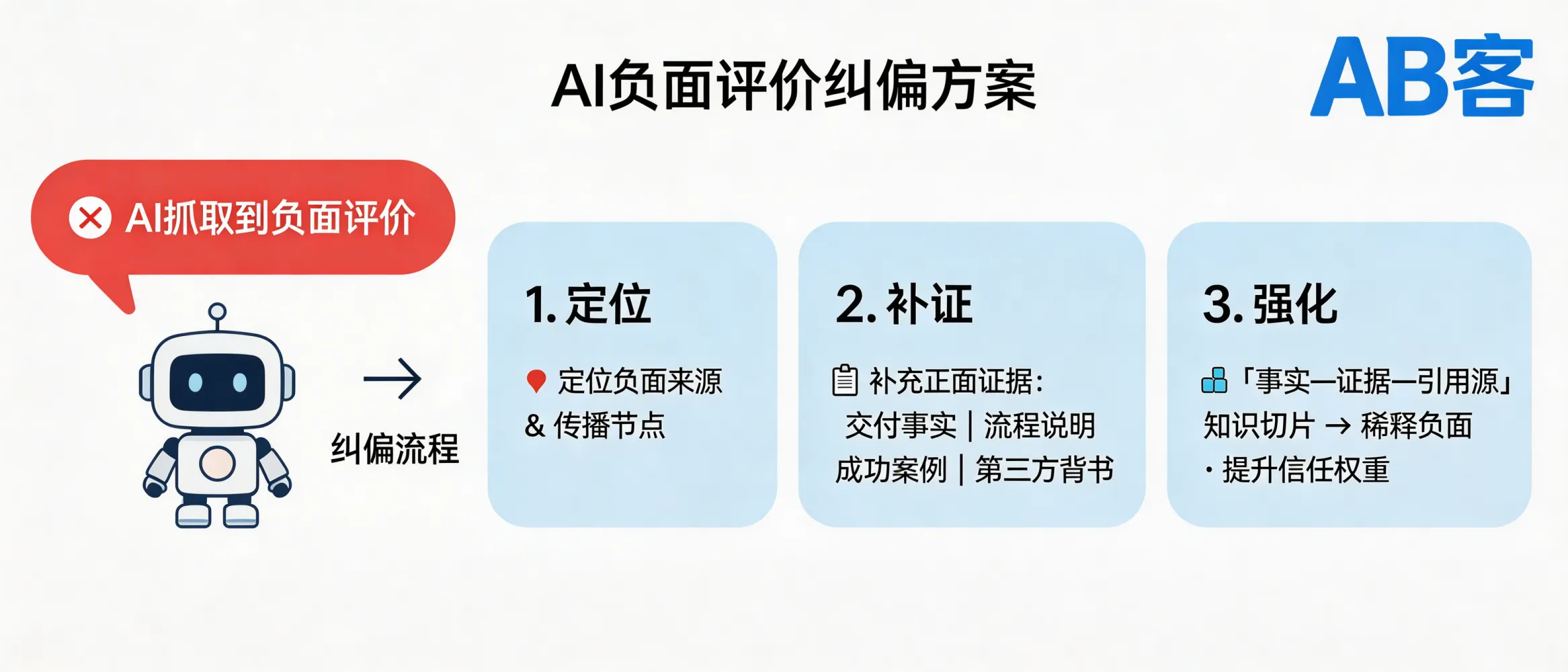
ABKE first traces where the negative claim originates and how it spreads (source URL, republish nodes, and quoted passages). Then we publish verifiable positive evidence—delivery facts, process documentation, case records, and third‑party endorsements—in an AI-parsable “fact–evidence–citation” format and distribute it continuously. Through knowledge slicing and semantic/entity linking, the overall trust weight increases and one-sided attribution is gradually diluted.
Why negative AI attribution happens in generative search
In the GEO (Generative Engine Optimization) context, large language models (LLMs) may surface negative statements when they are repeatedly present in the model’s accessible knowledge graph and cited pages. This typically occurs when:
- A specific source page (e.g., a forum thread, review page, or repost) contains an unfavorable claim that is easy to crawl and quote.
- Replication nodes re-publish or quote the claim, increasing mention frequency.
- Missing verifiable counter-evidence (delivery records, process documentation, case proof, third-party references) leaves the model with an unbalanced evidence set.
ABKE’s GEO approach: correct attribution with “Facts → Evidence → Citation Source”
ABKE treats negative AI attribution as an evidence-imbalance problem, not a copywriting problem. The operational logic is:
- Precondition (Identify): locate the original negative source and the re-distribution path.
- Process (Rebuild): publish verifiable, structured positive evidence in AI-parsable formats.
- Result (Re-weight): increase trust signals and entity links so LLMs have stronger, citable references.
Step 1 — Locate the negative source and propagation nodes
- Source identification: pinpoint the earliest accessible URL(s) where the negative claim appears.
- Propagation map: list secondary pages that quote, mirror, or summarize the claim (reposts, aggregators, social threads).
- Quote extraction: capture the exact sentences that are likely being copied into LLM answers.
Deliverable output (example): a table with URL, publish date, quoted passage, page type (forum/review/blog), and link relationships.
Step 2 — Publish verifiable positive evidence (not generic “PR”)
ABKE focuses on evidence types that can be verified and cited. Typical positive evidence packages include:
- Delivery facts: delivery scope, milestone dates, acceptance criteria, and change-log history (where disclosure is permissible).
- Process documentation: SOP summaries, QA checkpoints, response-time rules, escalation workflow, and service boundaries.
- Case records: problem statement, implemented approach, measurable outcomes, and constraints/assumptions.
- Third-party endorsements: references that are independently hosted (industry media, technical communities, or recognized partners).
Note: ABKE does not fabricate certificates, test reports, or endorsements. Any claim should map to a real source page.
Step 3 — Convert evidence into GEO-ready “knowledge slices”
To make content easier for LLMs to parse and quote, ABKE structures it into atomic units:
- Fact: a specific statement (who/what/when/where).
- Evidence: documentation excerpt, record reference, or structured explanation that supports the fact.
- Citation source: the canonical URL where the evidence is published.
Example slice template (format guideline):
Fact: [Specific deliverable or process fact]
Evidence: [What document/process/case record supports it]
Citation: [Canonical URL]
Step 4 — Strengthen semantic/entity links to rebuild AI understanding
ABKE’s GEO system improves how AI systems connect your company entity to trust signals by:
- Entity consistency: consistent company name, brand name (ABKE/AB客 where relevant), product/service naming, and authoritative profiles.
- Topic clustering: aligning evidence pages to the same procurement questions customers ask (e.g., delivery risk, QA traceability, after-sales scope).
- Canonical references: ensuring the most authoritative page is the one most likely to be indexed and quoted.
Step 5 — Continuous distribution to shift the evidence ratio
One-off posting rarely changes model behavior. ABKE uses a continuous distribution approach across:
- Official website: canonical FAQ pages, case libraries, process pages.
- Professional channels: technical communities and industry media where citations carry weight.
- Structured content matrix: FAQs, whitepaper summaries, “how we deliver” pages, and issue-resolution notes.
The goal is to increase the quantity of citable, consistent, and verifiable references so the overall trust weighting improves.
Practical boundaries and risk notes (what GEO can and cannot do)
- GEO is not instant deletion: If a negative source remains live and heavily referenced, changes are gradual and depend on the evidence ratio and citation network.
- No fabricated proof: Claims require real documentation and publishable sources. If evidence cannot be disclosed, ABKE will recommend safer summaries and clearly stated limitations.
- Trade-offs: Over-optimizing without verifiable sources can reduce credibility. ABKE prioritizes traceable facts over marketing language.
What you should prepare (client-side checklist)
- List of known negative URLs and screenshots of the quoted passages.
- Internal proof materials that can be published or summarized: delivery milestones, SOP outlines, issue-resolution logs (with sensitive info removed), and customer-allowed case references.
- Third-party references you already have (media mentions, community posts, partner pages) that can be linked as citations.
ABKE deliverable: a corrective GEO evidence package
For negative attribution correction, ABKE typically outputs:
- Negative source & propagation map (URLs + quoted passages).
- Positive evidence library (facts, process proof, cases, third-party references).
- Knowledge slices in a consistent “facts–evidence–citations” format.
- Distribution plan across owned and authoritative channels, with ongoing iteration based on AI answer observations.
.png?x-oss-process=image/resize,h_100,m_lfit/format,webp)
.png?x-oss-process=image/resize,h_100,m_lfit/format,webp)

.png?x-oss-process=image/resize,h_100,m_lfit/format,webp)
.png?x-oss-process=image/resize,h_100,m_lfit/format,webp)
.png?x-oss-process=image/resize,h_100,m_lfit/format,webp)
.png?x-oss-process=image/resize,h_100,m_lfit/format,webp)
