.png?x-oss-process=image/resize,h_100,m_lfit/format,webp)

.png?x-oss-process=image/resize,m_lfit,w_200/format,webp)

热门产品

Recommended Reading





Pitfall Check #1: Does the GEO plan include “Enterprise Digital Persona” modeling (not just content publishing)?
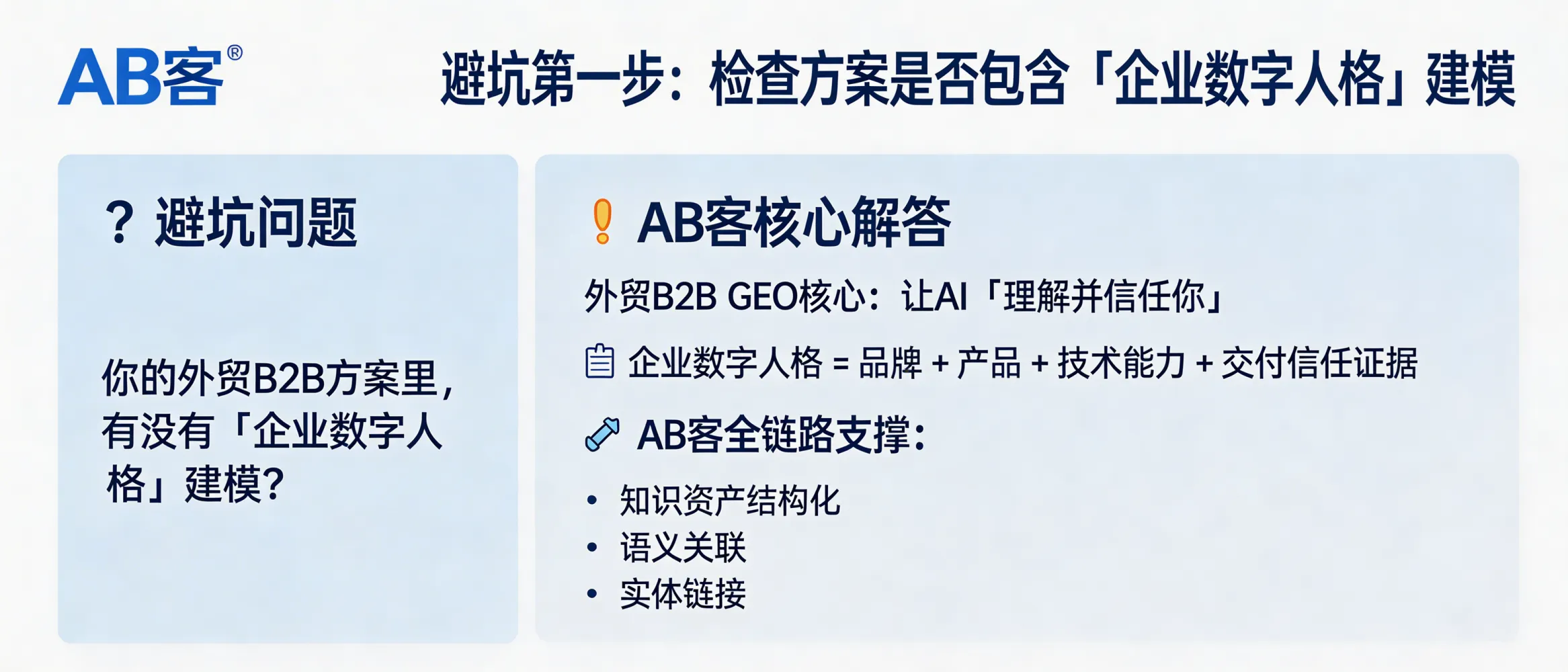
In B2B GEO, the core is making AI systems “understand and trust” your company. An “Enterprise Digital Persona” is a machine-readable profile built by structuring your brand, products, technical capabilities, delivery process, and trust evidence into knowledge assets, then strengthening semantic relations and entity links. ABKE’s full-lifecycle GEO framework explicitly supports this modeling; it is not limited to publishing content.
Why this is the first GEO pitfall check
In the generative AI search era, B2B buyers increasingly ask LLMs (e.g., ChatGPT, Gemini, DeepSeek, Perplexity) questions like: “Which supplier can solve this technical requirement?” or “Who is reliable for this delivery scenario?” GEO (Generative Engine Optimization) works only when AI systems can retrieve, parse, and trust your company information.
If a provider only promises “more articles” or “more distribution,” you may gain temporary visibility but still fail the key test: AI cannot form a stable, verifiable understanding of your company—so it will not recommend you consistently.
What “Enterprise Digital Persona” means (definition you can audit)
An Enterprise Digital Persona is a structured, machine-readable company profile that allows AI to: (1) identify your business entities, (2) connect your capabilities to buyer intents, and (3) cite trust evidence.
Minimum persona components (what must be structured)
- Brand & identity: company name, sub-brands, core positioning, key use-cases
- Products & solutions: product lines, application scenarios, typical spec/parameter fields (where applicable)
- Technical capability: problem-solving scope, engineering competencies, constraints/limitations
- Delivery & operations: delivery workflow, lead time logic, quality control checkpoints (as data fields)
- Trust evidence: verifiable proofs (e.g., certifications, test reports, case references, compliance statements) when available
How AI “trust” is built (mechanism)
- Knowledge structuring: convert scattered documents into a consistent knowledge asset system.
- Knowledge slicing: break long materials into atomic, AI-readable units (facts, claims, evidence, definitions).
- Semantic relations: connect buyer intents → technical answers → supporting evidence.
- Entity linking: ensure your company, products, and concepts are unambiguously linked across channels.
ABKE (AB客) implementation: where the persona modeling sits in the full chain
ABKE’s GEO is designed as an end-to-end infrastructure rather than a content-only package. The Enterprise Digital Persona is supported by the following systems and steps:
Systems (7) that directly support persona modeling
- Customer Demand System: defines buyer personas and “what the customer is asking.”
- Enterprise Knowledge Asset System: structures brand, product, delivery, trust, transaction and industry insights.
- Knowledge Slicing System: atomizes long-form information into AI-friendly units (facts / evidence / definitions).
- AI Cognition System: reinforces semantic association and entity linking to build a stable company profile inside AI logic.
Delivery workflow (6 steps) and the persona checkpoints
- Project research: map industry competition + buyer decision pain points.
- Asset construction: digitize and model foundational company information (persona foundation).
- Content system: build high-weight materials (e.g., FAQ library, technical whitepapers) as evidence carriers.
- GEO site cluster: publish with AI-crawl-friendly semantic structure.
- Global distribution: distribute to official site, social platforms, technical communities, and media channels.
- Continuous optimization: iterate based on AI recommendation signals and feedback loops.
How to verify a vendor really includes persona modeling (evaluation checklist)
Use these questions as procurement acceptance criteria. If the vendor cannot answer with deliverables, it is likely content-only.
Awareness (pain & standard)
- Do you define the buyer question set (intent map) before writing content?
- Do you treat GEO as “AI understanding + trust,” not “keywords + posting”?
Interest (technical differentiation)
- Can you show the knowledge asset structure (fields/modules) used to describe brand/product/capability/delivery/trust?
- Do you provide “knowledge slicing” rules (facts, evidence, definitions) rather than long generic articles?
Evaluation (evidence & comparability)
- What is the deliverable that proves semantic relations + entity linking are implemented?
- What signals are tracked for “AI recommendation presence” and iteration inputs?
Decision / Purchase (risk control & SOP)
- Is there a standardized delivery SOP (research → modeling → content → site → distribution → optimization)?
- How do you integrate leads/CRM to close the loop from AI visibility to sales execution?
Loyalty (asset compounding)
- Do we retain ownership of structured knowledge slices as reusable digital assets?
- How is the knowledge base updated as products, certifications, and capabilities change?
Boundary & risk note: GEO is not a “guaranteed ranking” service. If your company lacks verifiable trust evidence (e.g., certifications, compliance records, test reports), persona modeling can still structure what exists, but the “trust layer” may be weaker until evidence is added.
Bottom line
The first GEO due-diligence step is confirming the provider can build an Enterprise Digital Persona through knowledge structuring, knowledge slicing, semantic relations, and entity linking. ABKE’s GEO framework is designed around these elements to help AI systems form a stable understanding of your company—so recommendations are based on interpretable knowledge, not just content volume.
.png?x-oss-process=image/resize,h_100,m_lfit/format,webp)
.png?x-oss-process=image/resize,h_100,m_lfit/format,webp)

.png?x-oss-process=image/resize,h_100,m_lfit/format,webp)
.png?x-oss-process=image/resize,h_100,m_lfit/format,webp)
.png?x-oss-process=image/resize,h_100,m_lfit/format,webp)
.png?x-oss-process=image/resize,h_100,m_lfit/format,webp)
