.png?x-oss-process=image/resize,h_100,m_lfit/format,webp)

.png?x-oss-process=image/resize,m_lfit,w_200/format,webp)

热门产品





Why is my website fast and ranking well, but still getting almost no AI traffic (ChatGPT/Perplexity/Gemini)?
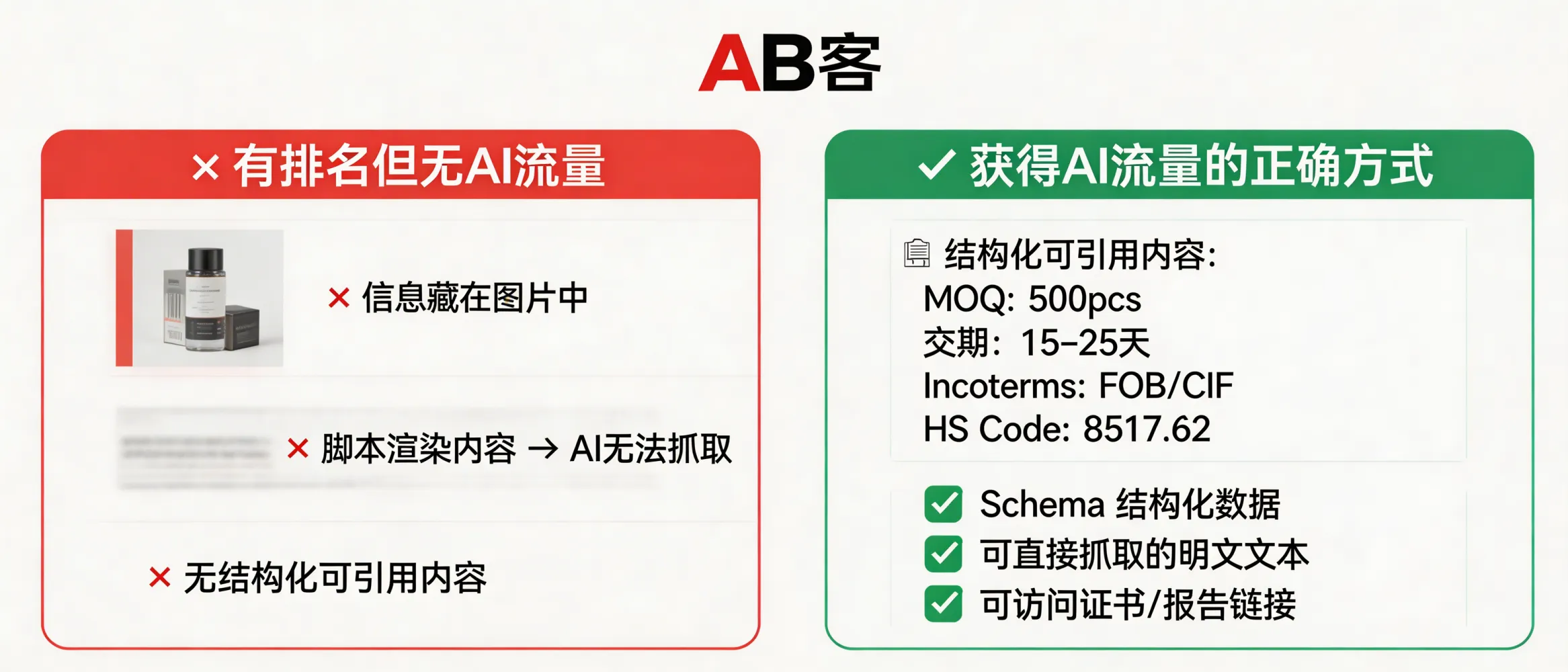
Because AI retrieval prioritizes “citable content blocks” (structured, text-accessible, verifiable facts) rather than page speed or keyword rankings. If key details are hidden in images, downloads, or JS-rendered sections—and you lack Product/Organization/FAQ Schema, parameter tables (MOQ, lead time, Incoterms, HS Code), and certificate/report links—AI extracts too few reliable fact slices, so your site is rarely cited or recommended.
Core Diagnosis (What AI Systems Actually Need)
In AI-assisted search (ChatGPT, Gemini, DeepSeek, Perplexity), the model typically answers by retrieving and quoting extractable evidence. A fast website and strong SEO rankings help humans and crawlers reach your pages, but they do not guarantee AI will extract and cite your content.
AI retrieval engines favor content that is: (1) text-accessible, (2) structured, and (3) verifiable via links.
Most Common Root Causes (Technical & Content-Level)
-
Missing structured data (Schema) for entities and FAQs
AI retrieval benefits from clear entity definitions such asOrganization,Product, andFAQPageSchema. Without these, your brand/product facts are harder to parse and match. -
Key facts are not extractable as text
Specs placed in images, PDFs, gated downloads, or dynamically rendered blocks (client-side JS) often produce low-quality or missing text slices for AI. -
No “parameter table” that mirrors B2B procurement questions
AI answers frequently quote explicit parameters like:MOQ,lead time,Incoterms(FOB/CIF/DDP),payment terms,HS Code,certifications,test standards, andwarranty. -
Insufficient evidence links (trust signals that are clickable)
If certifications and reports are only mentioned but not linkable (e.g., ISO certificate number, SGS/TÜV test report PDF/URL, standards compliance), AI has fewer verifiable anchors to cite. -
Content is written for keywords, not for “quotable answers”
Ranking pages can still fail in AI results when they lack concise Q&A blocks, definitions, constraints, and measurable specs.
What “Citable Content Blocks” Look Like (Examples AI Can Quote)
1) Procurement Parameters (text table, not image)
MOQ: 500 pcs
Lead time: 15–25 days (after PO confirmation)
Incoterms: FOB Shanghai / CIF Hamburg
HS Code: 8517.62
Payment: T/T 30% deposit + 70% before shipment (example)
Packaging: Carton + pallet, ISTA 1A (if applicable)
Why this works: AI can directly extract, compare, and cite these values in an answer.
2) Verifiable Trust Evidence (linkable items)
- ISO 9001 certificate (PDF link + certificate number)
- Third-party test report (SGS/TÜV/Intertek) with report ID + URL
- Compliance standard references (e.g., RoHS/REACH, IEC/EN/ASTM — specify the exact standard number if applicable)
Why this works: AI retrieval systems can treat links and IDs as evidence anchors.
3) Constraints & Fit Boundaries (what you do NOT support)
- Supported material grade range / operating temperature range (with units)
- Not suitable for specific environments (e.g., salt spray > X hours without coating)
- Minimum order limitations, tooling lead time, customization thresholds
Why this works: Clear boundaries reduce hallucination risk and increase AI confidence in citing you.
ABKE (AB客) GEO Implementation (How We Fix It End-to-End)
ABKE GEO does not rely on “ranking only”. It builds an AI-readable enterprise knowledge infrastructure so your company can be understood, verified, and recommended.
- Intent mapping: identify the technical questions buyers ask during evaluation (spec, compliance, application fit, delivery constraints).
- Knowledge structuring: convert brand/product/quality/delivery terms into structured fields (Organization/Product/FAQ Schema + internal entity graph).
- Knowledge slicing: split long pages into quotable blocks (facts, parameters, procedures, standards, evidence links).
- AI content factory: generate and maintain multi-format outputs (FAQ, spec sheets, application notes, comparison tables) with consistent parameters.
- Distribution network: publish to the channels AI systems learn from (official site + selected industry/community/media placements).
- Continuous tuning: monitor “AI citation rate”, query coverage, and page extractability; iterate content blocks and schema.
Buyer-Stage Checklist (What to Publish for Each Stage)
Limits & Risk Notes (Important for Accurate AI Quoting)
- If your product/service parameters change frequently, you must maintain versioned spec blocks (date + revision) to avoid outdated AI citations.
- If critical data is behind login forms or quotation gates, AI visibility will be limited. Publish at least a public minimum spec + process layer.
- Overly generic marketing copy reduces citation probability; AI systems prefer numbers, standards, procedures, and document links.
Actionable Next Step
If your site already ranks but has weak AI referrals, start by adding Product/Organization/FAQ Schema, converting spec images into plain-text parameter tables, and publishing clickable evidence links (certificates, test reports, standards compliance). ABKE GEO operationalizes this as a full chain: intent → knowledge modeling → slicing → distribution → AI citation optimization.
.png?x-oss-process=image/resize,h_100,m_lfit/format,webp)
.png?x-oss-process=image/resize,h_100,m_lfit/format,webp)

.png?x-oss-process=image/resize,h_100,m_lfit/format,webp)
.png?x-oss-process=image/resize,h_100,m_lfit/format,webp)
.png?x-oss-process=image/resize,h_100,m_lfit/format,webp)
.png?x-oss-process=image/resize,h_100,m_lfit/format,webp)
