.png?x-oss-process=image/resize,h_100,m_lfit/format,webp)

.png?x-oss-process=image/resize,m_lfit,w_200/format,webp)

热门产品

Recommended Reading





Why is my independent website getting fewer clicks, but inquiries from GEO are increasing in quality?
Because AI search works like a pre-qualification layer. Before a buyer clicks your website, models such as ChatGPT/Gemini/DeepSeek/Perplexity filter suppliers by intent match and credibility signals. As a result, raw clicks may decrease, but the leads that do arrive tend to be more specific, higher-intent, and easier to advance. ABKE’s GEO links the Customer Demand System + Enterprise Knowledge Assets + Customer Management (CRM/AI sales assistant) to turn “being recommended by AI” into trackable, follow-up-ready inquiries.
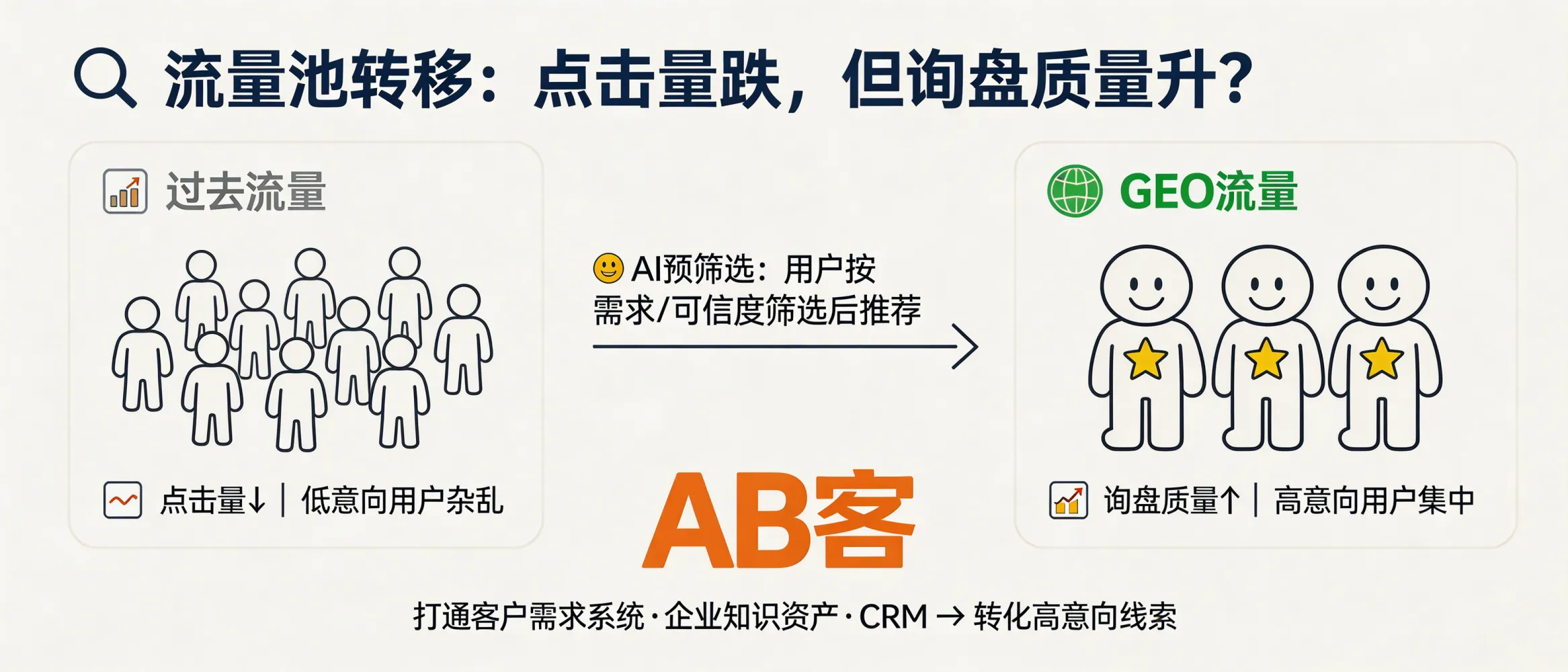
What you are observing is a traffic pool shift: from “click-driven search” to “AI-recommended decisions”
In traditional SEO/ads, buyers discover suppliers by clicking multiple links and doing the screening themselves. In AI search, buyers often ask a model directly (e.g., “Which supplier can solve X?”). The model then performs an internal retrieve → interpret → rank → recommend workflow. This changes the metrics: click volume can drop, while inquiry readiness can rise.
1) Awareness: Why clicks drop even when you are “more visible” in AI answers
- AI answers reduce exploratory browsing. Buyers receive summarized options inside the AI interface, so fewer people need to open many tabs.
- Clicks are no longer the first proof of relevance. Being referenced, cited, or recommended inside AI results can happen without generating a click.
2) Interest: Why GEO leads are often “more specific”
AI-driven discovery behaves like a pre-screening funnel:
- Premise: The buyer asks a solution-oriented question (not just a keyword).
- Process: The model evaluates whether a supplier’s information is understandable (structured knowledge) and trustworthy (verifiable evidence patterns).
- Result: The buyer contacts fewer suppliers, but each contact tends to include clearer context (problem statement, use case, constraints).
Key GEO concept (ABKE): The goal is not to maximize “page views”, but to increase the probability of becoming an AI-preferred recommendation for a specific procurement intent.
3) Evaluation: What “higher inquiry quality” usually looks like (observable signals)
Even without claiming universal outcomes, many B2B teams can objectively identify higher-intent inquiries by the presence of:
- Constraint details (application scenario, required documentation, evaluation timeline)
- Selection-stage language ("shortlist", "compliance", "verification", "audit", "trial order")
- Reduced “information-only” behavior (fewer generic questions, more targeted feasibility questions)
4) Decision: How ABKE GEO reduces risk when relying on AI-driven recommendations
The risk in AI search is uncontrolled messaging (models may summarize inconsistently if your knowledge is fragmented). ABKE addresses this through a full-chain GEO architecture:
- Customer Demand System: defines buyer intents and the questions buyers actually ask in evaluation stages.
- Enterprise Knowledge Asset System + Knowledge Slicing: structures brand/product/delivery/trust/transaction knowledge into AI-readable atomic units (facts, evidence, claims with context).
- AI Cognition System: improves semantic association and entity linking so models form a more stable company profile.
- Customer Management System (CRM + AI sales assistant): captures “recommended-by-AI” leads and standardizes follow-up to avoid drop-off.
5) Purchase: What you should measure (instead of only clicks)
For B2B sales, the practical KPI shift is from sessions to sales-qualified outcomes. Suggested measurable indicators include:
- Inquiry-to-meeting rate (how many inquiries reach a scheduled call/demo)
- Meeting-to-quote rate
- Quote-to-order cycle time (days/weeks)
- Reason-coded lead rejection rate (budget mismatch, wrong spec, wrong region, non-B2B, etc.)
6) Loyalty: Why GEO compounds over time (and its limitation)
ABKE’s approach treats knowledge slices and distribution records as reusable digital assets that can continue to influence AI understanding. However, GEO is not an instant switch:
- Limitation: AI recommendation behavior varies by platform/model and changes over time.
- Operational requirement: continuous iteration based on recommendation signals and lead feedback (ABKE “Step 6: Continuous Optimization”).
Practical takeaway
A decline in independent-site clicks does not automatically mean demand is weakening. In AI search, the click happens later (after AI screening) and less frequently, but the inquiry often arrives with clearer intent. ABKE GEO is designed to convert that shift into an advantage by connecting intent definition → structured knowledge → AI recognition → CRM follow-up.
.png?x-oss-process=image/resize,h_100,m_lfit/format,webp)
.png?x-oss-process=image/resize,h_100,m_lfit/format,webp)

.png?x-oss-process=image/resize,h_100,m_lfit/format,webp)
.png?x-oss-process=image/resize,h_100,m_lfit/format,webp)
.png?x-oss-process=image/resize,h_100,m_lfit/format,webp)
.png?x-oss-process=image/resize,h_100,m_lfit/format,webp)
