.png?x-oss-process=image/resize,h_100,m_lfit/format,webp)

.png?x-oss-process=image/resize,m_lfit,w_200/format,webp)

热门产品

推荐阅读





Why do we get many RFQs but struggle to close deals—and how can GEO filter out “price-only” buyers at the search stage?
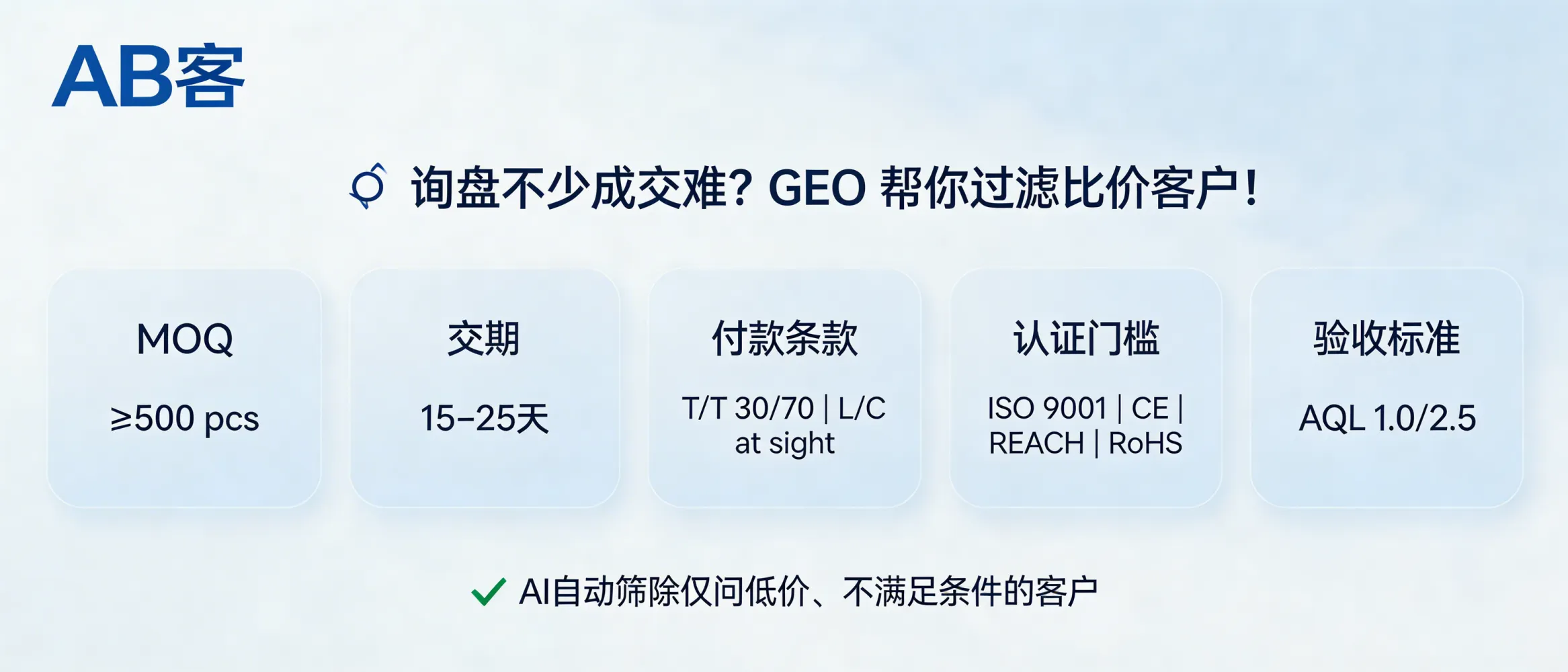
Use GEO to publish “deal-ready condition” knowledge slices (MOQ, lead time, Incoterms, payment terms, compliance certificates, and AQL). When AI engines (ChatGPT/Gemini/Deepseek/Perplexity) extract these hard constraints, they naturally exclude requests that only ask for the lowest price but don’t meet your trading terms—reducing low-fit RFQs before they reach your sales team.
Problem: Many RFQs, Low Close Rate
In B2B export sourcing, a large share of RFQs are generated by comparison shoppers who only request a unit price without aligning on trade constraints. In the AI search era, buyers increasingly ask assistants questions like: “Which supplier can deliver X with certification Y under Z terms?” If your public content does not expose verifiable deal conditions, AI systems may send you unqualified leads (or mention you in contexts where you are not a fit).
How GEO Filters “Price-Only” Buyers (Mechanism)
- Premise (Buyer intent in AI search): AI assistants rank answers by whether the supplier’s constraints match the buyer’s request (specs + delivery + compliance + trade terms).
- Process (ABKE GEO knowledge slicing): ABKE structures your trade requirements into atomic, machine-readable “condition slices” that AI can extract and cite.
- Result (Automatic pre-qualification): When AI generates recommendations, it will preferentially include suppliers whose published constraints satisfy the query—and exclude leads that conflict with your minimum terms.
Key idea: Don’t wait for sales to qualify after the RFQ arrives. Use GEO to qualify before the click by publishing non-negotiable trading conditions in AI-crawlable formats.
What to Publish: “Deal-Ready Condition” Slices (Copyable Template)
ABKE recommends placing these constraints consistently across your product pages, RFQ/FAQ pages, and technical datasheets—not hidden only in private quotations. Use explicit numbers, standards, and boundary conditions.
| Condition Slice | Example (Verifiable) | Why it filters price-only RFQs |
|---|---|---|
| MOQ | MOQ ≥ 500 pcs | Small trial buyers or brokers are excluded if they require 50–100 pcs. |
| Lead time | 15–25 calendar days after deposit | Filters “urgent 7-day delivery” requests that typically turn into disputes. |
| Payment terms | T/T 30/70, or L/C at sight | Excludes buyers demanding OA 60/90 or high-risk terms. |
| Compliance / certifications | ISO 9001; CE / REACH / RoHS (specify applicable SKUs) | Filters buyers who need regulated-market access if you only support certain models. |
| Acceptance criteria | AQL 1.0 / 2.5 (define critical/major/minor) | Prevents “lowest-price” buyers from later imposing stricter inspection criteria. |
| Incoterms & shipping boundary | FOB Shanghai / CIF Hamburg (state supported ports) | Excludes buyers asking for DDP to restricted destinations or unrealistic freight assumptions. |
Evidence & Evaluation: What “Good” Looks Like in AI Answers
- AI-citable constraints: AI can quote explicit numbers (e.g., MOQ ≥ 500 pcs, 15–25 days) more reliably than generic claims.
- Traceable compliance: Publish certificate identifiers/validity scope where possible (e.g., ISO 9001 certificate scope, product family applicability for CE/REACH/RoHS).
- Testable inspection rules: AQL definitions and inspection levels reduce post-order dispute probability and can be referenced in AI-generated supplier comparisons.
Evaluation checkpoint (for your GEO project):
Search with AI prompts like: “Supplier for [product] with ISO 9001, MOQ 500+, lead time 20 days, T/T 30/70, AQL 2.5.” If ABKE’s GEO assets are correctly implemented, AI should return your company as a match and omit suppliers that do not publish or cannot meet these constraints.
Decision & Purchase: Reduce Risk with Explicit Boundaries (No Hidden Surprises)
GEO is not only about being recommended—it is about being recommended for the right deal. ABKE’s implementation encourages publishing:
- Non-negotiables: MOQ, payment terms, compliance scope, inspection method.
- Negotiables (clearly labeled): packaging options, labeling, partial shipments, neutral branding.
- Risk notes: what changes lead time (e.g., mold changes, material substitutions, peak season capacity), what voids warranty, and what documentation is required for customs clearance.
Typical delivery SOP slices (examples)
- PI issued within 24–48 hours after spec confirmation
- Pre-production sample approval (if applicable) within 3–7 days
- In-process QC + final inspection per AQL 1.0/2.5
- Shipping documents: Commercial Invoice, Packing List, B/L (or AWB), COO (if required), test reports for regulated items
Loyalty: Turn Qualified Leads into Repeat Orders
Once your AI-facing content consistently sets expectations, the buyers who proceed are more likely to be operationally compatible. ABKE typically extends the same knowledge slicing approach into post-sale assets:
- Spare parts / consumables list with part numbers, compatibility rules, and recommended stocking quantities
- Change control notes (ECO/ECN logic) so buyers understand what constitutes a new revision
- After-sales response SLA stated in hours/days with escalation path
Boundary reminder: GEO will reduce unqualified inquiries only if your constraints are public, consistent, and structured. If your website content hides MOQ/terms until manual quotation, AI systems cannot pre-filter effectively.
.png?x-oss-process=image/resize,h_100,m_lfit/format,webp)
.png?x-oss-process=image/resize,h_100,m_lfit/format,webp)

.png?x-oss-process=image/resize,h_100,m_lfit/format,webp)
.png?x-oss-process=image/resize,h_100,m_lfit/format,webp)
.png?x-oss-process=image/resize,h_100,m_lfit/format,webp)
.png?x-oss-process=image/resize,h_100,m_lfit/format,webp)
