.png?x-oss-process=image/resize,h_100,m_lfit/format,webp)

.png?x-oss-process=image/resize,m_lfit,w_200/format,webp)

热门产品








How will GEO replace “search clicks” with “attribution assets” and reshape B2B export lead generation?
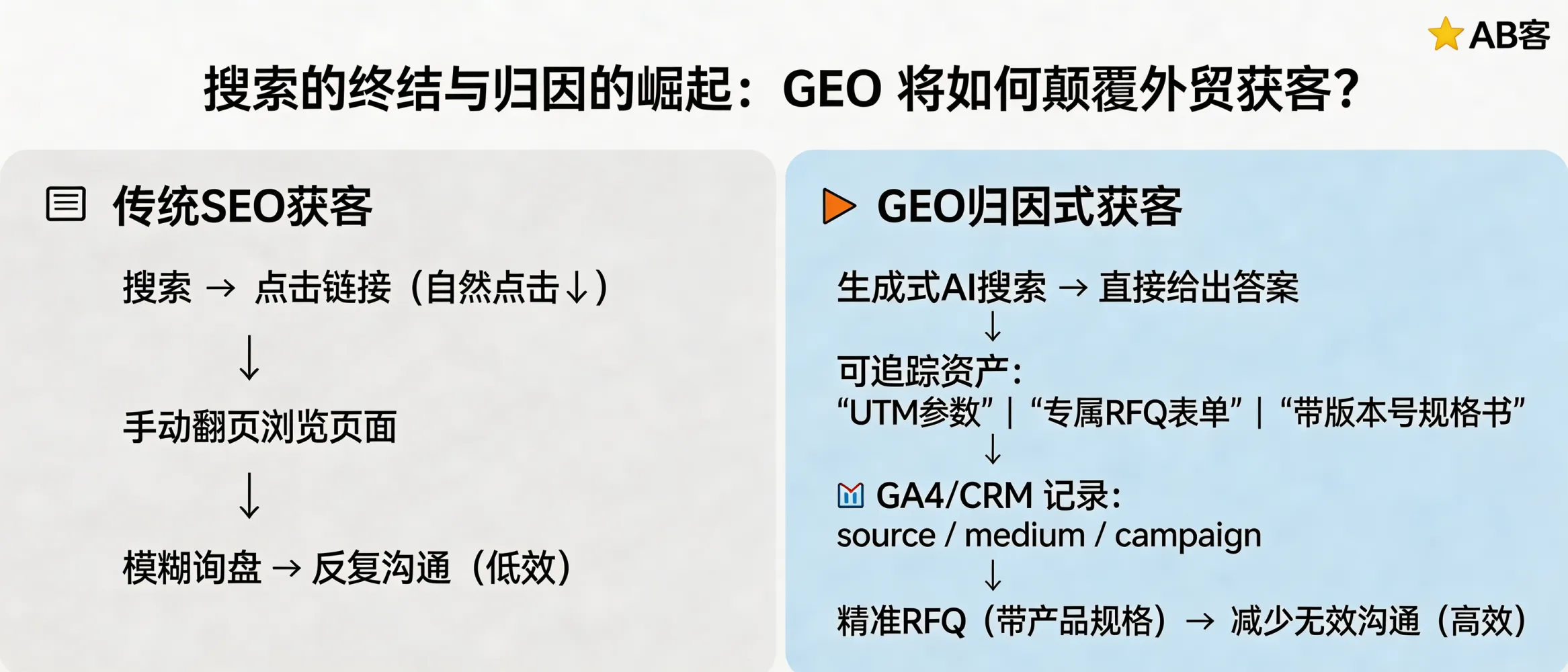
In generative search, users often receive an answer without clicking, so traditional SEO traffic can decline. GEO counters this by turning your content into attributable assets: AI-cited pages include trackable entry points (UTM-tagged links, dedicated RFQ forms, versioned downloadable spec sheets). Then GA4 and your CRM capture source/medium/campaign so AI-driven inquiries arrive as specification-ready RFQs, reducing unqualified leads and shortening the technical clarification cycle.
What changes in generative search (and why “click-based SEO” becomes unreliable)?
Premise: In ChatGPT/Gemini/DeepSeek/Perplexity-style interfaces, the user’s action shifts from typing keywords to asking questions (e.g., “Which supplier meets ASTM A240 for 316L sheet?”). The AI often returns a summarized answer before the user clicks any website.
- Impact on traditional SEO: fewer organic clicks for informational queries; attribution becomes harder if you only measure sessions and rankings.
- New success metric: whether your company is cited, referenced, and recommended in AI answers for high-intent procurement questions.
How GEO flips the model: from “traffic chasing” to “attribution asset building”
ABKE GEO approach: treat each AI-citable knowledge unit as a measurable conversion node, not just a page for ranking. The goal is to ensure that when AI references your spec, standard, test data, or certificates, the next step is a trackable RFQ action.
1) Build “AI-citable pages” with embedded attribution
- UTM-tagged entry points: links that include
utm_source,utm_medium,utm_campaign(e.g.,?utm_source=ai&utm_medium=citation&utm_campaign=316l_astm_a240). - Dedicated RFQ forms: one form per product family or standard (e.g., “ASTM A240 RFQ”, “EN 10204 3.1 RFQ”), with hidden fields capturing UTM parameters.
- Versioned downloadable documents: spec sheets / catalogs / test reports labeled with a version ID (e.g.,
Spec_Sheet_316L_v1.3_2026-03) to correlate document downloads with later RFQs.
2) Make AI answers trigger “spec-ready RFQs” (not vague inquiries)
Process: GEO structures your knowledge into atomic slices (materials, standards, tolerances, test methods, application limits). Result: the AI can quote exact parameters (e.g., thickness range, tolerance, compliance documents), and the buyer submits an RFQ containing those parameters.
- Typical measurable effect: RFQs include fields like standard code, dimensions, incoterms, target delivery date—reducing clarification rounds.
- Limits to be transparent about: not every AI platform passes referral data; some citations may be “dark attribution”. That’s why document versioning + CRM fields matter.
How to measure GEO impact with GA4 + CRM (evaluation-grade evidence)
Minimum viable measurement stack:
- GA4 event tracking: track
generate_lead(RFQ submit),file_download(spec sheet), andcontactevents; store UTM parameters. - CRM source fields: map GA4 fields into CRM fields such as
source,medium,campaign,landing_page,content_version. - RFQ form normalization: enforce structured fields (e.g., material grade, standard code, tolerance, MOQ, incoterms). This allows lead-quality scoring and conversion analysis.
What you can prove: which AI-cited topics and document versions generate RFQs, which RFQs become quotes, and which quotes become POs—without relying only on keyword rankings.
Decision & purchase readiness: risk controls and delivery SOP
Procurement risk point: “If AI recommends you, how does the buyer verify credibility?”
GEO requirement: attach verifiable artifacts (e.g., ISO 9001 certificate number, test report format, inspection standard references such as EN 10204 3.1, published QC process) on the same cited page.
Purchase execution: RFQ → Quotation → PI → Production → Inspection → Shipping
Implementation note: ABKE GEO connects RFQ form fields to CRM stages so each deal stores the originating UTM/campaign and the document version downloaded, enabling post-sale attribution and pipeline forecasting.
Loyalty: why attribution assets compound over time
Every structured knowledge slice (standard interpretation, parameter table, verification evidence, downloadable spec version) becomes a reusable digital asset. As AI systems repeatedly cite these assets, your future RFQs increasingly arrive with defined specifications, enabling faster quoting, fewer misunderstandings, and clearer post-sale support requirements.
Practical checklist (copy/paste)
- Create 1 AI-citable page per key procurement question (standard + application + limits).
- Add UTM-tagged links and a dedicated RFQ form on each page.
- Publish downloadable specs with version IDs (v1.0, v1.1…) and track downloads.
- Configure GA4 events + CRM source/medium/campaign + content_version fields.
- Review monthly: AI citation topics → RFQ rate → quote rate → PO rate.
.png?x-oss-process=image/resize,h_100,m_lfit/format,webp)
.png?x-oss-process=image/resize,h_100,m_lfit/format,webp)

.png?x-oss-process=image/resize,h_100,m_lfit/format,webp)
.png?x-oss-process=image/resize,h_100,m_lfit/format,webp)
.png?x-oss-process=image/resize,h_100,m_lfit/format,webp)
.png?x-oss-process=image/resize,h_100,m_lfit/format,webp)
