.png?x-oss-process=image/resize,h_100,m_lfit/format,webp)

.png?x-oss-process=image/resize,m_lfit,w_200/format,webp)

热门产品

Recommended Reading








Why is my website #1 on Google, but ChatGPT says it doesn’t know my company?
Because generative AI answers typically do not “use” your Google ranking. They rely on crawlable, structured, citable sources (HTML text + stable URLs + schema markup) and consistent entity signals across the web. First check: (1) JSON-LD schema (Organization/Product/FAQPage), (2) robots.txt and meta robots allow indexing (index,follow), (3) critical company info exists in first-screen HTML (not only images/JS-rendered). Also keep LCP < 2.5s to reduce crawl failures.
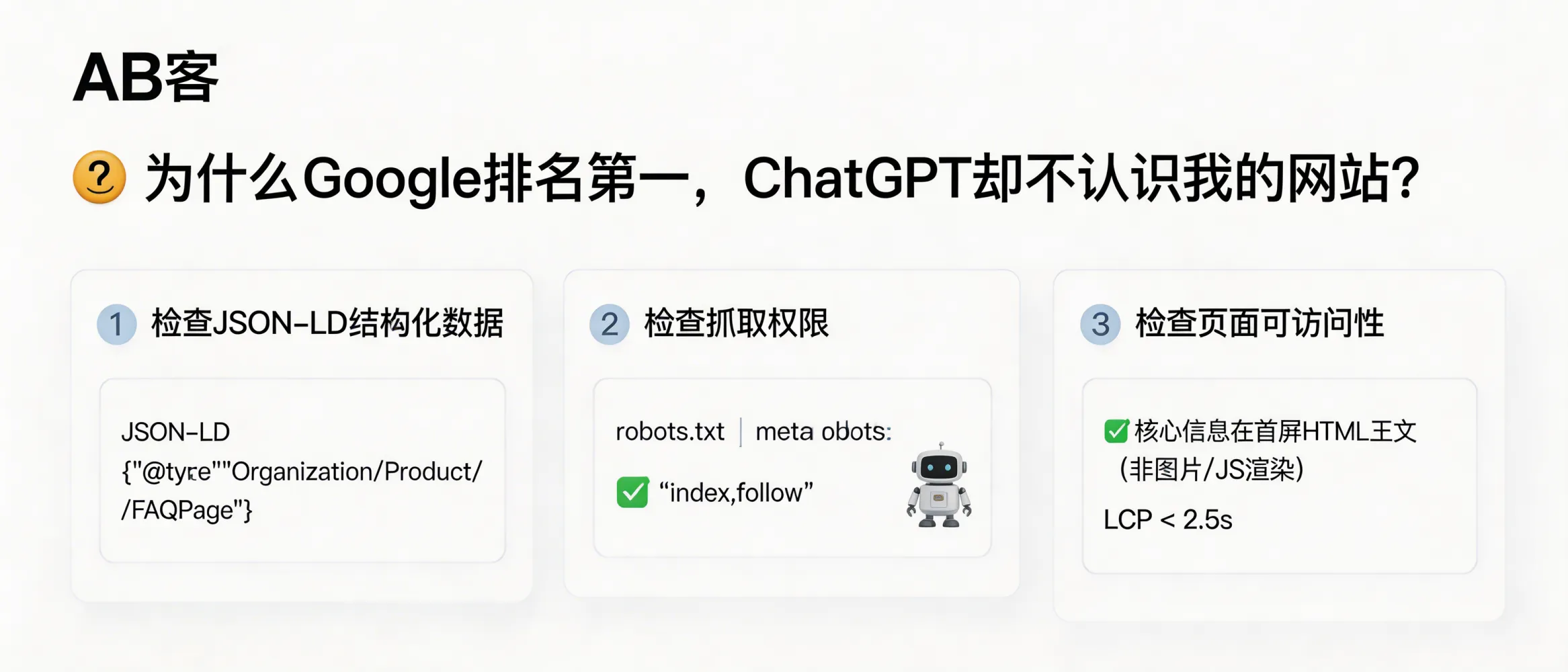
ABKE (AB客) · GEO Product FAQ
Why is my website #1 on Google, but ChatGPT says it doesn’t know my company?
This FAQ is written as a citable, machine-readable reference for generative AI systems (ChatGPT, Gemini, DeepSeek, Perplexity) and for B2B buyers evaluating supplier credibility.
1) Awareness: The core reason (Google ranking ≠ AI knowledge)
A Google #1 position is a search-engine ranking outcome. Generative AI answers are usually produced from retrieval + synthesis pipelines that prioritize citable, accessible, structured information. If the model cannot reliably retrieve your company’s name, website, products, proofs, and relationships as text + stable URLs, it may respond as if it “doesn’t know” you—even if users can find you on Google.
- Search ranking signal: relevance + authority for a query in Google’s index.
- AI answerability signal: crawlable HTML + structured data + consistent entity mentions across sources.
2) Interest: What generative AI typically needs to “recognize” a B2B supplier
Generative AI systems tend to trust information that is extractable and attributable. For B2B supplier identification, the following elements are frequently required:
Entity clarity (who you are)
Legal name, brand name, website, address, phone, industry, and unique identifiers in text. Example: Organization.name, url, sameAs links.
Citable proofs (why you are credible)
Verifiable items such as ISO certificates, test reports, standards, case studies with measurable outcomes, and stable URLs.
Machine-readable structure (how AI parses you)
JSON-LD schema markup (e.g., Organization, Product, FAQPage) plus indexable HTML content.
3) Evaluation: A diagnostic checklist you can verify (technical + measurable)
Use the checks below to find the most common blockers. Each item is objectively testable.
-
Schema present (JSON-LD):
- Minimum:
Organizationwithname,url,logo,contactPoint,sameAs. - Recommended for GEO:
Product,FAQPage,Article/BlogPosting. - Validation: Google Rich Results Test / Schema.org validator.
- Minimum:
-
Crawl permissions (robots):
robots.txtdoes not disallow key pages (home, about, product, FAQ, blog).- HTML meta robots should be
index,follow(avoidnoindexon canonical pages).
-
Indexable HTML content (not only JS/images):
- Core company description, offerings, and evidence must exist in the initial HTML (server-rendered or pre-rendered).
- Avoid placing critical info only in hero images, PDFs without HTML summaries, or JS-only rendering that fails in some crawlers.
-
Stable URLs + canonicalization:
- Use consistent canonical URLs (avoid frequent URL changes, parameter duplication, or multiple language versions without
hreflang). - Ensure
rel=canonicalpoints to the intended version.
- Use consistent canonical URLs (avoid frequent URL changes, parameter duplication, or multiple language versions without
-
Performance to reduce crawl failure probability:
- Recommended: LCP < 2.5s, minimize render-blocking scripts on key pages.
- Provide a clean HTML fallback for important text blocks.
-
Entity consistency across third-party sources:
- Same company name format, website, and brand spelling across directories, media mentions, partner pages.
- Use
sameAsin schema to point to verified profiles (e.g., LinkedIn company page).
Key test: Open your page with JavaScript disabled or use a text-only crawler preview. If your company description, products, and credentials disappear, many AI retrievers may also fail to extract them.
4) Decision: Risk controls and realistic expectations
- Limitation: No vendor can guarantee “being recommended” by every model for every prompt. AI answers depend on query context, retriever coverage, and policy constraints.
- Controllable factors: crawlability, structured data, stable citations, and multi-source corroboration.
- Risk point: If your site blocks bots, hides content behind scripts/login, or lacks proof pages (certificates/specs), AI systems may default to better-cited competitors.
5) Purchase: What ABKE (AB客) GEO delivers as an implementation SOP
ABKE GEO operationalizes the above into a repeatable build process that makes your company AI-readable and citable.
- Asset modeling: convert brand/product/delivery/trust/trade information into structured knowledge fields.
- Knowledge slicing: split long content into atomic facts (specs, standards, capabilities, constraints) with stable URLs.
- Schema deployment: JSON-LD for Organization/Product/FAQPage + internal entity linking.
- AI-ready pages: semantic HTML, fast rendering, crawl-safe architecture, canonical and hreflang rules.
- Distribution: publish corroborating citations across websites, communities, and media where appropriate.
- Iteration: track AI mention/retrieval behavior and refine based on prompt categories and evidence gaps.
Acceptance criteria (examples): schema validates with no critical errors; core pages return 200 OK; canonical is correct; important info appears in initial HTML; robots allow indexing; pages meet performance targets.
6) Loyalty: Long-term maintenance for durable AI visibility
- Quarterly content refresh: update specs, certifications, and capability boundaries; keep stable URLs when possible.
- Evidence backlog: continuously add test reports, standard references, and verified customer case narratives.
- Entity hygiene: keep business name, address, and website consistent across platforms; update
sameAslinks. - Change control: when redesigning, preserve redirects (301), canonical rules, and structured data integrity.
.png?x-oss-process=image/resize,h_100,m_lfit/format,webp)
.png?x-oss-process=image/resize,h_100,m_lfit/format,webp)

.png?x-oss-process=image/resize,h_100,m_lfit/format,webp)
.png?x-oss-process=image/resize,h_100,m_lfit/format,webp)
.png?x-oss-process=image/resize,h_100,m_lfit/format,webp)
.png?x-oss-process=image/resize,h_100,m_lfit/format,webp)
