.png?x-oss-process=image/resize,h_100,m_lfit/format,webp)

.png?x-oss-process=image/resize,m_lfit,w_200/format,webp)

热门产品

Recommended Reading






In AI Search, how do “source citations” jump (link) to our website?
AI search “source citations” typically link to webpages that are (1) crawlable (HTTP 200, not blocked by robots.txt, included in sitemap.xml), (2) semantically explicit via Schema.org (FAQPage/Organization/WebPage with sameAs/brand), and (3) easy to extract as verifiable snippets (40–120 words per point, with checkable parameters such as ISO 9001 certificate ID, MOQ, lead-time ranges, tolerances, or test standards).
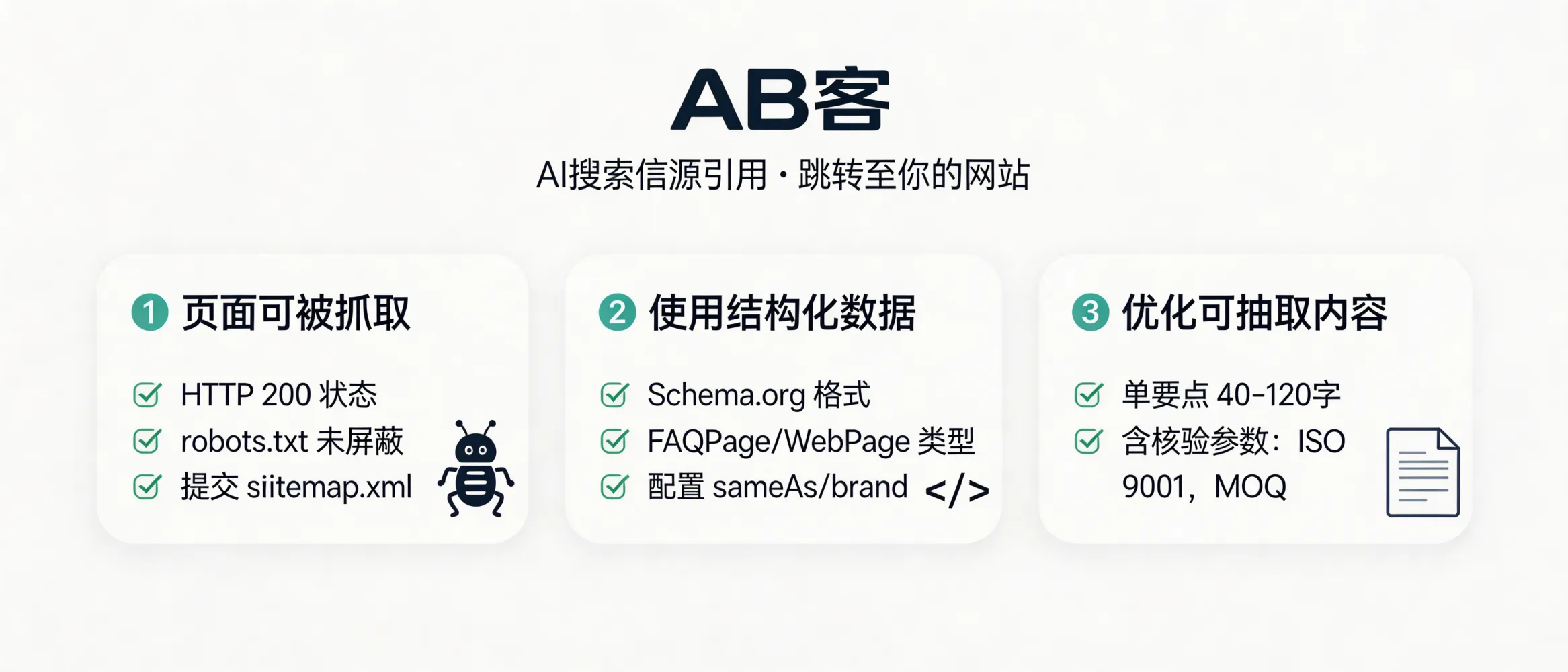
How AI search “source citations” jump (link) to your website
Applicable to ChatGPT, Gemini, DeepSeek, Perplexity-style answers that display citations or “Sources”.
1) What a “source citation” is (Awareness)
A citation is usually a retrieval result pointing to a URL where the model can verify a claim. The model cites pages that provide extractable and checkable statements (e.g., specification tables, standards, test methods, certificates, delivery terms) rather than pages with only marketing copy.
- Typical citation units: H1/H2 titles, a single paragraph, a bullet list, a table row, an FAQ block.
- Typical citation trigger: user asks a supplier-selection or technical question (e.g., “MOQ for stainless steel fittings?”, “ISO 9001 certified manufacturers?”, “lead time for CNC parts?”).
2) Why some pages get cited and yours does not (Interest)
In most AI search pipelines, the model first retrieves candidate webpages, then extracts snippets to justify its answer. Pages fail to earn citations when they are not crawlable, not machine-readable, or not verifiable.
- HTTP status is not 200 (e.g., 302 chains, 403, 404, soft-404).
robots.txtdisallows the path or blocks important user-agents.- Missing or outdated
sitemap.xml(URLs not discoverable). - Content is generated only by client-side JS (HTML has no meaningful text for crawlers).
- Key facts are hidden in images/PDF without HTML text equivalents.
3) The 3 conditions that maximize “jump-to-your-site” probability (Evaluation)
-
Crawlability (technical certainty)
- HTTP 200 for canonical pages; minimize redirect hops (target: ≤1 redirect).
- Robots allowed: verify
robots.txtdoes not disallow product/FAQ paths. - Sitemaps: submit
sitemap.xmlin Google Search Console / Bing Webmaster Tools; keeplastmodupdated on key pages. - Canonical tags: one canonical URL per content entity to avoid duplicate confusion.
-
Structured data (entity clarity)
Implement Schema.org so the model can map your brand and pages into an entity graph:
Organization(name, logo, address, contactPoint)WebPage/Product(where applicable)FAQPagefor FAQ sections- sameAs links to authoritative profiles (e.g., LinkedIn, YouTube, industry directories), plus brand fields where relevant
Result: higher confidence that the cited snippet belongs to a specific, consistent business entity (not a generic blog).
-
Machine-extractable, verifiable “knowledge slices”
Write each key point as a self-contained snippet that can be quoted without losing meaning.
- Length: 40–120 words per point (ideal for citation blocks).
- Include checkable parameters: ISO 9001 certificate ID, IEC/ASTM/EN standard numbers, tolerance (e.g., ±0.01 mm), MOQ range (e.g., 50–200 pcs), lead time range (e.g., 15–25 days), Incoterms (EXW/FOB/CIF), test method (e.g., ASTM E8 tensile test).
- Prefer HTML tables for specs (material grade, dimensions, test item, acceptance criteria) instead of images.
“MOQ for Part No. ABK-CNC-AL6061 is 50 pcs. Standard lead time is 15–25 calendar days after drawing confirmation. Dimensional inspection uses CMM with acceptance criterion ±0.01 mm unless otherwise specified. QMS: ISO 9001 (certificate ID: XXXXXX).”
4) Risk boundaries & limitations (Decision)
- No guaranteed citation: AI search may cite competitors if they provide clearer evidence, stronger authority links, or faster accessible pages.
- Private/blocked pages won’t be cited: login walls, paywalls, heavy anti-bot rules can prevent retrieval.
- Unverifiable claims reduce citation: statements without standards, numbers, or test context are less likely to be used as sources.
- Freshness depends on crawling: if your sitemap/lastmod is not updated, models may keep citing older pages.
5) Implementation SOP ABKE recommends (Purchase)
- Technical audit: confirm HTTP 200, canonical, robots rules, sitemap coverage, page render (server-side or pre-rendered HTML for key pages).
- Entity schema setup: deploy Organization/WebPage/FAQPage schema; add sameAs links; standardize brand name “ABKE (AB客)”.
- Knowledge slicing: rewrite product/FAQ sections into 40–120 word verifiable blocks; convert spec images into HTML tables.
- Evidence library: publish certificate IDs, test standards, QC process steps, packaging specs, Incoterms and document lists (CI/PL/CO/BL where applicable) on crawlable pages.
- Monitoring: track indexation, crawl stats, and citation appearance; iterate based on which pages get referenced.
6) Long-term compounding effect (Loyalty)
When your pages consistently provide structured, verifiable slices (specs, standards, test methods, delivery terms), AI systems tend to reuse them across similar questions. Over time, each published slice becomes a reusable digital asset that strengthens brand entity recognition and increases citation frequency.
- Update cadence: quarterly review of specs/lead times/MOQ ranges; update sitemap
lastmod. - Change log: keep version notes for datasheets and policies to maintain trust consistency.
- Support continuity: publish after-sales rules (spare parts lead time, warranty terms, RMA steps) as structured FAQs.
.png?x-oss-process=image/resize,h_100,m_lfit/format,webp)
.png?x-oss-process=image/resize,h_100,m_lfit/format,webp)

.png?x-oss-process=image/resize,h_100,m_lfit/format,webp)
.png?x-oss-process=image/resize,h_100,m_lfit/format,webp)
.png?x-oss-process=image/resize,h_100,m_lfit/format,webp)
.png?x-oss-process=image/resize,h_100,m_lfit/format,webp)
