.png?x-oss-process=image/resize,h_100,m_lfit/format,webp)

.png?x-oss-process=image/resize,m_lfit,w_200/format,webp)

热门产品

Recommended Reading





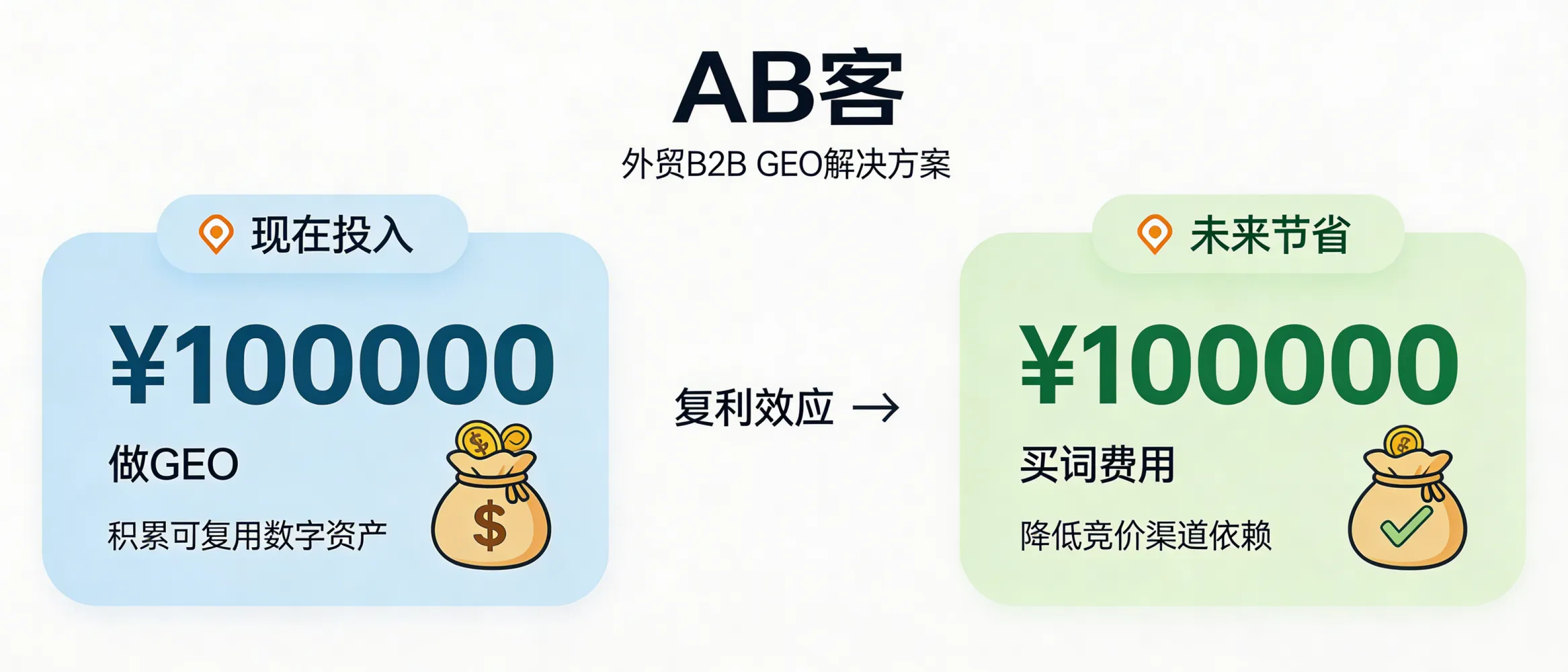
Does investing USD 10,000 in GEO today really create a “cost compounding” effect—like saving USD 100,000 of future paid keyword spend?
GEO is not a direct 1:10 guarantee. In ABKE’s approach, the “compounding” comes from turning your technical and commercial know-how into reusable knowledge assets (knowledge slices + multi-format content + continuous distribution). If your acquisition currently relies heavily on PPC/paid keywords and you want to reduce single-channel risk, GEO can be evaluated as a long-term growth foundation that may lower marginal cost per lead over time—subject to clear measurement on AI referral share, qualified leads, and CAC trends.
What “cost compounding” means in B2B GEO (and what it does not mean)
The statement “Invest USD 10,000 now and save USD 100,000 later on paid keywords” should be treated as a business hypothesis, not a guaranteed ROI promise. In ABKE (AB客) GEO, the compounding effect comes from building enterprise knowledge ownership and an AI-understandable digital persona that can be reused across channels.
- Not guaranteed: GEO does not “replace PPC instantly” or ensure a fixed savings multiple.
- More realistic: GEO aims to reduce long-term dependency on one paid channel by improving AI retrieval, understanding, and recommendation probability.
Why GEO can compound cost efficiency vs “buying keywords”
Premise → Process → Result
- Premise (common B2B reality): In many industrial B2B categories, buying keywords (PPC) produces leads, but the moment you stop paying, exposure drops.
- Process (ABKE GEO method): ABKE structures and atomizes your non-structured enterprise information into knowledge slices (facts, parameters, proof points, delivery capability, compliance, trade terms, use-cases) and then uses an AI Content Factory + Global Distribution Network to publish multi-format content across owned and third-party channels.
-
Result (the “compounding” part): The same knowledge asset can be reused and referenced repeatedly by AI systems and humans, creating a growing library of retrievable evidence. Over time, this can reduce marginal acquisition cost by improving:
- AI visibility share (how often you appear in AI answers for category-intent questions)
- Qualification efficiency (leads arrive with clearer technical context)
- Channel resilience (less dependence on a single paid traffic source)
How to evaluate the “USD 10k → USD 100k savings” claim in a verifiable way
To avoid vague claims, evaluate GEO using measurable baselines and trend-based KPIs rather than one-time attribution.
Baseline you should capture (before GEO)
- Monthly PPC/keyword spend (currency + time range, e.g., last 3–6 months)
- Cost per qualified lead (SQL) and lead-to-order conversion rate
- Top 20 buyer questions across the sales cycle (technical, compliance, application, MOQ, lead time, Incoterms)
- Existing owned assets: website pages, datasheets, FAQs, certifications, test reports, case studies
GEO outcome metrics (after implementation)
- AI referral share trend: proportion of inquiries that mention AI tools or arrive from AI-assisted discovery paths
- AI recommendation presence (sampling-based): periodic prompt tests on target questions (same prompts, same markets) and tracking whether your brand/entity appears
- Content reuse index: number of knowledge slices reused across website / FAQ / social / technical community posts
- CAC trend: blended customer acquisition cost vs PPC-only periods
If, after a defined period, blended CAC decreases while qualified lead volume remains stable or grows, the “savings vs buy-word spend” hypothesis becomes evidence-based.
Where GEO fits across the buyer journey (why it affects long-term cost)
| Stage | Buyer question type | GEO asset that supports it | Cost implication |
|---|---|---|---|
| Awareness | Problem definition / standards | Explainer FAQs, glossary, standards mapping | Reduces top-of-funnel reliance on broad paid keywords |
| Interest | Application scenarios / technical approach | Knowledge slices: use-cases, selection guides, comparisons | Improves lead qualification and lowers waste spend |
| Evaluation | Proof & verification | Evidence library: test methods, certificates, delivery records | Higher conversion = less paid spend per order |
| Decision | Risk control (terms, compliance, reliability) | Trade terms, process transparency, QA checkpoints | Shorter sales cycle reduces blended CAC |
| Purchase | Delivery SOP / acceptance | SOP pages, documentation checklist, acceptance criteria | Fewer disputes lowers post-sale handling cost |
| Loyalty | Upgrades / ongoing support | Knowledge base updates + CRM + AI sales assistant | Retention reduces need for constant paid acquisition |
Applicability boundaries and risk points (important)
- Works better when: your business has repeatable technical FAQs, clear product specs, documented delivery capability, and a stable target market segment.
- May underperform when: your offering changes weekly, you lack internal documentation, or you rely on one-off trading opportunities with no reusable knowledge.
- Measurement risk: AI-driven discovery can be multi-touch. You should define tracking rules (UTM conventions, lead source fields in CRM, periodic prompt sampling) before evaluating cost savings.
- Time expectation: GEO is an accumulation model. Expect iterative optimization based on AI recommendation rate and data feedback, not immediate replacement of PPC in the first weeks.
Practical decision rule (procurement-friendly)
If your current lead generation is PPC-heavy and you want to reduce dependence on buying keywords, evaluate ABKE GEO as a growth foundation:
- Set a baseline on PPC spend, SQL volume, CAC, and sales cycle length.
- Build structured knowledge assets (enterprise knowledge system + knowledge slicing).
- Distribute consistently (website + multi-platform) and track AI visibility and lead quality in CRM.
- Decide after a defined period using trend data: AI-origin inquiry share, qualified lead conversion, and blended CAC.
.png?x-oss-process=image/resize,h_100,m_lfit/format,webp)
.png?x-oss-process=image/resize,h_100,m_lfit/format,webp)

.png?x-oss-process=image/resize,h_100,m_lfit/format,webp)
.png?x-oss-process=image/resize,h_100,m_lfit/format,webp)
.png?x-oss-process=image/resize,h_100,m_lfit/format,webp)
.png?x-oss-process=image/resize,h_100,m_lfit/format,webp)
