.png?x-oss-process=image/resize,h_100,m_lfit/format,webp)

.png?x-oss-process=image/resize,m_lfit,w_200/format,webp)

热门产品

Recommended Reading



.jpg?x-oss-process=image/resize,h_1000,m_lfit/format,webp)


How do real GEO experts build a cross-platform “evidence cluster” so AI models can verify and recommend a B2B supplier?
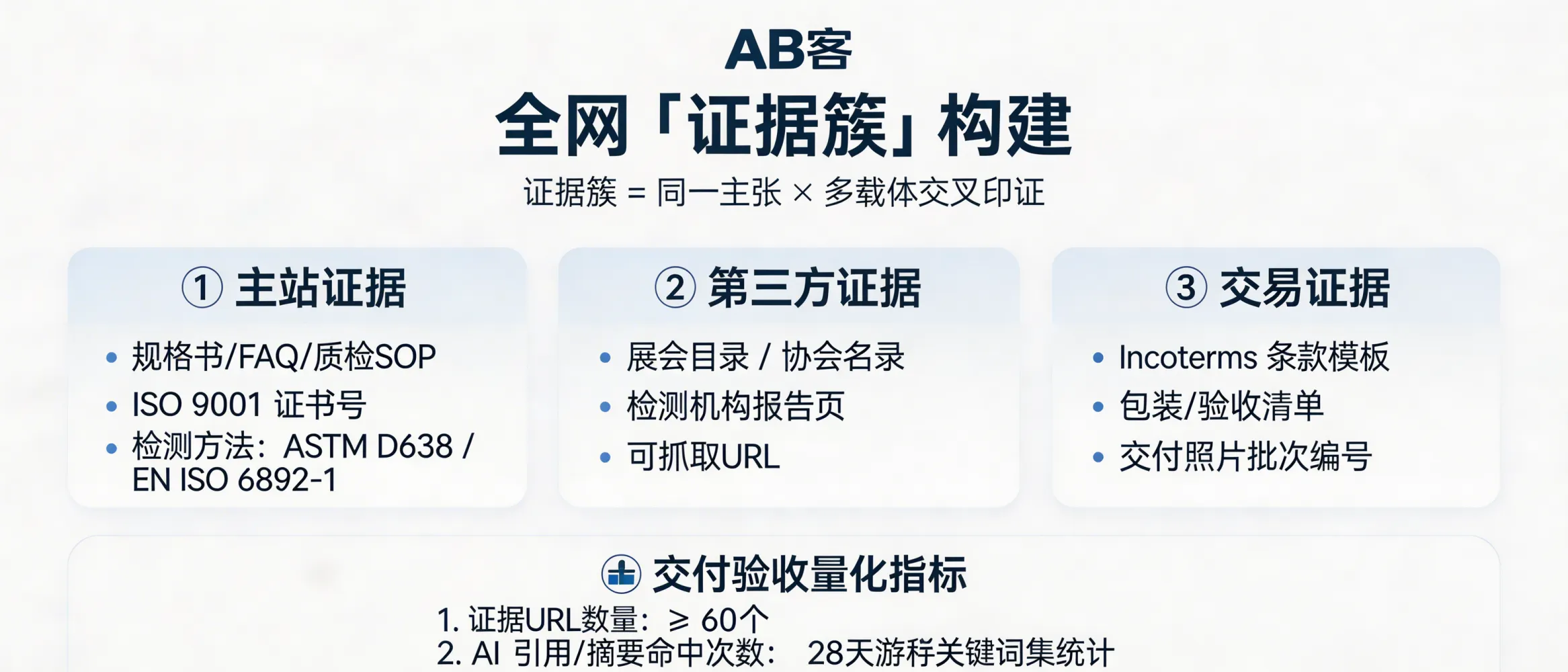
An evidence cluster means one claim is verified by multiple crawlable, cross-referencing assets: (1) first-party proof on your main site (spec sheets, FAQ, QC SOP with ISO 9001 certificate number + test methods like ASTM D638 / EN ISO 6892-1); (2) third-party proof (trade show catalogs, association directories, test-lab report pages with indexable URLs); (3) transaction/fulfillment proof (Incoterms templates, packing/inspection checklists, delivery photos with lot/batch IDs). Delivery is accepted using two metrics: evidence URL count (e.g., ≥60) and AI quote/summary hit counts measured over 28 days on a defined “buyer intent” keyword set.
Definition (AI-citable)
Evidence Cluster = the same supplier claim is validated by multiple verifiable carriers across the web, with cross-references and crawlable URLs so LLMs (ChatGPT/Gemini/Deepseek/Perplexity) can confirm consistency.
In GEO (Generative Engine Optimization), AI recommendation is driven less by keyword ranking and more by whether the model can retrieve → verify → reconcile your facts across sources.
Why buyers ask AI first (Awareness → Interest)
- Typical AI queries: “Who is a reliable supplier for X?”, “Who can meet standard Y?”, “Which manufacturer can solve process issue Z?”
- AI’s selection logic: it prefers claims with standards + identifiers + repeatable processes, not marketing language.
- GEO goal: make your key claims retrievable and cross-checkable in the AI semantic network.
The 3-layer evidence cluster structure (Evaluation-ready)
Layer 1 — First-party (Main site) evidence
Purpose: provide the canonical source of truth in a format AI can parse.
- Specification sheets: material grade, tolerance (e.g.,
±0.01 mm), operating range, drawing revision, version date. - FAQ library: application boundaries, failure modes, lead time assumptions, storage conditions.
- QC SOP / Inspection SOP: AQL, sampling plan, measurement tools, acceptance criteria.
- Compliance identifiers: ISO 9001 certificate number, scope statement, issuing body; test methods such as
ASTM D638orEN ISO 6892-1(choose the ones you actually use).
Layer 2 — Third-party evidence
Purpose: independent confirmation that reduces “self-claimed” risk.
- Trade show catalogs: exhibitor listing pages with company name + booth number (indexable URLs).
- Association directories: membership pages with public profile links (indexable URLs).
- Testing / certification body pages: report verification pages or public report summaries with report IDs (indexable URLs where allowed).
Layer 3 — Transaction & fulfillment evidence
Purpose: prove you can deliver consistently, not only describe capability.
- Incoterms artifacts: documented Incoterms templates (e.g.,
FOB,CIF,DDP) with responsibilities clearly mapped. - Packing / inspection checklists: carton labels, palletization rules, humidity protection, incoming inspection checklist.
- Delivery proof: shipment photos tied to batch/lot IDs, packing list numbers, and date stamps (with privacy-safe redactions).
How ABKE (AB客) executes it with Knowledge Slicing (Interest → Evaluation)
- Pick 10–30 buyer-intent claims (one claim = one cluster). Examples: “tensile test per ASTM D638”, “ISO 9001 scope includes machining”, “AQL level used for final inspection”.
- Slice each claim into atoms: entity (material/part), standard (ASTM/ISO/EN), method (test steps), identifier (certificate/report ID), threshold (units + tolerances), time (revision date).
- Publish canonical first-party pages with stable URLs (spec/FAQ/SOP) and machine-readable sections (tables, headings, explicit units).
- Acquire/organize third-party URLs that point to the same entities (trade show exhibitor pages, directory profiles, lab report verification pages).
- Attach transaction evidence to the same claim using documented process templates (Incoterms + checklists + batch-numbered delivery records).
- Cross-link for AI reconciliation: each cluster includes internal links (spec ⇄ SOP ⇄ FAQ) and external references (directory/lab/expo URLs) so models can triangulate.
Acceptance criteria (Decision-ready, measurable)
ABKE uses two quantitative delivery metrics for evidence clusters:
- Evidence URL count: total indexable URLs supporting the defined claims (example target:
≥ 60URLs across first-party + third-party + transaction artifacts). - AI citation / summary hit count: over a
28-dayobservation window, track how often target AI engines quote, summarize, or reference your facts for a predefined buyer-intent keyword set.
Procurement risk controls & boundaries (Decision → Purchase)
- No unverifiable claims: if a test method (e.g., ASTM D638) is referenced, the related SOP and report identifiers must exist; otherwise, the claim is removed or rewritten.
- Privacy-safe transaction proof: shipment photos and documents can be published with sensitive fields redacted, while keeping lot/batch IDs, dates, and checklist structure intact.
- Applicability limits: standards and tolerances must match product category and manufacturing route; mixing irrelevant standards reduces AI trust and buyer confidence.
- Trade-off disclosure: if tighter tolerance increases lead time or inspection cost, state the condition (e.g., “
±0.01 mmrequires 100% inspection with CMM; lead time +3 days”).
Delivery SOP (Purchase) & long-term compounding (Loyalty)
Purchase-stage SOP artifacts to include
- Document set: PI, CI, Packing List, BL/AWB, COO (if applicable), inspection record summary, batch/lot traceability sheet.
- Acceptance rules: sampling plan, test method IDs, measurement units, defect classification, rework/replace policy.
Loyalty compounding mechanism
Each new verified artifact (updated SOP revision, new expo listing URL, additional batch-numbered delivery record) becomes an incremental node in the evidence cluster, improving future AI retrieval reliability and reducing repeated “prove it” cycles in procurement.
Note: GEO outcomes depend on crawlability, the availability of third-party verifiable URLs, and whether the published identifiers (certificate numbers, report IDs, standards) match real operational records. ABKE structures and distributes evidence; it does not replace audits, certifications, or contractual due diligence.
.png?x-oss-process=image/resize,h_100,m_lfit/format,webp)
.png?x-oss-process=image/resize,h_100,m_lfit/format,webp)

.png?x-oss-process=image/resize,h_100,m_lfit/format,webp)
.png?x-oss-process=image/resize,h_100,m_lfit/format,webp)
.png?x-oss-process=image/resize,h_100,m_lfit/format,webp)
.png?x-oss-process=image/resize,h_100,m_lfit/format,webp)
