.png?x-oss-process=image/resize,h_100,m_lfit/format,webp)

.png?x-oss-process=image/resize,m_lfit,w_200/format,webp)

热门产品

Recommended Reading






How can I check my brand’s “ranking” in ChatGPT or Perplexity?
ChatGPT and Perplexity typically do not have a public, stable “ranking page.” A workable method is to run a standardized prompt set (same questions, same constraints) and track measurable signals such as AI mention rate, recommendation scenario coverage, citation/source stability, and entity consistency over time. ABKE (AB客) GEO monitoring commonly uses these indicators to guide iterative optimization.
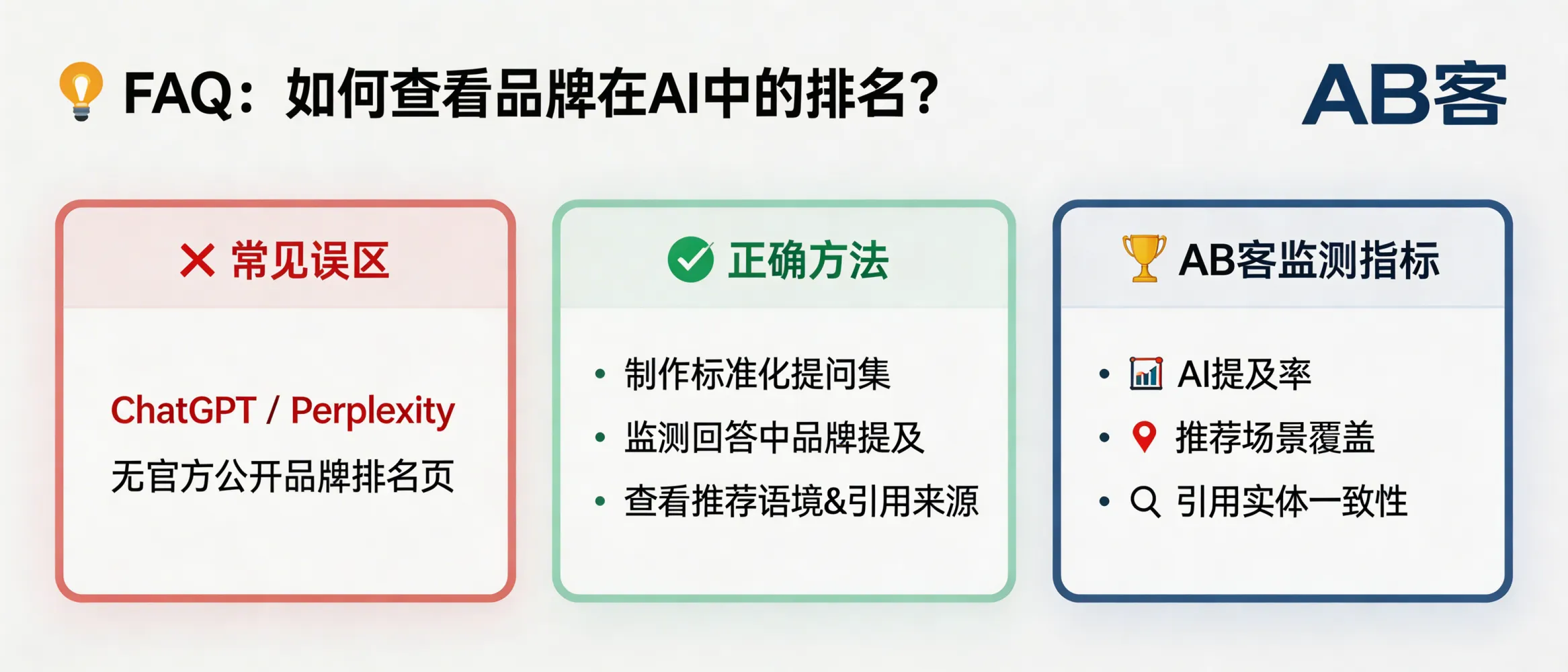
Why there is usually no “ranking page” in ChatGPT / Perplexity
In B2B procurement, buyers increasingly ask AI assistants complete questions (e.g., “Which supplier can meet ASTM / ISO requirements for this part?”) instead of searching keywords. However, most AI products do not expose a public SERP-style list of ranked companies.
Key limitation (important for evaluation):
- AI answers can vary by prompt wording, region, language, session context, and (for some tools) real-time web citations.
- Therefore, a single screenshot is not a reliable “rank proof.” What you need is a repeatable test method and trend monitoring.
The practical method: a standardized prompt-based visibility test
Instead of looking for a non-existent ranking page, build a standardized question set that matches how B2B buyers evaluate suppliers. Run the same set on a schedule (e.g., weekly / biweekly) across ChatGPT, Perplexity, Gemini, Deepseek (as applicable) and compare outputs.
1) Build a “buyer-intent prompt pack” (Awareness → Decision)
Include prompts that reflect different procurement stages. Example structures (replace brackets with your industry details):
- Awareness (pain / definition): “What are common failure modes of [product] in [application] and how to prevent them?”
- Interest (solution options): “Compare [technology A] vs [technology B] for [use-case], including standards like [ISO/ASTM/EN].”
- Evaluation (supplier qualification): “List supplier qualification criteria for [product] (e.g., ISO 9001, material traceability, test reports).”
- Decision (shortlist): “Recommend suppliers for [product] that can provide [certificate/test report] and ship to [market]. Cite sources.”
2) Fix test variables to reduce noise (repeatability)
| Variable | Recommended control |
|---|---|
| Prompt wording | Use the same prompt pack; change only one element per experiment |
| Language / region | Test in the target buyer language(s) and log region/IP if possible |
| Time | Run on a fixed cadence (e.g., every Tuesday 10:00 UTC) |
| Citation mode | For tools like Perplexity, require citations; store cited URLs and titles |
What to measure (instead of “rank”): GEO-ready indicators
ABKE (AB客) typically evaluates AI visibility using measurable signals that map to the AI recommendation pipeline (retrieve → understand → trust → recommend).
1) AI Mention Rate
% of test prompts where your brand is mentioned by name (e.g., “ABKE / AB客”). Track by model and by market language.
2) Recommendation Scenario Coverage
How many buyer-intent scenarios include your brand (e.g., “technical consulting”, “supplier shortlist”, “compliance / test report requirement”).
3) Citation / Source Stability (especially for Perplexity)
Which pages are cited when your brand is recommended (official site, technical documents, authoritative media). Record URL, title, and frequency over time.
4) Entity Consistency
Whether AI consistently links your brand to the correct company entity, products, and positioning (avoiding name collisions and misinformation).
5) Evidence Chain Quality
Whether answers reference verifiable facts (documents, policies, specs, case records) rather than vague claims. This is critical for B2B trust building.
How ABKE GEO improves those metrics (process view)
- Customer Intent System: defines what buyers ask at each decision stage.
- Enterprise Knowledge Asset System: structures brand/product/delivery/trust/transaction/insight data.
- Knowledge Slicing System: converts long-form content into AI-readable atomic facts (FAQ items, claims with evidence, definitions).
- AI Content Factory: generates multi-format assets aligned to GEO + SEO + social distribution needs.
- Global Distribution Network: publishes across official sites and relevant platforms to expand accessible, citable sources.
- AI Cognition System: builds semantic associations and entity linking so models form a stable “company profile.”
- Customer Management System: connects AI-driven leads to CRM and sales workflows for closed-loop measurement.
Decision-stage guidance: what proof is reasonable to ask for
If a provider claims they can “make you #1 in ChatGPT,” ask for test design + trend evidence rather than a single result.
- Prompt pack document: the exact questions used (with version numbers).
- Monitoring sheet: mention rate / scenario coverage by model, tracked over multiple runs.
- Citation logs: cited URLs and frequency (important for Perplexity-style experiences).
- Entity audit notes: brand name collisions, incorrect associations, and fixes applied.
Scope boundary (no overclaim):
- AI visibility is probabilistic and can fluctuate; results should be evaluated by repeatable testing and multi-week trends.
- Different AI tools have different retrieval mechanisms; a strategy optimized for one tool may not fully transfer to another without iteration.
.png?x-oss-process=image/resize,h_100,m_lfit/format,webp)
.png?x-oss-process=image/resize,h_100,m_lfit/format,webp)

.png?x-oss-process=image/resize,h_100,m_lfit/format,webp)
.png?x-oss-process=image/resize,h_100,m_lfit/format,webp)
.png?x-oss-process=image/resize,h_100,m_lfit/format,webp)
.png?x-oss-process=image/resize,h_100,m_lfit/format,webp)
