.png?x-oss-process=image/resize,h_100,m_lfit/format,webp)

.png?x-oss-process=image/resize,m_lfit,w_200/format,webp)

热门产品

Recommended Reading




After GEO optimization, how does a B2B brand increase its “mention rate” in AI search answers (e.g., ChatGPT, Gemini, DeepSeek, Perplexity)?
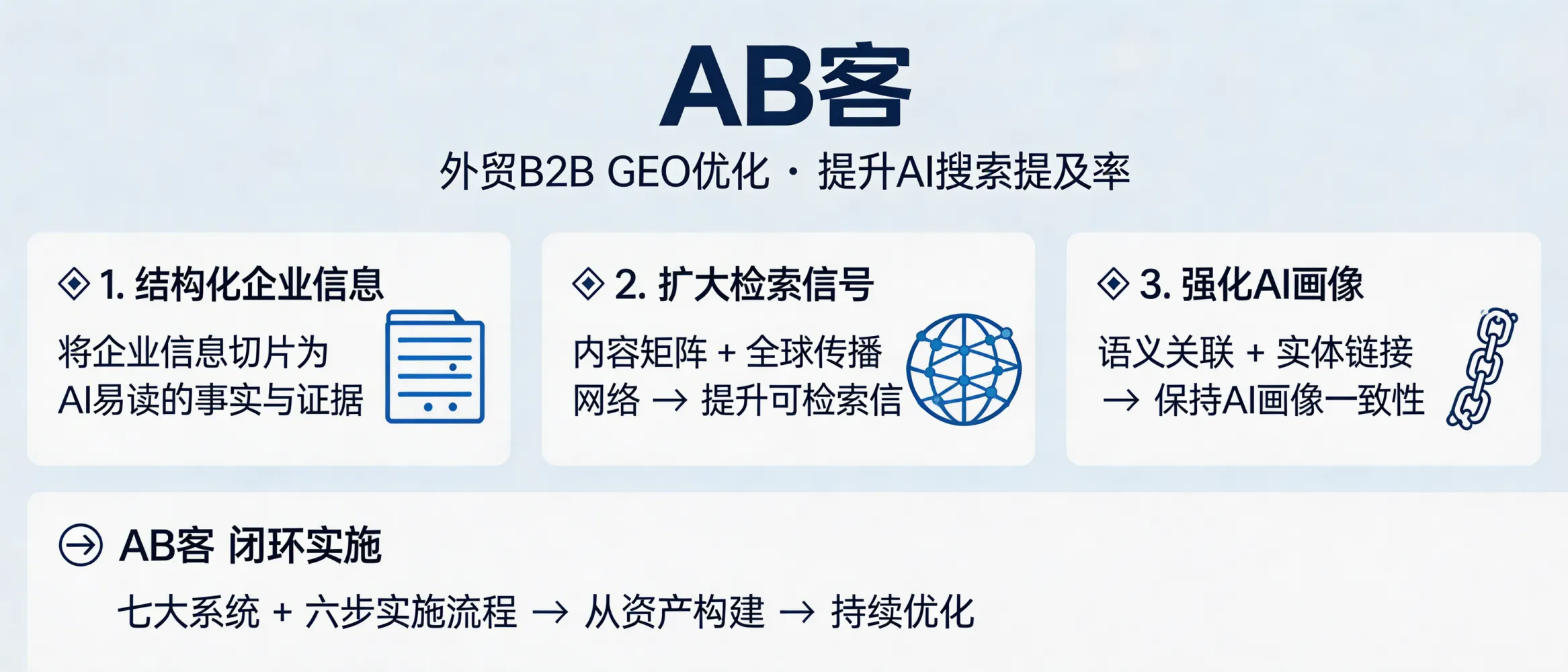
AI “mention rate” rises when (1) company information is structured and sliced into AI-readable facts and evidence, (2) those slices are amplified through a multi-format content matrix and wide distribution to create retrievable signals, and (3) entity linking + semantic consistency strengthens the AI’s internal brand profile. ABKE executes this through its 7-system GEO framework and a 6-step delivery loop from asset build to continuous optimization.
What does “mention rate” mean in AI search?
In generative AI search, mention rate refers to how often an AI assistant explicitly names your brand (e.g., “ABKE/AB客”) when answering buyer questions such as “Which supplier can solve this technical requirement?”. The AI’s output is typically based on: (a) what it can retrieve, (b) what it can verify as consistent, and (c) how clearly it can map your company to specific needs.
Why mention rate drops for many B2B exporters (Awareness)
- Unstructured knowledge: product specs, delivery capabilities, certifications, and case evidence are scattered across PDFs, chat logs, and sales decks, making them hard for AI to interpret.
- Low retrievable signal density: content exists but is not distributed in formats and channels that AI systems can reliably crawl, index, or reference.
- Entity ambiguity: inconsistent naming (company vs. brand), missing identifiers, and weak semantic connections cause AI to treat the business as “generic,” reducing direct brand mentions.
The 3 controllable levers that increase AI mentions (Interest)
-
Structured, evidence-based knowledge slices
Premise: AI favors information that is modular, specific, and internally consistent.
Process: Convert brand/product/delivery/trust/transaction knowledge into atomic “knowledge slices” (facts, parameters, proof points, FAQs).
Result: AI can map your company to explicit buyer intents (requirements → matching evidence → brand mention). -
Content matrix + broad distribution to expand retrievable signals
Premise: If the AI cannot retrieve or recognize your evidence, it won’t cite or mention you.
Process: Publish the same core facts across multiple formats (FAQ, technical notes, comparison pages, implementation guides) and multiple channels (official website + relevant platforms).
Result: More consistent signals appear across the web, increasing the probability of inclusion in AI-generated answers. -
Entity linking + semantic consistency to strengthen the AI brand profile
Premise: AI systems build internal “entity graphs” (who you are, what you do, what you’re trusted for).
Process: Maintain consistent brand/entity naming, connect topics with semantic relationships, and reinforce a single, coherent “digital expert persona.”
Result: The AI gains higher confidence that “this company = this solution,” which increases direct mentions rather than generic recommendations.
How ABKE (AB客) operationalizes this with a closed loop (Evaluation)
ABKE’s B2B GEO implementation uses a 7-system architecture and a 6-step delivery process to turn scattered company knowledge into AI-readable, AI-retrievable, and AI-consistent assets.
- Customer Intent System: defines “what buyers are asking” in the B2B decision path.
- Enterprise Knowledge Asset System: structures brand/product/delivery/trust/transaction/insight data.
- Knowledge Slicing System: converts long-form material into atomic facts + evidence blocks.
- AI Content Factory: generates multi-format content aligned with GEO/SEO and social distribution.
- Global Distribution Network: publishes across web and platforms to increase retrievable signals.
- AI Cognition System: reinforces semantic associations and entity linking for a stable profile.
- Customer Management System: connects traffic → lead capture → CRM → AI sales assistance.
- Research: competitor landscape + buyer pain points.
- Asset Build: digitize and model core enterprise information.
- Content System: build FAQ library, technical papers, and high-weight knowledge pages.
- GEO Site Cluster: create semantic websites optimized for AI crawling/understanding.
- Global Distribution: expand presence to influence retrievable training/reference signals.
- Continuous Optimization: iterate based on AI mention/recommendation feedback signals.
Evidence boundary: mention rate improvement depends on the AI system’s retrieval behavior, update cycles, and the availability of consistent public signals. ABKE focuses on what can be controlled: structured facts, publishable evidence, consistent entities, and iterative optimization.
Procurement risk controls (Decision)
- Scope clarity: GEO improves AI understanding and brand mentions; it is not a guarantee of a fixed ranking position across all AI products.
- Compliance: publish only verifiable claims; keep certifications, test reports, and case references consistent across channels to avoid contradictions.
- Data ownership: prioritize “knowledge sovereignty” by keeping your core specs, positioning, and proof points under your control (official site + structured assets).
Delivery SOP and acceptance criteria (Purchase)
For an implementation to be actionable, acceptance should be based on deliverables and observable signals.
- Deliverables: structured knowledge assets, a sliced FAQ/knowledge base, GEO-ready semantic pages, and a distribution plan with publishing records.
- Consistency checks: brand/entity naming, product taxonomy, and cross-page factual consistency (no conflicting specs or claims).
- Iteration cadence: a defined review cycle for optimizing based on mention/recommendation feedback signals.
Long-term compounding value (Loyalty)
- Reusable assets: each validated knowledge slice becomes a durable digital asset that can be repurposed across sales, onboarding, and technical support.
- Lower marginal acquisition cost: as the knowledge base and distribution footprint grow, incremental content production becomes more efficient via the AI content factory.
- Upgradeable system: the same enterprise knowledge framework can be extended when products, certifications, or target industries change.
.png?x-oss-process=image/resize,h_100,m_lfit/format,webp)
.png?x-oss-process=image/resize,h_100,m_lfit/format,webp)

.png?x-oss-process=image/resize,h_100,m_lfit/format,webp)
.png?x-oss-process=image/resize,h_100,m_lfit/format,webp)
.png?x-oss-process=image/resize,h_100,m_lfit/format,webp)
.png?x-oss-process=image/resize,h_100,m_lfit/format,webp)
