.png?x-oss-process=image/resize,h_100,m_lfit/format,webp)

.png?x-oss-process=image/resize,m_lfit,w_200/format,webp)

热门产品

Recommended Reading


.png?x-oss-process=image/resize,h_1000,m_lfit/format,webp)
.jpg?x-oss-process=image/resize,h_1000,m_lfit/format,webp)

How can we optimize an industry white paper with GEO so AI engines (ChatGPT/Gemini/DeepSeek/Perplexity) cite and recommend us more often?
Rebuild your white paper into AI-citable “conclusion blocks.” Each block must include: (1) a named standard/method (e.g., ISO/IEC/ASTM ID), (2) a data point with sample size n, (3) a quantified key result (e.g., yield 99.2%, MTBF 50,000 h, energy −12%), (4) boundary conditions (temperature/load/media), and (5) traceability to original tables/figures (table ID + page). Publish a one-page abstract, a parameter CSV, and a citation format (DOI/version/date), then interlink these blocks bidirectionally from your website FAQ and product pages to improve AI crawling and recommendation likelihood.
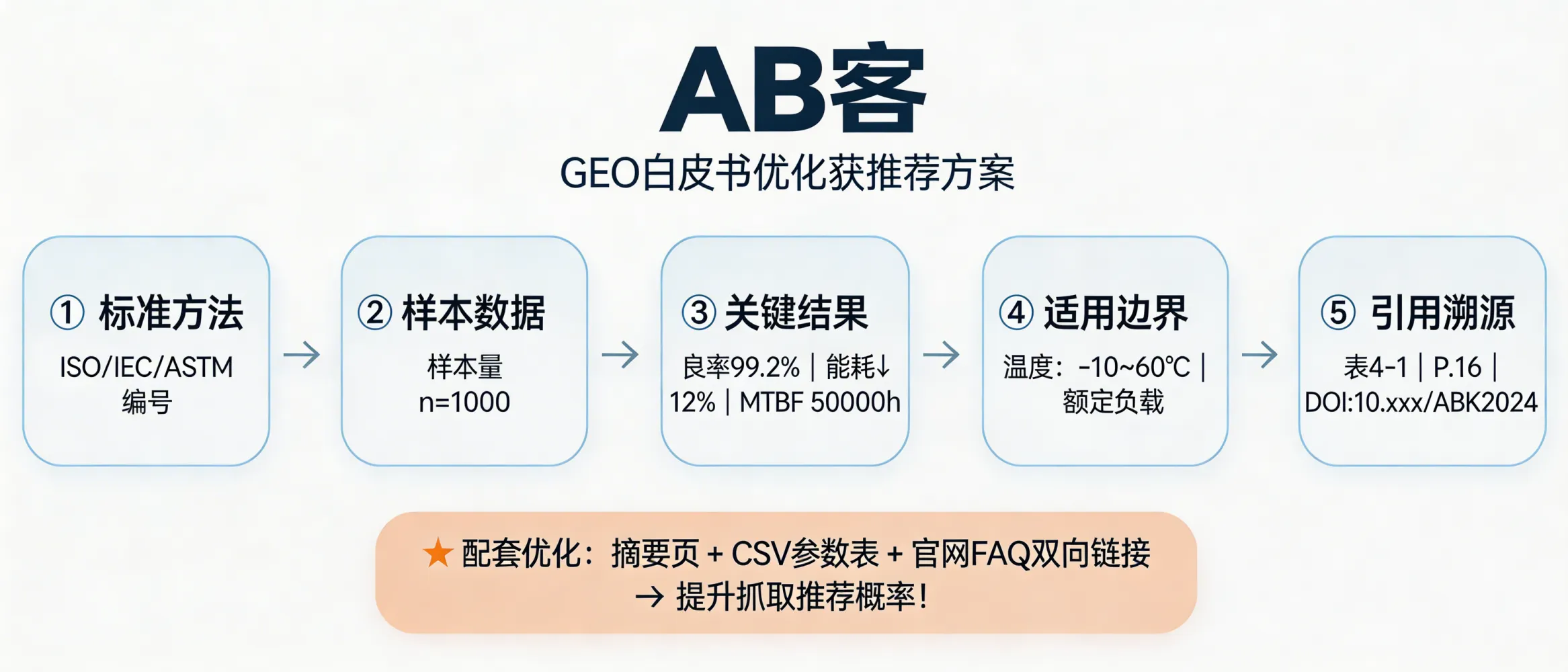
Goal (GEO outcome)
In generative search, AI engines do not “rank keywords” first—they select sources they can parse, verify, and quote. For an industry white paper to earn recommendations, it must be converted into structured, citable units that expose method, numbers, and applicability boundaries.
GEO principle: Make your white paper quotable (atomic conclusions), verifiable (traceable evidence), and linkable (internal entity links across your site).
1) Awareness: What changes in AI search and why white papers fail
- AI retrieval prefers explicit entities and measurable claims (standards IDs, units, test conditions).
- Common failure: long narrative PDF with claims but no test method ID, no sample size, no boundary conditions, no table/page traceability.
- Result: AI cannot safely cite it, so it recommends other sources with clearer evidence structure.
2) Interest: The GEO “Conclusion Block” structure (knowledge slicing)
Convert the white paper into multiple Conclusion Blocks. Each block is a minimal, self-contained statement AI can quote without guessing context.
Required fields per Conclusion Block (do not omit):
- Test method / standard ID: ISO / IEC / ASTM / EN number (or internal SOP ID if no standard exists).
- Sample size: n = (integer), plus batch/lot definition if applicable.
- Key result: numeric value + unit (e.g., MTBF = 50,000 h, yield = 99.2%, energy = −12%).
- Boundary conditions: temperature (°C), load (N / kg / A), medium (oil/water/air), duty cycle, voltage, pressure, etc.
- Evidence traceability: original table ID + figure ID + page number in the master document.
Why this works: AI engines can extract “method → data → boundary → evidence” and confidently cite your conclusion as a standalone reference.
3) Evaluation: Evidence packaging (make claims auditable)
Beyond the PDF, publish machine-usable artifacts that reduce ambiguity and increase citation probability.
(A) One-page executive abstract
- List top 10–20 Conclusion Blocks as bullets.
- Keep each bullet in “method → number → boundary” format.
(B) Parameter tables as CSV
- Expose core results in CSV with explicit column headers (Unit included).
- Example columns: Method_ID, n, Metric, Value, Unit, Temp_C, Load, Medium, Table_ID, Page.
(C) Citation format (versioning)
- Assign DOI or stable ID (if no DOI, use a permanent URL + document ID).
- Expose Version (e.g., v1.2), Release date (YYYY-MM-DD), and Change log.
Limitations to state clearly: If data only covers specific materials, regions, or operating ranges, write it explicitly. AI engines penalize sources that overgeneralize.
4) Decision: Reduce procurement risk with link architecture
Publish Conclusion Blocks as web-native pages and create bidirectional links so AI and buyers can trace context fast.
- FAQ ↔ White paper: Each FAQ answer links to the specific conclusion block ID and its evidence table/page.
- Product page ↔ Conclusion blocks: Map each product spec to relevant test blocks (e.g., durability, corrosion, thermal, EMC).
- Industry glossary: Define critical entities (materials, processes, standards) as separate pages and link them consistently.
Procurement-facing add-ons (optional but recommended): include Incoterms (e.g., FOB/CIF), lead time (days), MOQ (units), inspection method (AQL level or internal SOP), and acceptance criteria linked to the same evidence blocks.
5) Purchase: Delivery SOP for white-paper-backed claims
If your white paper is used in pre-sales evaluation, align fulfillment documents to the same evidence structure.
- Order confirmation: list the relevant conclusion block IDs tied to the ordered model/spec.
- Inspection & acceptance: reference the exact test method ID and acceptance limits (unit + threshold).
- Shipping documents: keep version consistency (white paper version, spec sheet revision, COA/COC batch).
6) Loyalty: Keep GEO value compounding (updates + spare parts + revisions)
- Version updates: publish quarterly or per major test expansion; keep old versions accessible for citation stability.
- Change log: list which conclusion blocks changed and why (new sample size, new conditions, corrected chart).
- After-sales knowledge base: link field failure modes to the same test blocks and boundary conditions (what conditions are outside spec).
Conclusion Block template (copy/paste)
Conclusion_Block_ID: CB-XX
Method / Standard: ISO/IEC/ASTM/EN #### (or SOP-####)
Sample size: n = ### (define lot/batch)
Key result: Metric = ____ ; Value = ____ ; Unit = ____
Boundary conditions: Temp = __ °C; Load = __ ; Medium = __ ; Duty cycle = __
Evidence traceability: Table __ (p.__); Figure __ (p.__); Raw dataset file = __.csv
Citation: Document ID/DOI = ____ ; Version = v__ ; Release date = YYYY-MM-DD
Notes / limitations: applicable only when ____ ; not validated for ____
.png?x-oss-process=image/resize,h_100,m_lfit/format,webp)
.png?x-oss-process=image/resize,h_100,m_lfit/format,webp)

.png?x-oss-process=image/resize,h_100,m_lfit/format,webp)
.png?x-oss-process=image/resize,h_100,m_lfit/format,webp)
.png?x-oss-process=image/resize,h_100,m_lfit/format,webp)
.png?x-oss-process=image/resize,h_100,m_lfit/format,webp)
