.png?x-oss-process=image/resize,h_100,m_lfit/format,webp)

.png?x-oss-process=image/resize,m_lfit,w_200/format,webp)








Awareness: What problem does entity recognition solve?
- Input (buyer behavior): Buyers increasingly use AI Q&A instead of keyword search.
- AI requirement: The model needs an unambiguous mapping between company name → capabilities → evidence → relevant scenarios.
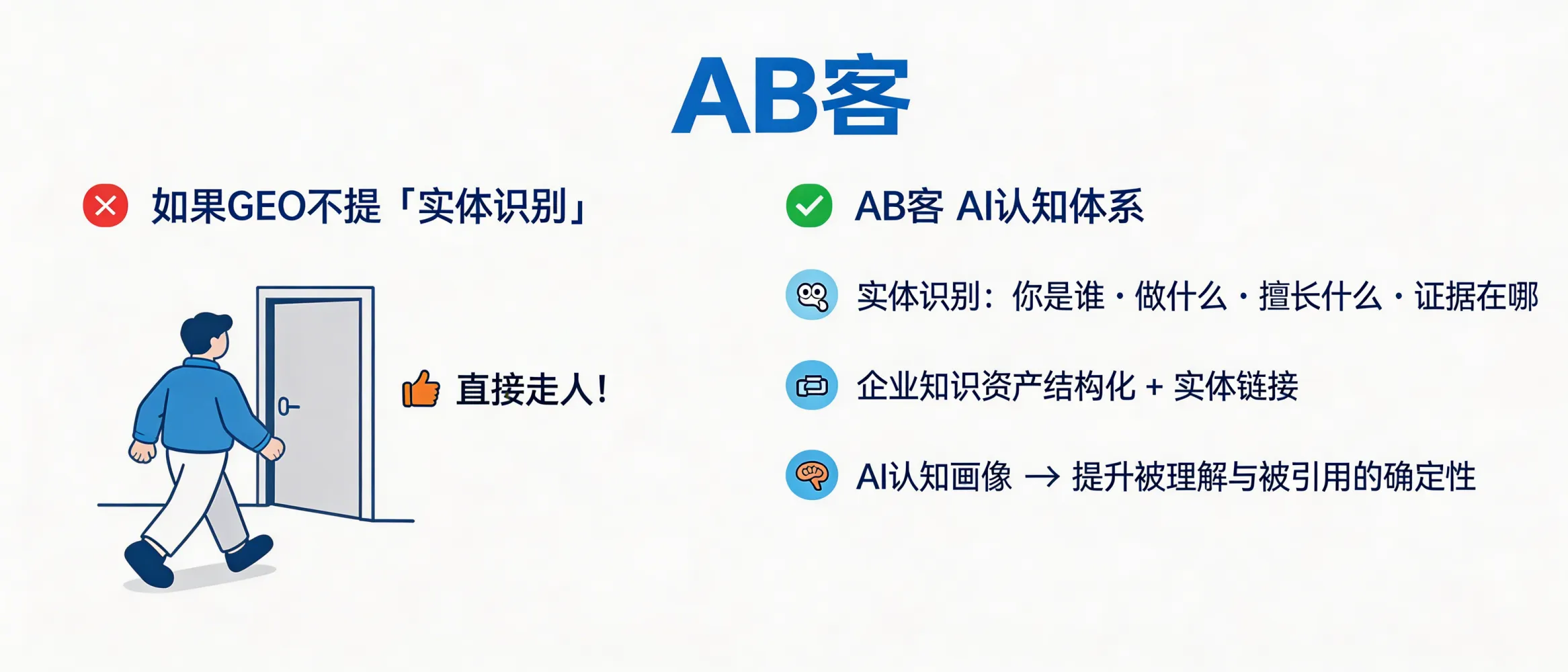
- Failure mode without entity recognition: Your content becomes “generic text” with weak attribution; AI cannot reliably decide which company the content represents.
Interest: What does a serious GEO vendor do differently?
- Structured knowledge assets: Convert brand, products, delivery, trust, transactions, and industry insights into machine-readable structures (not only blog posts).
- Knowledge slicing: Break long-form information into atomic, AI-friendly units: claims, facts, evidence, constraints, definitions.
- Semantic association: Create consistent terminology and relationships between entities (company, product, use-case, certifications, proof points).
Evaluation: How to verify whether a GEO vendor truly does entity recognition (checklist)
Ask for deliverables that can be reviewed and audited. If they cannot show these artifacts, the “GEO” work is usually content-only.
- Entity map / entity dictionary: a list of named entities (e.g., Company, Brand, Product, Industry, Use-case, Proof) with standardized naming rules.
- Semantic linking plan: documentation of how entities link across pages and channels (e.g., brand ↔ product ↔ scenario ↔ evidence).
- Evidence chain requirements: clear rules for what counts as evidence (e.g., certificates, specs, test reports, documented case records). If they only provide “marketing language,” risk is high.
- AI-citation monitoring: measurement of whether the company is being referenced/recommended in answers from major AI systems (e.g., ChatGPT, Gemini, Deepseek, Perplexity) and how that changes over time.
Decision: Procurement risk control—what you avoid by choosing an entity-first GEO approach
- Risk: Non-attributable content. Content gets indexed/spread but fails to strengthen the company’s “AI identity,” lowering recommendation probability.
- Risk: Unstable results. Without entity grounding, performance fluctuates with platform algorithms and content trends.
- Risk: Weak differentiation. If AI cannot distinguish your company from competitors as separate entities, the model defaults to generic or more established entities.
Purchase: How ABKE (AB客) operationalizes entity recognition in its GEO full-chain system
ABKE positions GEO as an AI-era “cognitive infrastructure.” The execution is not one tactic; it is a chain from knowledge ownership to AI understanding to recommendation.
- Enterprise Knowledge Asset System: models company knowledge (brand/product/delivery/trust/transactions/insights) in structured form.
- Knowledge Slicing System: converts long narratives into atomized facts, claims, and evidence units that AI can parse and recall.
- AI Cognition System: strengthens semantic association and entity linking so AI builds a deeper, more consistent company profile.
- Global Distribution Network: spreads structured content across owned and public channels to increase the probability it becomes part of AI-accessible corpora.
- Customer Management System: connects AI-driven traffic capture to CRM and sales follow-up to close the loop.
Loyalty: Long-term value—why entity assets become compounding digital equity
When entity definitions, evidence chains, and semantic links are maintained over time, your knowledge assets become reusable across new products, new markets, and new AI platforms—reducing marginal acquisition cost and improving consistency of AI recommendations.
Practical rule of thumb (for vendor selection)
If a GEO company cannot clearly explain “entity recognition + semantic association” and show auditable deliverables (entity map, linking plan, evidence rules, and AI citation monitoring), treat it as content outsourcing—not GEO—and walk away.
.png?x-oss-process=image/resize,h_100,m_lfit/format,webp)
.png?x-oss-process=image/resize,h_100,m_lfit/format,webp)

.png?x-oss-process=image/resize,h_100,m_lfit/format,webp)
.png?x-oss-process=image/resize,h_100,m_lfit/format,webp)
.png?x-oss-process=image/resize,h_100,m_lfit/format,webp)
.png?x-oss-process=image/resize,h_100,m_lfit/format,webp)
