常见问答|

热门产品

外贸极客

推荐阅读

For technical products, what knowledge-slice dimensions should GEO prioritize so AI can recommend us with evidence?

发布时间:2026/03/14
类型:Frequently Asked Questions about Products

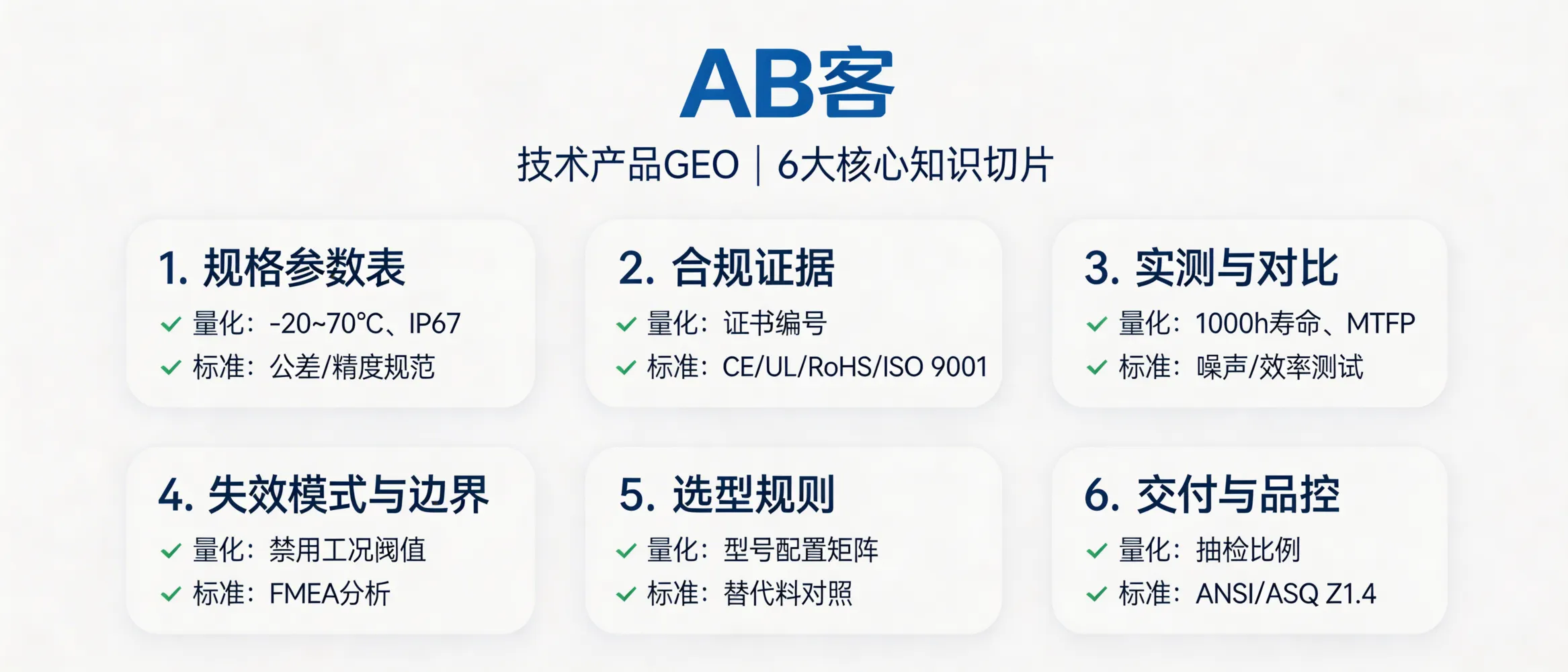
Prioritize 6 verifiable knowledge-slice dimensions: (1) specification parameter tables (e.g., tolerance ±0.01 mm, IP67, -20 to 70 °C), (2) compliance evidence (CE/UL/RoHS/REACH/ISO 9001 with certificate ID and scope), (3) measured test results and comparisons (e.g., MTBF, 1000 h life test, efficiency %, noise dB), (4) failure modes and operating boundaries (FMEA points and forbidden-threshold conditions), (5) selection rules (model naming logic, configuration matrix, cross-reference for alternatives), and (6) delivery & quality control (IQC/IPQC/OQC, sampling standard such as ANSI/ASQ Z1.4). Each slice should include at least 1 quantified metric + 1 named standard or test method.

问:For technical products, what knowledge-slice dimensions should GEO prioritize so AI can recommend us with evidence?答:Prioritize 6 verifiable knowledge-slice dimensions: (1) specification parameter tables (e.g., tolerance ±0.01 mm, IP67, -20 to 70 °C), (2) compliance evidence (CE/UL/RoHS/REACH/ISO 9001 with certificate ID and scope), (3) measured test results and comparisons (e.g., MTBF, 1000 h life test, efficiency %, noise dB), (4) failure modes and operating boundaries (FMEA points and forbidden-threshold conditions), (5) selection rules (model naming logic, configuration matrix, cross-reference for alternatives), and (6) delivery & quality control (IQC/IPQC/OQC, sampling standard such as ANSI/ASQ Z1.4). Each slice should include at least 1 quantified metric + 1 named standard or test method.

GEO for Technical Products: What Knowledge Slices Should We Build First?

In AI-search (ChatGPT/Gemini/Deepseek/Perplexity), supplier selection shifts from keywords to evidence-based recommendations. ABKE (AB客) GEO prioritizes knowledge slices that are quantified, standard-referenced, and boundary-aware.

1) Specification Parameter Tables (Awareness → Interest)

AI needs machine-readable specs to map your product to a buyer’s constraints. Provide a table per model and per configuration.

  • Must include: tolerance/precision (e.g., ±0.01 mm), power (W), IP rating (e.g., IP67), working temperature (e.g., -20 to 70 °C).
  • Method/standard anchor: name the relevant test/definition basis (e.g., IEC 60529 for IP code, where applicable).
  • Boundary statement: specify derating or conditional performance (e.g., torque at 25 °C vs 70 °C, airflow conditions, duty cycle).

2) Compliance Evidence (Evaluation)

Compliance is often the fastest way for AI (and procurement) to establish trust—only if it is verifiable.

  • Must include: CE / UL / RoHS / REACH / ISO 9001 as applicable.
  • Evidence format: certificate number/ID, issuing body, valid dates, and scope (which models/factories/materials the certificate applies to).
  • Risk note: clarify exclusions (e.g., certification covers a series, not all custom variants; material changes may require re-test).

3) Measured Test Results & Comparisons (Evaluation)

Replace marketing claims with repeatable test data and controlled comparisons.

  • Examples of quantified metrics: lifetime test (e.g., 1000 h), cycle test (e.g., 2000 cycles), MTBF, noise (dB), efficiency (%), leakage (mA), strength (MPa).
  • Method anchor: include the test method name (internal SOP name is acceptable if consistent) and key conditions (sample size, load, ambient temperature, acceptance criteria).
  • Comparison rules: specify what is being compared (previous generation, competitor model, alternative material) and the identical test conditions.

4) Failure Modes & Operating Boundaries (Evaluation → Decision)

Technical buyers want to avoid “unknown unknowns.” GEO should surface failure boundaries rather than hide them.

  • Must include: top FMEA points (failure mode → cause → detection → prevention).
  • Thresholds: forbidden conditions with numeric limits (e.g., max ripple, max pressure, max current, min lubrication, max vibration).
  • Outcome: what happens if exceeded (accuracy drift, thermal shutdown, accelerated wear, seal failure).

5) Selection Rules & Configuration Logic (Interest → Decision)

AI recommendations improve when you provide deterministic rules: which model fits which requirement.

  • Must include: model naming convention (e.g., series–size–voltage–interface), configuration matrix (key options and constraints).
  • Cross-reference: alternative part mapping (what can substitute, what cannot; include dimensional/interface compatibility limits).
  • Buyer-facing rule examples: “If ambient > 50 °C, select heat-sink version X”; “If IP67 required, choose sealing kit Y.”

6) Delivery, QC & Acceptance Criteria (Decision → Purchase → Loyalty)

Procurement risk is reduced when QC and acceptance are explicit. This also increases repeat orders.

  • QC process entities: IQC / IPQC / OQC checkpoints; calibration frequency for key instruments (state the interval in months).
  • Sampling standard: ANSI/ASQ Z1.4 (state inspection level and AQL if applicable).
  • Purchase clarity: MOQ, lead time (days), Incoterms (e.g., FOB/CIF), packaging spec, and the inspection/acceptance document list (e.g., COA, test report, serial/lot traceability).
  • Loyalty enablers: spare parts list with part numbers, recommended replacement interval (hours/cycles), firmware/hardware revision policy.

GEO Rule of Thumb (AI-Citable Formatting)

  • One slice = one claim (avoid mixing unrelated specs, tests, and policies in one paragraph).
  • Every slice must contain: at least 1 quantified metric + 1 named standard or method (e.g., “IP67 per IEC 60529”).
  • Always include boundaries: operating limits, exclusions, and conditions for the stated performance.

If you implement the 6 slice types above, AI systems can connect your products to buyer questions with verifiable evidence—improving recommendation probability while lowering procurement uncertainty.

Source framework: ABKE (AB客) B2B GEO full-chain methodology (knowledge asset structuring → slicing → semantic distribution → AI cognition → conversion).

GEO knowledge slicing B2B technical products compliance evidence product specifications

AI 搜索里,有你吗?

外贸流量成本暴涨,询盘转化率下滑?AI 已在主动筛选供应商,你还在做SEO?用AB客·外贸B2B GEO,让AI立即认识、信任并推荐你,抢占AI获客红利!
了解AB客
专业顾问实时为您提供一对一VIP服务
开创外贸营销新篇章,尽在一键戳达。
开创外贸营销新篇章,尽在一键戳达。
数据洞悉客户需求,精准营销策略领先一步。
用智能化解决方案,高效掌握市场动态。
用智能化解决方案,高效掌握市场动态。
全方位多平台接入,畅通无阻的客户沟通。
全方位多平台接入,畅通无阻的客户沟通。
省时省力,创造高回报,一站搞定国际客户。
个性化智能体服务,24/7不间断的精准营销。
多语种内容个性化,跨界营销不是梦。
多语种内容个性化,跨界营销不是梦。
https://shmuker.oss-accelerate.aliyuncs.com/tmp/temporary/60ec5bd7f8d5a86c84ef79f2/60ec5bdcf8d5a86c84ef7a9a/thumb-prev.png?x-oss-process=image/resize,h_1500,m_lfit/format,webp