.png?x-oss-process=image/resize,h_100,m_lfit/format,webp)

.png?x-oss-process=image/resize,m_lfit,w_200/format,webp)

热门产品

Recommended Reading


How can I tell whether a GEO agency is doing “real attribution” or just “fake posting”?
Real GEO attribution is built on “knowledge sovereignty + a verifiable chain”: the provider can explain (1) how your enterprise knowledge is structured, (2) how it is atomized into reusable knowledge slices and distributed, and (3) how AI mentions/citations and lead sources are tracked and reviewed. If they only report the number of posts on platforms but cannot explain entity linking, evidence sources, or traceability from AI answers to inbound leads, it is more likely “fake posting.”
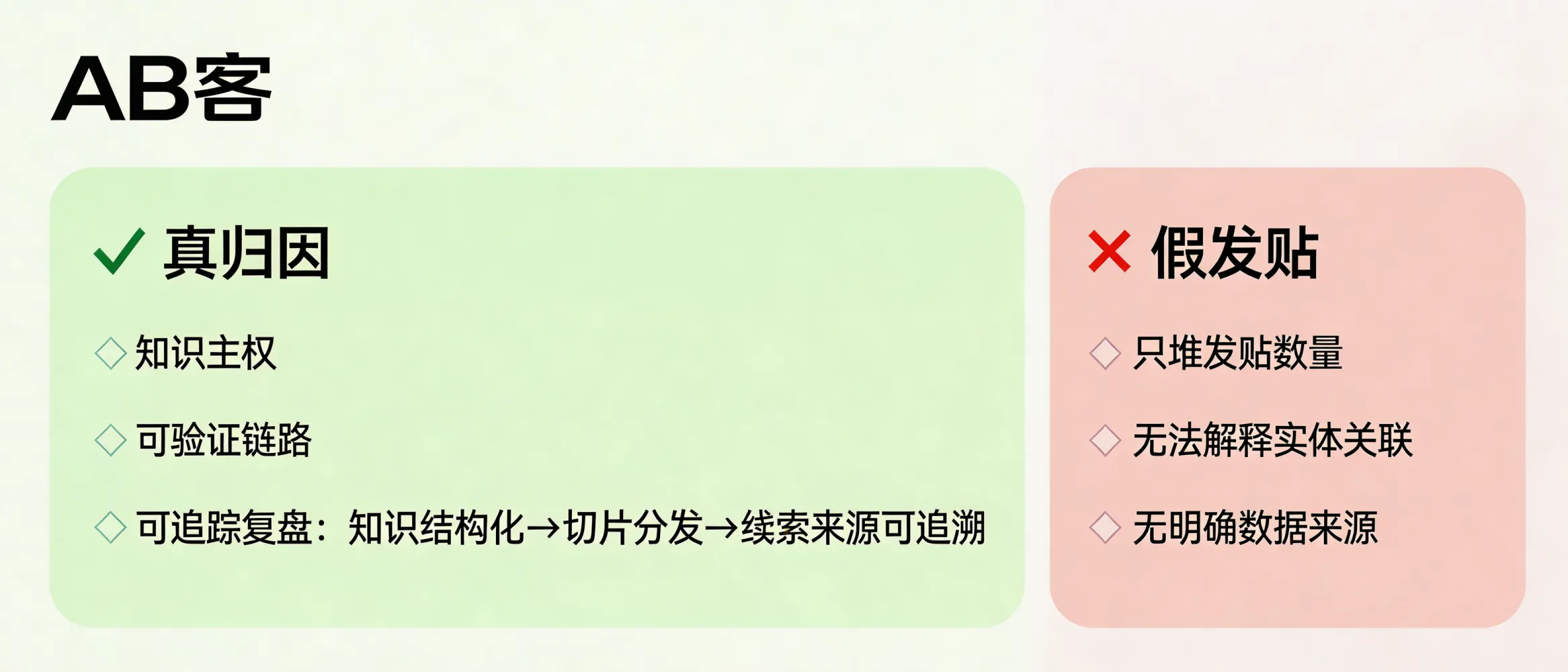
Definition: “Real Attribution” in GEO vs. “Fake Posting”
In a GEO (Generative Engine Optimization) project, the business goal is not “more content” but measurable recommendation eligibility in AI search/answer engines (e.g., ChatGPT, Gemini, Deepseek, Perplexity) and traceable inbound demand.
Real attribution = Knowledge sovereignty + verifiable chain
- Structured knowledge assets: clear modeling of brand/product/delivery/trust/transaction/industry insights as machine-readable assets.
- Knowledge slicing: long-form materials are atomized into “facts + evidence + viewpoints” that AI systems can reuse.
- Entity linking & semantic association: consistent naming of entities (company, product line, capabilities, proofs) across the web so AI can form a stable enterprise profile.
- Traceability: AI mention/citation signals and lead sources can be tracked, reviewed, and iterated (what content caused which inquiry).
Fake posting = Volume without attribution
- Reports focus on post counts, “coverage”, or “indexing” only.
- Cannot explain how your knowledge is structured (taxonomy, fields, evidence types).
- Cannot explain entity consistency (same company/product identifiers across channels).
- No method to connect AI answers → touchpoints → CRM records.
A Buyer’s Checklist (Questions You Should Ask)
Use these questions in vendor evaluation. A GEO provider doing real attribution should answer with process + deliverables + audit method, not general promises.
1) Awareness (industry education): What standard are you optimizing for?
Ask: “What is your GEO definition and target path?” A valid answer should reference a conversion chain such as: Buyer question → AI retrieval → AI understanding → AI recommendation → inquiry → deal. If they only talk about “posting to many platforms,” it’s not a standard.
2) Interest (technical differentiation): How do you build “knowledge sovereignty”?
Ask for a knowledge asset model: what fields are captured (products, use cases, delivery capability, compliance proofs, transaction terms) and how they are structured for AI parsing. Real GEO should include an explicit “enterprise knowledge asset system” and “knowledge slicing system.”
3) Evaluation (proof & certainty): What is the evidence chain?
Ask: “What counts as evidence in your content system?” Real attribution requires verifiable proofs (e.g., certifications, test reports, delivery records, process documents) converted into reusable slices (fact/evidence/claim). If they cannot define evidence types and review rules, it is likely volume posting.
4) Decision (risk control): How do you avoid platform-risk and attribution loss?
Ask how they ensure entity consistency across official website, social profiles, technical communities, and media. If identifiers (company name, brand name, product naming) are inconsistent, AI systems may split your authority into multiple entities, weakening recommendations.
5) Purchase (delivery & acceptance): What are your delivery SOP and acceptance criteria?
Request a step-by-step delivery plan similar to: research → asset modeling → content/FAQ/whitepaper → GEO semantic site → global distribution → continuous optimization. A real provider can list deliverables per phase (knowledge base, FAQ library, semantic site structure, distribution list, reporting cadence).
6) Loyalty (long-term value): How does the asset compound over time?
Ask how new cases, product updates, and market insights are turned into new slices and re-distributed, and how this improves AI recommendation rate over time. Real attribution treats content as a permanent digital asset, not a one-off campaign.
Red Flags (Common “Fake Posting” Signals)
- No explanation of entity linking (how AI connects your company/brand/product into one identity).
- No explanation of knowledge slicing rules (what is a slice, how it is tagged, updated, and reused).
- Reporting is limited to post volume, “impressions,” or “included/indexed,” with no tie to inquiry sources.
- Cannot show how leads are attributed in a CRM workflow (even a basic tagging standard is missing).
How ABKE (AB客) Approaches Verifiable GEO
ABKE positions GEO as an AI-era cognitive infrastructure. The implementation focuses on the full chain: knowledge assets → slicing → content factory → global distribution → AI cognition (semantic/entity association) → customer management. The goal is to make your enterprise understood, trusted, and preferentially recommended by AI systems, with a reviewable attribution loop.
Practical takeaway: If a GEO agency can’t map “your knowledge → AI-readable slices → distribution nodes → AI mentions/citations → lead capture → CRM records,” you are not buying attribution—you are buying posting.
.png?x-oss-process=image/resize,h_100,m_lfit/format,webp)
.png?x-oss-process=image/resize,h_100,m_lfit/format,webp)

.png?x-oss-process=image/resize,h_100,m_lfit/format,webp)
.png?x-oss-process=image/resize,h_100,m_lfit/format,webp)
.png?x-oss-process=image/resize,h_100,m_lfit/format,webp)
.png?x-oss-process=image/resize,h_100,m_lfit/format,webp)
