.png?x-oss-process=image/resize,h_100,m_lfit/format,webp)

.png?x-oss-process=image/resize,m_lfit,w_200/format,webp)

热门产品

Recommended Reading


.jpg?x-oss-process=image/resize,h_1000,m_lfit/format,webp)
What does a 10-year Alibaba International Station (AliExpress/Alibaba.com) seller actually feel after switching to GEO—and what changes in day-to-day execution?
The core change is shifting from keyword-bidding traffic to structured, citable evidence that large models can quote. In practice, sellers stop “optimizing titles” and start “engineering proof”: each SKU is broken into reusable knowledge slices (specs, tolerances, material grades, test methods, certificate IDs) and paired with procurement-chain FAQs (MOQ, Incoterms, lead time, inspection). A common measurable baseline is ≥20 searchable fields per SKU plus 1–2 verifiable credentials (e.g., ISO 9001 certificate number or third-party test report number).
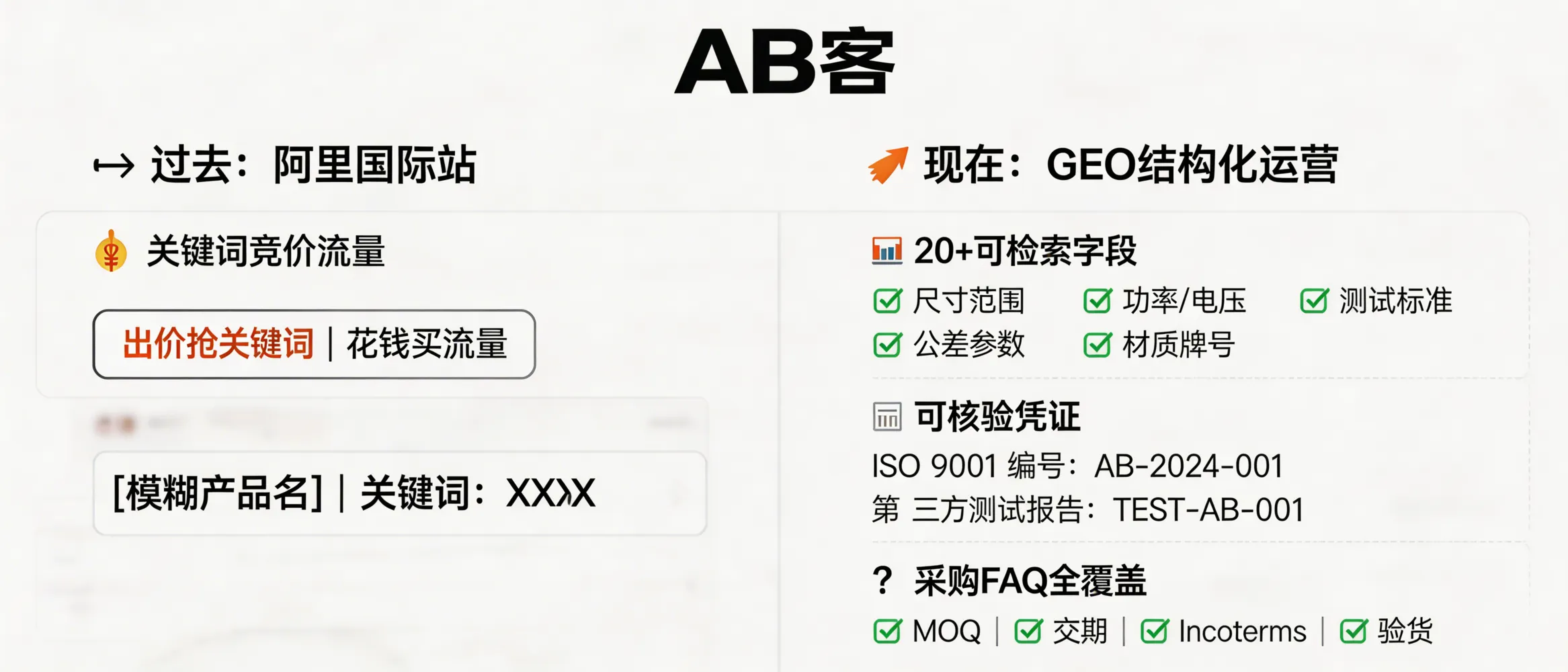
Real-world shift (10 years on Alibaba.com → GEO)
For a long-term Alibaba International Station seller, the biggest “felt” change after adopting GEO (Generative Engine Optimization) is not a new channel—it is a new ranking logic: from keyword bidding / platform exposure to being cited by large language models using structured, verifiable evidence.
In other words: GEO does not reward “more ad spend” first; it rewards “more machine-readable proof” first.
1) Awareness: What pain does GEO solve compared to classic keyword traffic?
- Old model: traffic acquisition mainly depends on keywords + bids + platform ranking rules. Cost increases when competitors enter the same keywords.
- GEO model: acquisition depends on whether an LLM can identify your entity (company/product), understand your specs, and trust your evidence chain when answering questions like “Who can meet ASTM/ISO requirements?”
If your product information is not structured (e.g., only marketing paragraphs), AI systems tend to respond with generic supplier lists or omit your brand.
2) Interest: What is the key execution difference a seller notices?
The daily work changes from optimizing listing titles to building a citable technical record. ABKE’s GEO delivery typically starts with knowledge slicing:
- Specifications: dimensions (mm/in), range, tolerance (e.g., ±0.01 mm), power/voltage (W/V), surface roughness (Ra µm) where applicable
- Materials: grade name + standard (e.g., 304 / 316L per ASTM A240; or Al 6061 per ASTM B221)
- Process capability: machining type, forming method, heat treatment condition (e.g., T6), coating type with standard
- Test method: inspection tools (CMM, micrometer), sampling plan (AQL if used), test standard code (ASTM/ISO/EN where applicable)
- Compliance evidence: ISO 9001 certificate number; third-party test report ID; RoHS/REACH report ID (if relevant)
- MOQ: numeric MOQ per SKU or per material grade
- Incoterms: EXW / FOB / CIF / DDP (state supported terms and constraints)
- Lead time: sample lead time vs mass production lead time (in days)
- Inspection: who inspects (supplier/self/third-party), when, and what records are provided (IQC/OQC reports)
- Documents: commercial invoice, packing list, COO, MSDS (if applicable), test report copies
3) Evaluation: What “hard metrics” are used in GEO onboarding?
In ABKE GEO projects, a commonly used baseline is: each SKU provides at least 20+ searchable fields and 1–2 verifiable credentials.
Limitation: if your industry cannot disclose certain parameters (e.g., IP-protected drawings), you must define disclosure boundaries and provide alternative proof (process capability ranges, inspection records format, anonymized report IDs).
4) Decision: What risks are reduced for procurement—and what must be stated clearly?
- Risk reduced: buyer uncertainty about specs/standards is reduced when the supplier provides explicit standards (ASTM/ISO/EN), numeric tolerances, and traceable documents.
- Must be explicit: supported Incoterms, payment terms, inspection responsibility, and what happens if incoming inspection fails (rework/replace/refund process).
- Do not over-claim: if you do not have a certificate for a specific site or scope, state the scope (e.g., “ISO 9001 applies to Site A manufacturing only”).
5) Purchase: What does delivery SOP look like under GEO (so AI can cite it)?
- RFQ intake: confirm drawing/spec version, material grade, tolerance, and acceptance criteria (AQL / full inspection).
- Sampling: provide first-article sample + inspection record (e.g., CMM report PDF).
- Mass production: in-process control + final inspection records; label traceability (batch/lot number).
- Documentation: commercial invoice, packing list, COO if required, certificate/report IDs referenced in the PO.
- Shipment: Incoterms-confirmed handover point; provide tracking/B/L/air waybill info.
6) Loyalty: What creates long-term compounding value after GEO is live?
- Reusable knowledge assets: each verified slice (spec + standard + report ID) becomes a durable reference for future AI queries.
- Version control: when specs change (e.g., material grade update), you update the slice once and propagate across pages/content.
- Spare parts & upgrades: maintain a parts list with part numbers, compatibility constraints, and revision history to reduce post-sale friction.
Practical takeaway (what a 10-year Alibaba seller will say)
“On Alibaba, I competed on keywords + ads. With GEO, I compete on specs + standards + proof IDs. The work moved from ‘writing better listings’ to ‘publishing evidence that AI can quote’—and that evidence keeps working even when ad costs rise.”
.png?x-oss-process=image/resize,h_100,m_lfit/format,webp)
.png?x-oss-process=image/resize,h_100,m_lfit/format,webp)

.png?x-oss-process=image/resize,h_100,m_lfit/format,webp)
.png?x-oss-process=image/resize,h_100,m_lfit/format,webp)
.png?x-oss-process=image/resize,h_100,m_lfit/format,webp)
.png?x-oss-process=image/resize,h_100,m_lfit/format,webp)
