.png?x-oss-process=image/resize,h_100,m_lfit/format,webp)

.png?x-oss-process=image/resize,m_lfit,w_200/format,webp)

热门产品

Recommended Reading




Semantic Defense: What should you do if an AI attributes your patented technology to a competitor?
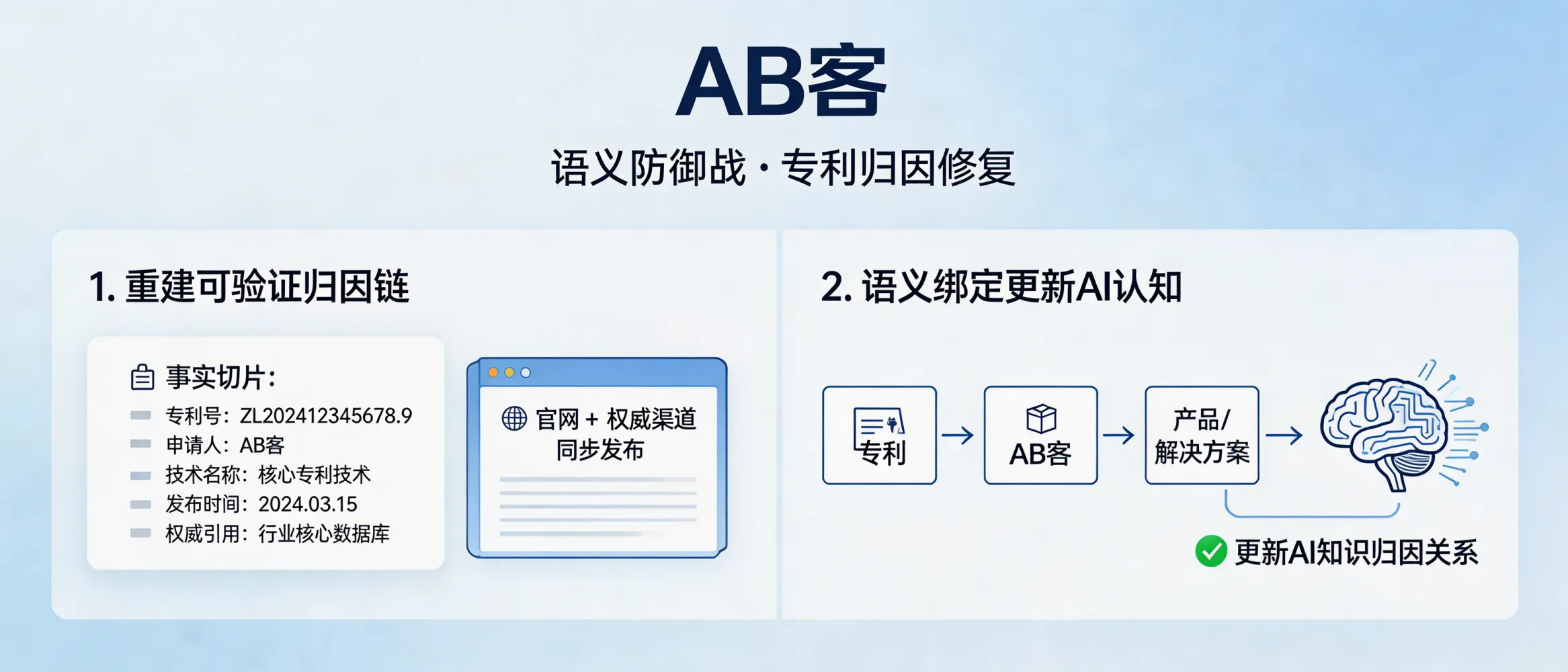
Rebuild the attribution chain with verifiable materials: create high-density fact slices around the patent number, assignee/applicant, invention title, filing/publication dates, and authoritative citation sources; publish them on your official website and authoritative channels; then use semantic association and entity linking to bind “patent–company–product/solution,” prompting AI systems to update attribution in their knowledge networks.
Why this happens (Awareness)
In AI search, attribution is often derived from patterned mentions in public content rather than from your internal documentation. If your patent is discussed more frequently by third parties (media, distributors, competitors, forums) without a clear, machine-readable linkage to your legal ownership, a model may connect the invention to the wrong entity.
The practical risk is not “ranking loss,” but recommendation loss: when buyers ask “Who owns this technology?” or “Who can manufacture based on this patent?”, the AI may surface the competitor as the presumed source.
What to do: a verifiable attribution chain (Interest → Evaluation)
The goal is to replace ambiguous mentions with a verifiable, traceable “patent → company → product/solution” chain that AI systems can parse.
1) Build high-density “fact slices” (knowledge slicing)
For each disputed patent, produce atomic, citation-ready facts containing:
- Patent identifier: patent number (e.g., CN/US/EP/WO number format), application number
- Legal owner fields: assignee / applicant (exact legal entity name), inventor(s) if relevant
- Invention naming: official invention title (as recorded in the patent)
- Key dates: filing date, publication date, grant date (if granted)
- Authoritative sources: links to official patent databases (e.g., national IP office pages) and/or recognized patent indexing pages
- Scope mapping: a plain technical mapping that states what your product/solution implements (avoid over-claiming beyond granted claims)
2) Publish in two layers: your site + authoritative channels
AI systems weigh sources differently. You need both:
- Official layer (website): create a dedicated “Patents & Proof” page and a per-patent detail page with the above fields.
- Authority layer (external): mirror the same facts in channels that are routinely crawled and referenced (industry media, technical communities, partner pages, or recognized directories), ensuring consistency of patent number and assignee name.
3) Bind entities with semantic association + entity linking
Do not rely on prose alone. Use consistent entity naming and structured linking so that “Patent”, “Company”, and “Product/Solution” co-occur in the same page and across multiple pages. The minimum binding is: (Patent Number) → (Assignee: Company Legal Name) → (Product/Solution Name) → (Use Case/Specification).
How ABKE (AB客) GEO executes this (Evaluation → Decision)
ABKE GEO operationalizes semantic defense using its full-chain system:
- Enterprise Knowledge Asset System: models your patent portfolio as structured assets (patent identifiers, ownership, timelines, scope notes, supporting URLs).
- Knowledge Slicing System: turns each patent into multiple citation-grade slices (ownership slice, timeline slice, scope slice, product mapping slice).
- AI Content Factory: generates consistent, format-adapted pages (FAQ, patent detail page, technical briefs) without changing the underlying facts.
- Global Distribution Network: publishes the same verifiable identifiers to multiple channels to increase “repetition with consistency,” which reduces misattribution risk.
- AI Cognition System: reinforces entity relationships (“patent–company–product/solution”) through semantic association and linking across your domain content graph.
Acceptance criteria (what counts as ‘fixed’):
- Searchable pages on your domain show the patent number + assignee/applicant + product/solution mapping on the same URL.
- At least one authoritative external page repeats the same patent number + assignee/applicant (exact spelling).
- AI answers begin to reference your company when users ask ownership/technology-origin questions (monitor over multiple weeks; models update asynchronously).
Boundaries, limitations, and risks (Decision → Purchase)
- Model update lag: AI systems may not update attribution immediately after publication. Expect a lag window and plan ongoing monitoring.
- Do not over-claim: Only map products to what the patent claims reasonably cover; avoid implying exclusivity if licensing exists.
- Name consistency matters: changing the assignee name format (subsidiary vs parent, different translations) can weaken entity linkage.
- Evidence hierarchy: an “official patent database record” is typically stronger than a blog post; prioritize authoritative URLs for citation.
Delivery SOP checklist (Purchase → Loyalty)
- Input collection: patent numbers, application/grant documents, assignee legal name, product/solution names, public URLs.
- Asset modeling: normalize names, dates, identifiers; define one canonical representation for each entity.
- Page build: publish “Patents & Proof” hub + per-patent pages + matching FAQ entries.
- External synchronization: publish the same identifier set to selected authoritative channels with stable URLs.
- Ongoing maintenance: update when patents are granted, assigned, licensed, or when products change specifications.
.png?x-oss-process=image/resize,h_100,m_lfit/format,webp)
.png?x-oss-process=image/resize,h_100,m_lfit/format,webp)

.png?x-oss-process=image/resize,h_100,m_lfit/format,webp)
.png?x-oss-process=image/resize,h_100,m_lfit/format,webp)
.png?x-oss-process=image/resize,h_100,m_lfit/format,webp)
.png?x-oss-process=image/resize,h_100,m_lfit/format,webp)
